India United Kingdom Economic Diplomacy and Bilateral Trade
Source:The Hindu ↗
Why It Matters
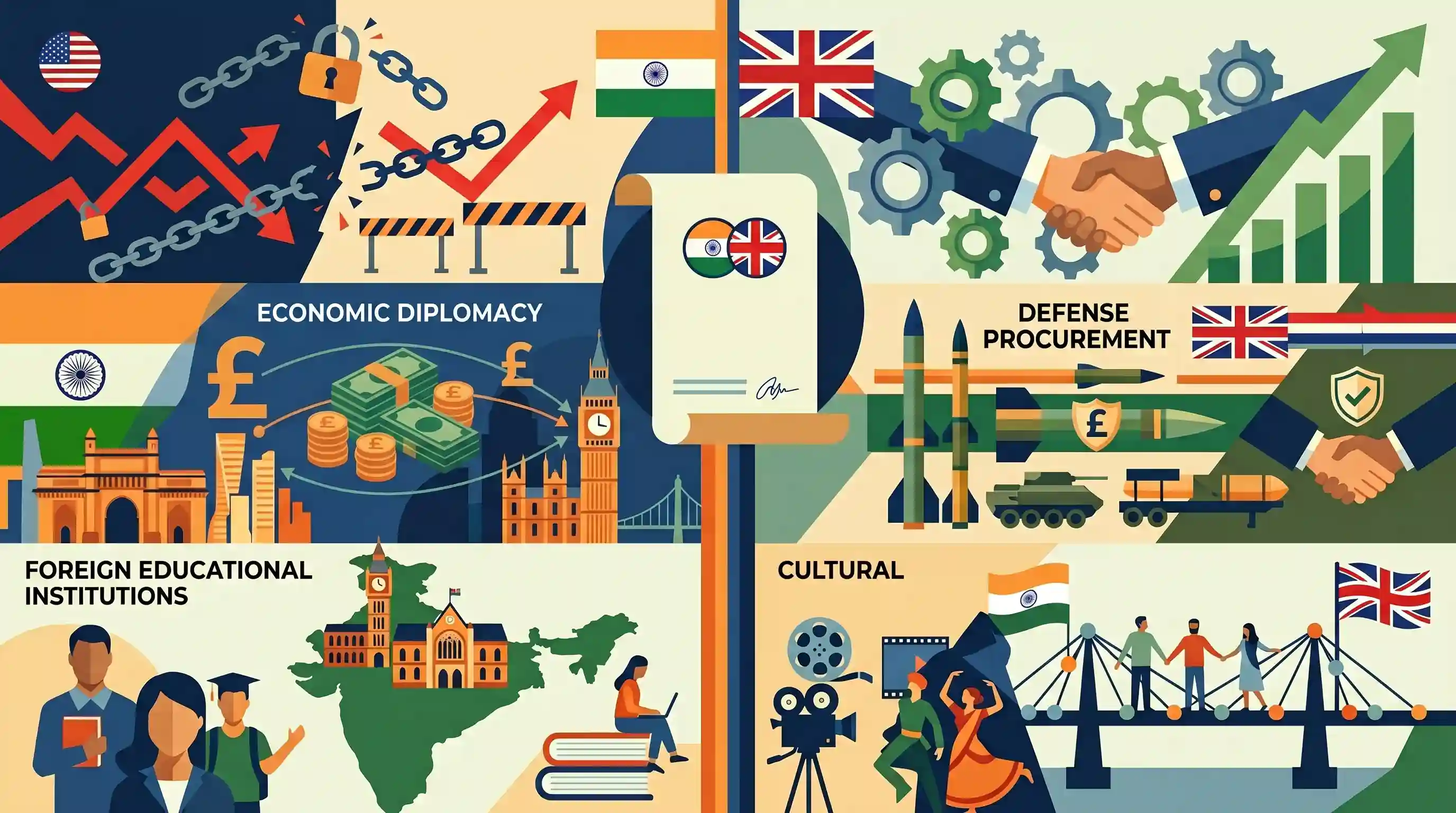
It illustrates a successful model of pragmatic economic diplomacy and bilateral cooperation amid rising global trade protectionism. Aspirants must understand how diversifying trade partnerships and multi-sectoral agreements (defense, education, culture) enhance India's strategic autonomy and economic resilience.
Summary
U.K. Prime Minister Keir Starmer's recent visit to India highlighted the growing maturity of the India-U.K. bilateral relationship. Contrastingly different from India's fraught negotiations with the U.S. and erratic trade tariffs, the India-U.K. engagement focuses on stable, multifaceted cooperation. The visit cemented a July trade deal and yielded substantial agreements, including a £350 million missile supply contract and £1.3 billion in investments by Indian companies in the U.K. The relationship also extends into education and culture, with U.K. universities opening campuses in India and new film production commitments, all bolstered by the influential Indian diaspora.
Key Points
- U.K. Prime Minister Keir Starmer's visit to India significantly deepened bilateral economic ties, cementing a trade deal signed earlier in July.
- Expanding India-U.K. trade, which currently accounts for a small percentage of each other's total exports, can help mitigate the impact of punitive 50% tariffs imposed by the U.S.
- Bilateral commitments include a £350 million missile supply deal to aid India's defense acquisitions and £1.3 billion in U.K. investments by 64 Indian companies.
- The partnership extends to cultural and educational sectors, with Yash Raj Films planning film shoots in the U.K. and two U.K. universities set to open campuses in India.
- The large Indian diaspora in the U.K. continues to play a pivotal role in strengthening socio-economic and political connections between the two democracies.
Important Terms
India-UK Comprehensive Economic and Trade Agreement (CETA)

A bilateral free trade agreement signed in 2025 (formally the CETA) to eliminate/reduce tariffs on 99% of goods, aiming to double bilateral trade by 2030.
UPSC context
GS Paper II (International Relations) and GS Paper III (Economy); tests trade diplomacy and India's post-Brexit economic strategies.
Lightweight Multirole Missile (LMM) Deal
A £350 million contract signed in 2025 for the supply of Thales-made precision missiles to the Indian Army, marking a deeper 'complex weapons' partnership.
UPSC context
GS Paper III (Security/Defense); relates to bilateral defense procurement, technology transfer, and the modernization of the Indian Armed Forces.
2030 Roadmap for India-UK Relations
A 2021 framework guiding the transition of India-UK ties to a 'Comprehensive Strategic Partnership' across five pillars: trade, defense, climate, health, and people-to-people links.
UPSC context
GS Paper II (International Relations); the fundamental blueprint for bilateral strategic engagement and institutional cooperation.
Foreign Higher Education Institutions (FHEIs)
Overseas universities allowed under UGC's 2023 regulations to establish independent campuses in India; the UK's University of Southampton was the first to receive approval.
UPSC context
GS Paper II (Social Justice/Education); tests understanding of NEP 2020 and the internationalization of India's higher education sector.
AMCA Jet Engine Co-development
A strategic defense project involving Rolls-Royce to co-develop a 120kN class engine with full technology transfer for India's indigenous 5th-generation stealth fighter jet.
UPSC context
GS Paper III (Science & Technology/Defense); critical for 'Atmanirbhar Bharat' and mastering high-end aero-engine propulsion technology.
Indian Diaspora in the UK
The nearly 1.8 million-strong community in the UK that contributes 6% of British GDP and serves as a vital 'Living Bridge' for soft power.
UPSC context
GS Paper II (International Relations); focuses on the role of the diaspora in influencing foreign policy and host-country economics.
Prelims Trap
Foreign universities setting up campuses in India under UGC rules are barred from repatriating surplus funds.
The UGC (Setting up and Operation of Campuses of FHEIs in India) Regulations, 2023 explicitly permit the cross-border movement of funds and repatriation of surplus profits under FEMA rules.
Static Concepts Connected
What are the UGC rules for Foreign Higher Educational Institutions (FHEIs) setting up in India?
- Eligibility Criteria: Institutions must be ranked within the top 500 globally (overall or subject-wise) or possess outstanding expertise in a specific area.
- Operational Autonomy: They are granted the freedom to independently evolve their admission processes, fee structures, and faculty recruitment mechanisms.
- Fund Repatriation: Institutions are permitted to remit funds and surplus profits back to their home jurisdictions in compliance with FEMA regulations.
What is the difference between a Preferential Trade Agreement (PTA) and a Free Trade Agreement (FTA)?
- PTA (Positive List): Reduces tariffs on a specifically negotiated "positive list" of products between partner countries.
- FTA (Negative List): Eliminates or significantly reduces tariffs on mostly all items except those on a "negative list" designed to protect sensitive domestic sectors.
- CEPA/CECA (Comprehensive): Goes beyond FTAs to include comprehensive trade in services, investments, intellectual property, and competition protocols (e.g., India-UAE CEPA).
Cross-Topic Patterns
Tariff Wars + Market Diversification
Escalating US protectionism and erratic tariffs are accelerating India's strategic pivot toward deeper FTA engagements and stable bilateral agreements with European partners like the UK.
Diaspora as Investment Bridges
The Indian diaspora's role has evolved beyond inward remittances, now actively facilitating "reverse investments" (like the £1.3B by Indian firms in the UK) to build geopolitical leverage.

UGC regulations on foreign university campuses + FEMA fund repatriation clauses will likely form a tricky 2026 Prelims policy question.
Linked PYQs · 4
Linked PYQs · 4
- 2025MainsGS3
What are the challenges before the Indian economy when the world is moving away from free trade and multilateralism to protectionism and bilateralism? How can these challenges be met?
- 2018MainsGS3
How would the recent phenomena of protectionism and currency manipulations in world trade affect macroeconomic stability of India?
- 2023MainsGS2
Indian diaspora has scaled new heights in the West. Describe its economic and political benefits for India.
- 2015MainsGS2
The quality of higher education in India requires major improvements to make it internationally competitive. Do you think that the entry of foreign educational institutions would help improve the quality of higher and technical education in the country? Discuss.
