India EU free trade agreement balances protection and market access
Source:The Hindu ↗
Why It Matters
The India-EU FTA represents a major shift in India's global trade posture, moving from historical protectionism towards pragmatic integration. Its provisions regarding the Carbon Border Adjustment Mechanism (CBAM) highlight the critical new intersection of climate policy and international trade barriers, making it highly relevant for both GS2 (International Relations) and GS3 (Economy/Environment) in the UPSC examination.
Summary
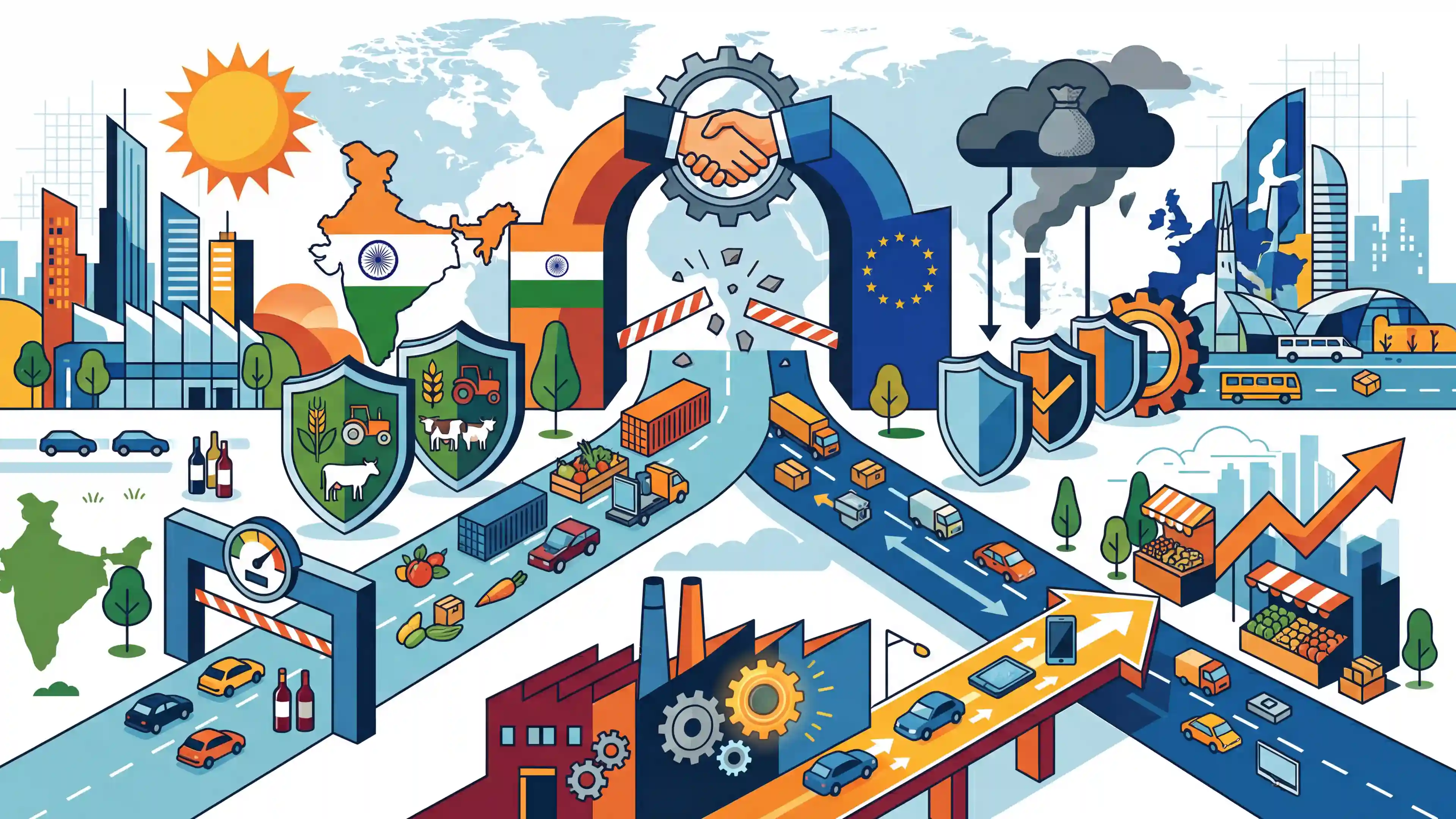
The editorial discusses the successful conclusion of the India-European Union Free Trade Agreement (FTA) as a milestone of mature and pragmatic diplomacy. The deal involves significant tariff reductions across the board while safely carving out protections for India's sensitive agriculture and dairy sectors. Compromises were reached in contentious areas like automobiles and wine through quota-based systems. While India could not obtain direct exemptions from the EU's incoming Carbon Border Adjustment Mechanism (CBAM), it secured protective clauses for future concessions. The ultimate success of this FTA, however, depends on India accelerating its domestic manufacturing reforms to effectively utilize the newly secured, cheaper export routes to European markets.
Key Points
- India and the European Union (EU) have successfully negotiated a Free Trade Agreement (FTA), with the EU eliminating tariffs on 99.5% of Indian exports and India doing so on 97.5% of EU exports.
- The agreement demonstrates India's pragmatic negotiation approach by protecting sensitive domestic sectors like strategic agriculture and dairy.
- Quota-based tariff models were adopted for automobiles and wine to safeguard domestic manufacturers while allowing limited market access for European luxury goods.
- Despite the inability to secure specific exemptions from the EU's Carbon Border Adjustment Mechanism (CBAM), India obtained a Most Favoured Nation (MFN)-style clause for future concessions.
- To fully capitalize on the agreement and offset potential tariff increases from the U.S., India must prioritize domestic reforms to boost large-scale manufacturing competitiveness.
Important Terms
India-EU Free Trade Agreement (FTA)

A comprehensive bilateral treaty between India and the European Union aimed at eliminating tariffs on most goods, opening service sectors, and establishing frameworks for investment and professional mobility.
UPSC context
GS Paper II & III: Bilateral agreements and liberalization. Tests understanding of trade diplomacy and economic integration with major blocs.
Carbon Border Adjustment Mechanism (CBAM)
An EU climate-trade policy that imposes a carbon price on imports of carbon-intensive products (like steel and cement) to prevent 'carbon leakage' and ensure fair competition for EU producers.
UPSC context
GS Paper III: Economy/Environment. Evaluates the impact of foreign green policies on India's industrial competitiveness and export strategy.
Sensitive Sectors
Economic areas (e.g., dairy and agriculture) that are granted special protections, lower liberalization commitments, or exclusions in trade deals to safeguard domestic livelihoods from import surges.
UPSC context
GS Paper III: Indian Economy/Agriculture. Critical for analyzing how India balances global trade commitments with domestic food security and farmer welfare.
Tariff Rate Quota (TRQ)
A trade policy mechanism that allows a fixed quantity of a product to be imported at a lower or zero tariff, while imports exceeding that limit face much higher duties.
UPSC context
GS Paper III: Economy/Trade. Tests knowledge of technical trade instruments used to reach compromises in contentious negotiation areas like automobiles.
European Union (EU)
A supranational political and economic union of 27 member states that operates as a single market; it is one of India's largest trading partners and a key strategic ally.
UPSC context
GS Paper II: Global Groupings. Essential for understanding India's engagement with major economic poles and the evolution of a multipolar world order.
Prelims Trap
India secured a complete exemption from the EU's Carbon Border Adjustment Mechanism (CBAM) under the new FTA.
India did not get a direct CBAM exemption. It secured an MFN-style clause guaranteeing parity only if the EU grants concessions to other nations later.
Static Concepts Connected
How does a Tariff Rate Quota (TRQ) work in international trade?
- Dual-tiered system: Allows a specified quantity of imported goods to enter a country at a reduced or zero tariff rate.
- Higher penalty duty: Once imports exceed this fixed quota threshold, any additional volume faces a significantly higher, often protective, tariff rate.
- Strategic compromise: Used to open markets partially (e.g., for European cars/wine) while shielding domestic industries from sudden supply shocks.
What is the Most Favoured Nation (MFN) principle under WTO?
- Non-discrimination core: Any trade concession or tariff cut granted to one WTO member must be immediately and unconditionally extended to all others.
- Exceptions exist: Countries can bypass MFN obligations when forming bilateral/regional Free Trade Agreements (under GATT Article XXIV) or giving preferential treatment to developing nations.
Cross-Topic Patterns
Trade agreements meeting Climate Policy
The integration of an MFN-style clause for CBAM shows how environmental taxation (GS3 Environment) is becoming a permanent fixture in modern bilateral trade negotiations (GS2 IR).
FTAs require supply-side reforms
Securing zero-tariff export routes is ineffective without manufacturing scale. This links the FTA's ultimate success directly to domestic structural reforms like PLI schemes and labor code implementation.

Expect a 2026 multi-statement Prelims question mixing India-EU FTA specifics, TRQ mechanics, and CBAM applicability rules.
Linked PYQs · 3
Linked PYQs · 3
- 2011MainsGS2
Compared to the South Asian Free Trade Area (SAFTA), the Bay of Bengal Initiative for Multisectoral Technical and Economic Cooperation Free Trade Area (BIMSTEC FTA) seems to be more promising." Critically evaluate.
- 2014MainsGS2
The aim of Information Technology Agreements (ITAs) is to lower all taxes and tariffs on information technology products by signatories to zero. What impact would such agreements have on India's interests?
- 2025PrelimsGS1
Consider the following statements : Statement I: Article 6 of the Paris Agreement on climate change is frequently discussed in global discussions on sustainable development and climate change. Statement II: Article 6 of the Paris Agreement on climate change sets out the principles of carbon markets. Statement III : Article 6 of the Paris Agreement on climate change intends to promote inter-country non-market strategies to reach their climate targets. Which one of the following is correct in respect of the above statements?
