Mathematics and the limits of cultural nationalism in education
Source:The Hindu ↗
Why It Matters
The debate around integrating traditional knowledge into modern curricula (via NEP 2020) is a major theme across GS1 (Indian Culture), GS2 (Education), and Essay papers. It touches upon the balance between celebrating historical heritage and maintaining an objective, universal scientific temper.
Summary
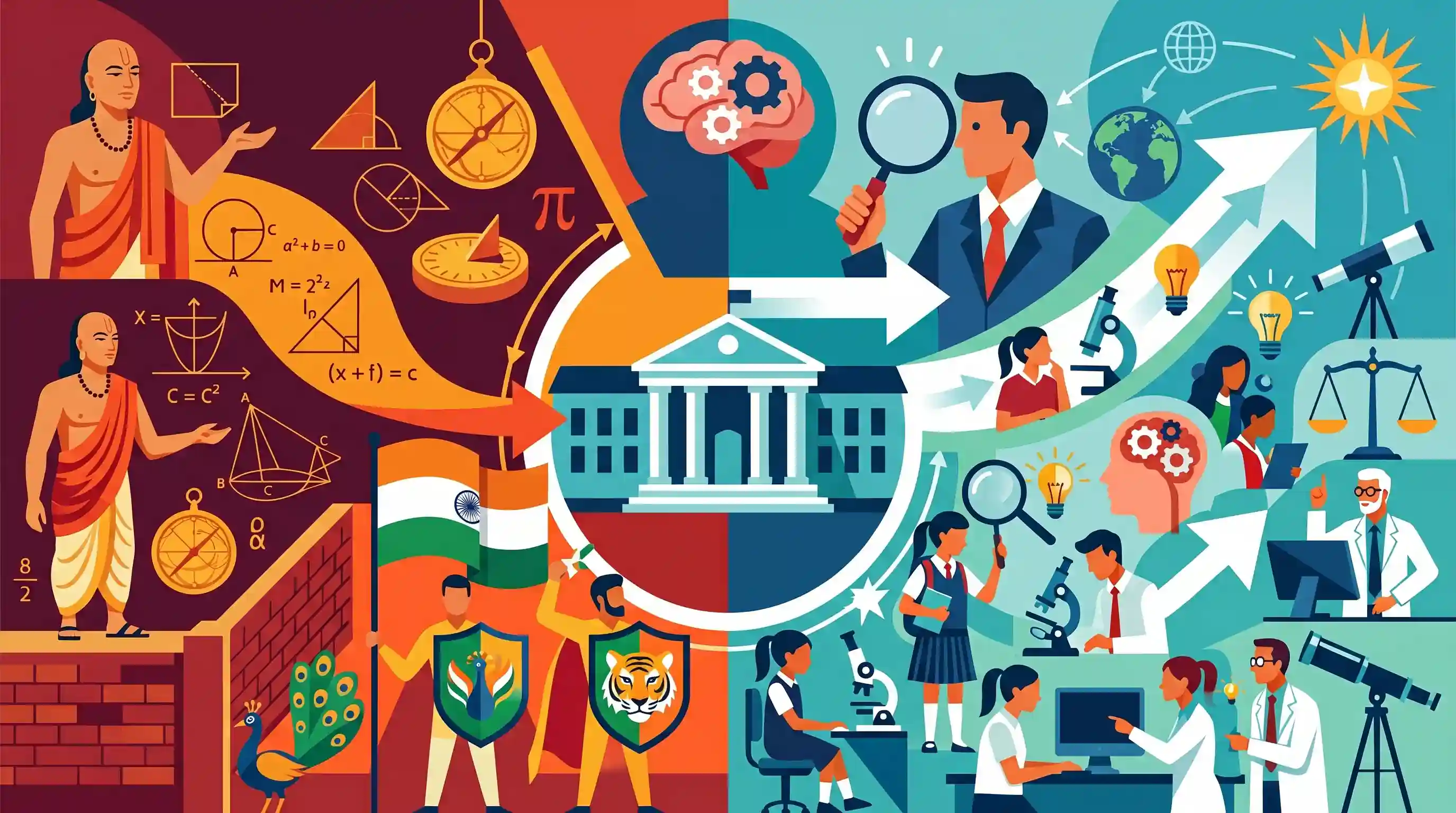
The article critically examines the tendency to weaponize mathematics and scientific achievements as tools for cultural nationalism. It argues that while recognizing India's historical contributions to mathematics (such as those by Aryabhata or Brahmagupta) through frameworks like the Indian Knowledge Systems (IKS) is important, reducing universal mathematical truths to nationalistic pride undermines the very essence of scientific inquiry. The piece emphasizes the constitutional mandate of fostering a scientific temper, advocating that education policies like NEP 2020 should promote reason and objective knowledge over cultural chauvinism.
Key Points
- Mathematical truths and scientific principles are inherently universal and transcend cultural or geopolitical boundaries.
- While incorporating ancient Indian mathematical contributions into the curriculum is valuable, using them to stoke cultural nationalism distorts the objective nature of scientific inquiry.
- The push for integrating the Indian Knowledge Systems (IKS) under the National Education Policy (NEP) 2020 should focus on historical appreciation rather than cultural chauvinism.
- Fostering a scientific temper—a fundamental duty under Article 51A(h)—requires viewing knowledge as a collective human endeavor rather than a tool for nationalistic pride.
Important Terms
National Education Policy (NEP) 2020

The 2020 policy framework aimed at transforming India's education system through holistic, multidisciplinary learning, focusing on foundational literacy, vocational training, and the integration of traditional knowledge with modern science.
UPSC context
Relevant for GS Paper II (Education) regarding policy reforms and human capital development.
Indian Knowledge Systems (IKS)
An initiative by the Ministry of Education to promote, preserve, and integrate traditional Indian wisdom—spanning science, arts, and philosophy—into the modern educational curriculum and research ecosystem.
UPSC context
GS Paper I (Culture) and Paper II (Education) for understanding indigenous knowledge integration.
Scientific Temper
A constitutional duty (Article 51A) advocating a rational, logical, and inquiry-based attitude. It emphasizes objectivity, humanism, and the spirit of reform over dogma or superstition.
UPSC context
GS Paper II (Polity/Fundamental Duties) and GS Paper IV (Ethics) for rational decision-making.
Cultural Nationalism
A form of nationalism defining the nation through shared heritage and traditions. In India, it often involves debating whether national identity should be rooted in secular or cultural paradigms.
UPSC context
GS Paper I (Society) and Paper II (Polity) concerning challenges to secularism.
Aryabhata
A 5th-century mathematician-astronomer whose work 'Aryabhatiya' introduced the place-value system, calculated the value of pi, and correctly proposed that the Earth rotates on its own axis.
UPSC context
GS Paper I (History/Culture) for ancient Indian contributions to global science.
Brahmagupta
A 7th-century mathematician who authored 'Brahmasphutasiddhanta,' the first text to treat zero as a number in its own right and provide rules for computing with negative numbers.
UPSC context
GS Paper I (History) regarding the evolution of mathematical thought in India.
Prelims Trap
"Aryabhata invented the symbol for zero and formalized the mathematical rules for its use."
While Aryabhata used zero conceptually as a placeholder, it was Brahmagupta who first formalized the mathematical rules for operations involving zero and negative numbers.
Static Concepts Connected
What are the distinct mathematical contributions of Aryabhata and Brahmagupta?
- Aryabhata: Authored the Aryabhatiya, conceptualized zero as a placeholder, accurately approximated Pi (π), and proposed a heliocentric planetary model.
- Brahmagupta: Authored Brahmasphutasiddhanta, formalized the rules for arithmetic operations with zero and negative numbers, and provided solutions for quadratic equations.
How does the Indian Constitution address the concept of "scientific temper"?
- Article 51A(h): Article 51A(h) makes it a Fundamental Duty for every citizen to develop scientific temper, humanism, and the spirit of inquiry and reform.
- Non-justiciable nature: While not directly enforceable by courts, these duties serve as guiding principles for state education policies and judicial interpretation regarding rationalism.
Cross-Topic Patterns
NEP 2020 vs. Scientific Temper
The integration of Indian Knowledge Systems (IKS) highlights the GS2 tension between promoting indigenous heritage and ensuring secular, objective scientific inquiry mandated by fundamental duties.
Ancient heritage as diplomatic soft power
Projecting historical scientific achievements (like Ayurveda and ancient mathematics) is increasingly used in India's soft power diplomacy, intersecting GS1 (Culture) and GS2 (IR).

Expect a multi-statement Prelims question matching ancient Indian scholars (Aryabhata, Brahmagupta) with their exact mathematical texts.
Linked PYQs · 4
Linked PYQs · 4
- 2023MainsEssay
Mathematics is the music of reason.
- 2020MainsGS2
National Education Policy 2020 is in conformity with the Sustainable Development Goal-4 (2030). It intends to restructure and reorient education system in India. Critically examine the statement.
- 2024MainsEssay
The doubter is a true man of science.
- 2022MainsGS1
Discuss the main contributions of Gupta period and Chola period to Indian heritage and culture.
