Rajasthan Transporters Strike Disrupts Essential Goods Supply
Source:economictimes ↗
Why It Matters
Understanding transport regulations, technology integration in public safety (like VLTD), and the economic impact of logistics disruptions is vital for both UPSC and RPSC RAS. It demonstrates the real-world friction between administrative technology mandates and ease of doing business in regional logistics.
Summary
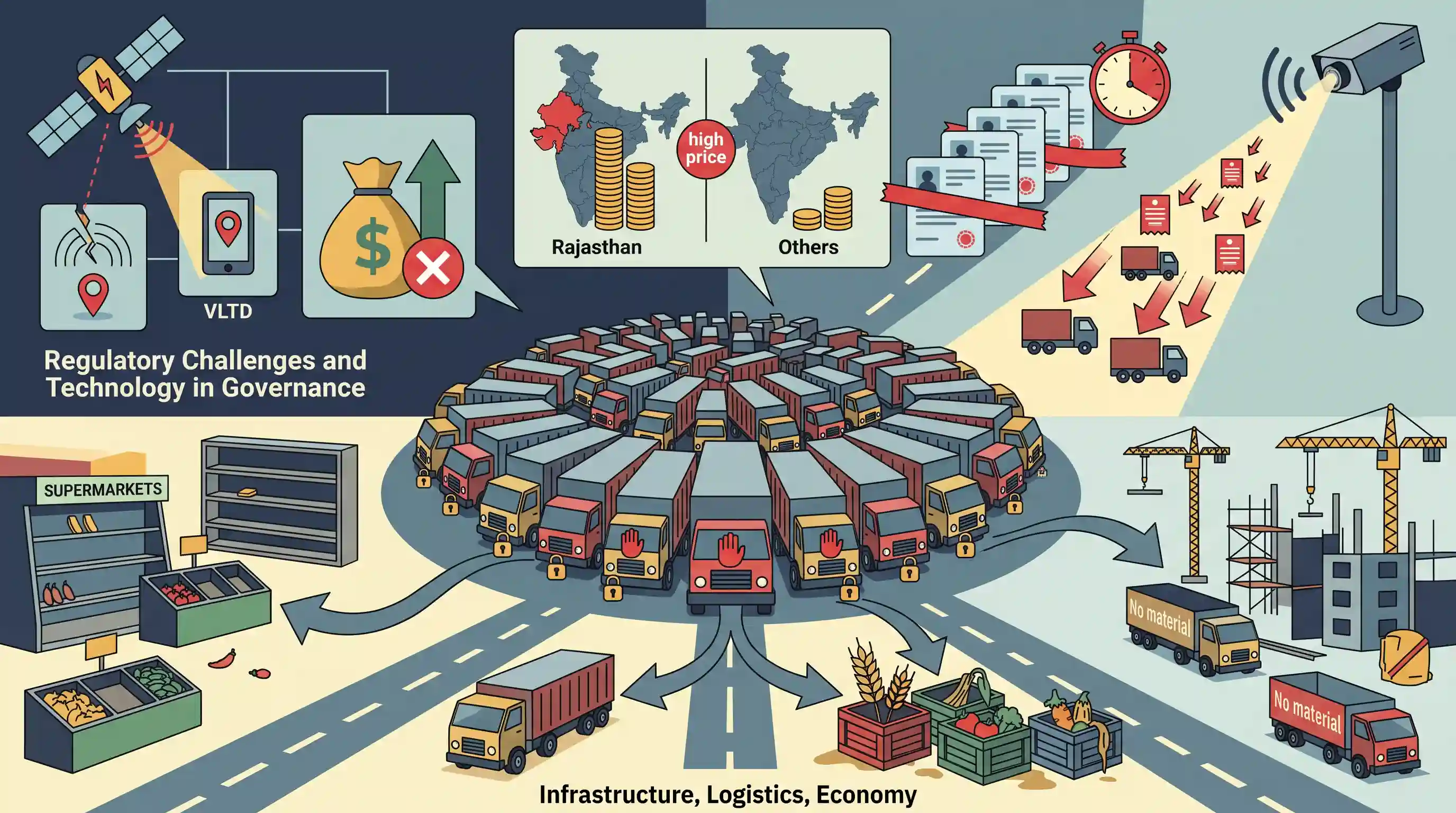
An indefinite transport strike led by the Rajasthan Truck Transport Sangharsh Samiti has grounded over 10,000 trucks in Rajasthan, threatening the supply of essential commodities, construction materials, and agricultural goods. Transporters are protesting against the mandatory installation of Vehicle Location Tracking Devices (VLTDs), high price disparity of these devices in Rajasthan compared to other states, permit delays, and automated e-detection challans.
Key Points
- Over 10,000 trucks and commercial vehicles went off the roads in Rajasthan due to an indefinite strike called by the Rajasthan Truck Transport Sangharsh Samiti, supported by regional transport associations.
- The core dispute centers on the mandatory implementation of Vehicle Location Tracking Devices (VLTDs) for issuing national permits, with transporters alleging a major price disparity: VLTDs cost around ₹25,000 to ₹30,000 in Rajasthan compared to just ₹3,000 to ₹3,500 in neighboring states like Haryana, Punjab, and Gujarat.
- Transporters also raised concerns over delays in renewing fitness certificates, the halt of all-India permit issuances for over a month (affecting 35,000 to 40,000 vehicles), and issues related to automated e-detection challans.
- The strike has grounded movement in critical logistics hubs like Jaipur's Transport Nagar and Vishwakarma Industrial Area (VKI), raising fears of impending shortages and price hikes for essentials, cement, steel, and groceries.
Important Terms
Intelligent Transport System (ITS)

An advanced framework integrating information, communication, and sensor technologies with transport infrastructure to optimize traffic management, vehicle-to-everything (V2X) safety, and transport logistics.
UPSC context
GS Paper 3 (Infrastructure and S&T); tests knowledge of smart city development, logistics efficiency, and technological governance.
Vehicle Location Tracking Device (VLTD) Regulations
Mandates under Rule 125H of the Central Motor Vehicles Rules requiring commercial public transport to equip GPS/NavIC trackers and panic buttons integrated with state command portals.
UPSC context
GS Paper 3 (Infrastructure and Technology); relevant for passenger safety, digital surveillance, and regulatory challenges in logistics.
Motor Vehicles Act
Legislation governing road transport in India, covering vehicle registration, licensing, traffic control, insurance, and safety mandates like speed-limiting devices and tracking systems.
UPSC context
GS Paper 2 (Government Policies); crucial for understanding road safety governance, transport regulations, and judicial enforcement in India.
Rajasthan Truck Transport Sangharsh Samiti
An umbrella organization representing truckers and transport operators in Rajasthan, formed to negotiate and protest against regulatory and financial burdens on logistics.
UPSC context
GS Paper 2 (Pressure Groups); demonstrates the role of trade associations in policy feedback and industrial dispute resolution.
Transport Department of Rajasthan
The state authority in Rajasthan tasked with administering transportation policies, issuing permits, collecting road taxes, and enforcing vehicle safety and environmental norms.
UPSC context
GS Paper 2 (State Administration); tests local executive challenges in implementing central tech directives and regional transport control.
Prelims Trap
AIS-140 compliant vehicle tracking systems rely exclusively on Global Positioning System (GPS) technology for location tracking.
Under MoRTH regulations, AIS-140 compliant VLTDs must support both GPS and India's indigenous NavIC (IRNSS) satellite systems, not just standard GPS.
Static Concepts Connected
What is Gross Fixed Capital Formation (GFCF)?
- Definition: Refers to the net increase in physical assets (such as machinery, equipment, buildings, and infrastructure) within an economy during an accounting period.
- Economic Indicator: Serves as a proxy for total investment in an economy, indicating future productive capacity and economic health.
- Exclusions: Excludes land purchases and financial assets, focusing purely on reproducible tangible and intangible assets.
What are the key technical standards of AIS 140?
- NavIC Integration: Mandates that tracking devices must support Indian regional navigation satellite system (NavIC) signals alongside global GPS.
- Safety Linkage: Requires active panic buttons linked to the Emergency Response Support System (ERSS-112) for public and commercial vehicles.
- Connectivity Requirement: Utilizes dual-profile eSIMs to ensure continuous data transmission to state transport department databases even in low-connectivity areas.
Cross-Topic Patterns
AIS-140 + Gati Shakti logistics goals
State-level disparities in executing central transport mandates cause localized logistics shocks, directly hindering PM Gati Shakti's objective of reducing national logistics costs.
Social welfare funds + Digital governance
Using women-safety funds to build vehicle tracking systems shows how social-sector allocations (Nirbhaya Fund) are integrated with hard transport IoT infrastructure.

UPSC may link AIS-140 standard's mandatory NavIC integration with the structural components of Gross Fixed Capital Formation (GFCF) in 2026.
Linked PYQs · 2
Linked PYQs · 2
- 2024RPSC_PRELIMSGS1
In Rajasthan's Gross Fixed Capital Formation of 2022-23, what is the order in which sectors are arranged from highest to lowest share? A. Construction B. Transport C. Agriculture D. Manufacturing
- 2023RPSC_PRELIMSGS1
In the year 2022-23, what sub-sector contributed the most to the Gross State Value Added (GSVA) of the service sector in Rajasthan, based on current values?
