Landslide blocks Chamba road and disrupts traffic in Himachal
Source:indiatoday ↗
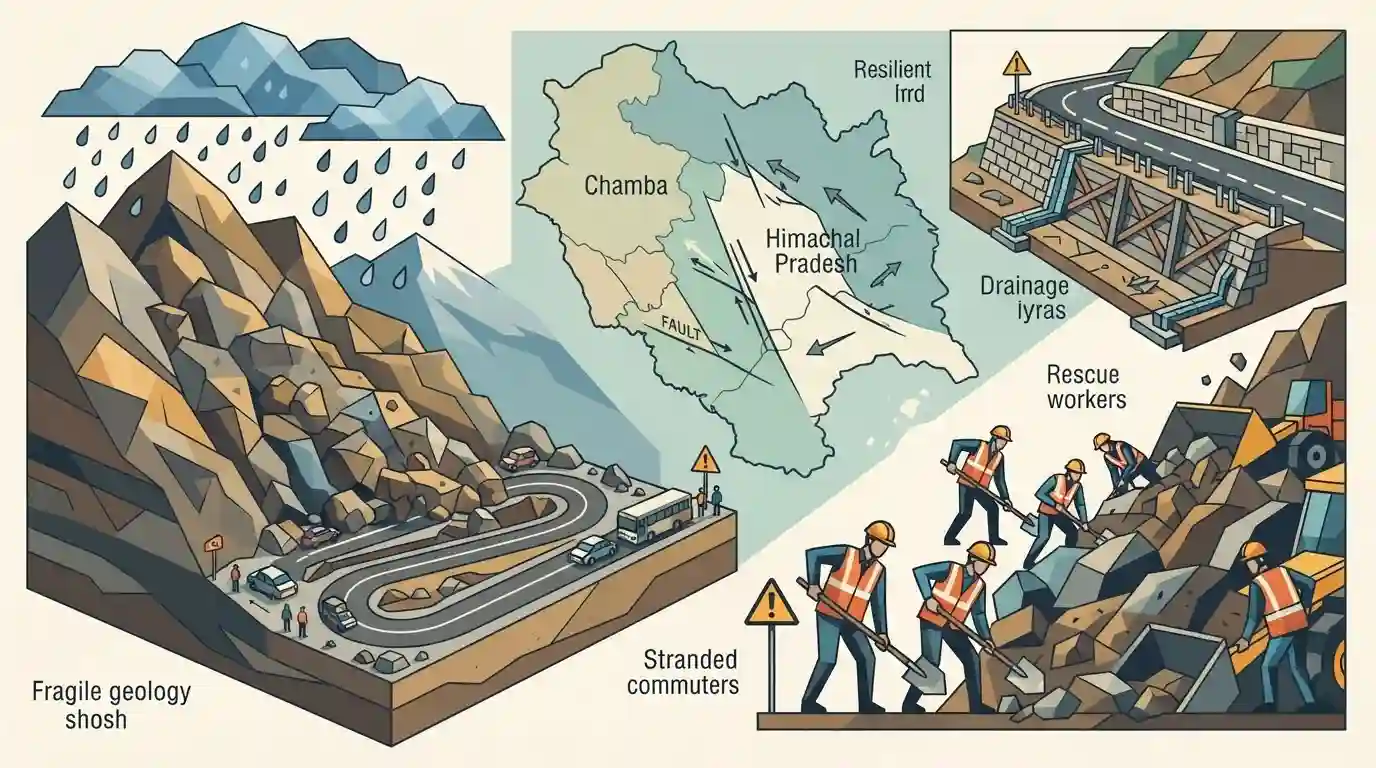
Why It Matters
Landslides in the Himalayas are a recurring geographical hazard linked to climate, topography, and infrastructure development. Understanding the vulnerability of specific districts like Chamba is directly relevant to HPAS Prelims geography and disaster management sections, as evidenced by previous year questions testing the susceptibility of various regions.
Summary
A massive landslide occurred on the Kodla-Urai road in the Bharmour region of Himachal Pradesh's Chamba district, severely disrupting traffic and leaving commuters stranded. While no casualties were reported, the incident highlights the high vulnerability of the Himalayan region to natural disasters. The landslide was primarily triggered by continuous heavy rainfall, which exacerbates the instability of the fragile mountainous terrain. The event underscores the critical need for effective disaster management strategies and resilient infrastructure to mitigate the impact of recurring geological hazards in the state.
Key Points
- A massive landslide hit the Kodla-Urai road in the Bharmour region of Chamba district, Himachal Pradesh, leading to significant traffic disruptions.
- No casualties were reported in the incident, but commuters were left stranded due to the blocked route.
- Continuous heavy rainfall in the region acts as a major trigger, highlighting the fragile geology of the Himalayan terrain.
- The event underscores the recurring threat of natural disasters in Himachal Pradesh, necessitating robust disaster management and resilient infrastructure.
Important Terms
Disaster Management Act, 2005

A landmark Indian legislation providing the statutory framework for disaster risk reduction, capacity building, and emergency response across national, state, and district levels.
UPSC context
Directly specified in HPAS GS Paper 1. Tests knowledge of India's statutory and institutional framework for disaster management.
National Disaster Management Authority (NDMA)
The apex statutory body for disaster management in India, chaired by the Prime Minister. It formulates national policies, plans, and guidelines to ensure an effective disaster response.
UPSC context
Crucial for GS Paper 1 (Disaster Management). Tests understanding of apex institutional mechanisms and national disaster policies.
National Institute of Disaster Management (NIDM)
A nodal national institution established under the DM Act 2005 to oversee human resource development, capacity building, training, research, and policy advocacy for disaster management.
UPSC context
Relevant for GS Paper 1. Evaluates knowledge of capacity building, disaster risk reduction approaches, and the training of stakeholders.
Himachal Pradesh State Disaster Management Authority (HPSDMA)
A state-level statutory body chaired by the Chief Minister, responsible for drafting disaster policies, approving plans, and coordinating emergency preparedness and response within Himachal Pradesh.
UPSC context
Vital for HPAS GS Paper 1. Tests knowledge of the hazard vulnerability profile and specific disaster governance framework of Himachal Pradesh.
Prelims Trap
Kinnaur or Shimla is the most landslide-susceptible district in Himachal Pradesh.
Aspirants often guess Kinnaur or Shimla due to frequent news coverage. However, GSI's Landslide Susceptibility Mapping actually ranks Chamba as the most vulnerable district (42.86%).
Static Concepts Connected
What makes the Himalayan geology in Himachal inherently susceptible to landslides?
- Tectonic Activity: Himalayas are young fold mountains on active convergent plate boundaries, making them highly prone to seismic tremors that destabilize slopes.
- Rock Structure: The region consists largely of loosely compacted, fragile sedimentary and metamorphic rocks that easily weather under heavy rainfall.
- Steep Gradients: High-relief terrain combined with intense monsoonal runoff creates ideal gravitational conditions for mass wasting and slope failures.
What is the institutional framework for disaster management in Himachal Pradesh?
- HPSDMA Constitution: The Himachal Pradesh State Disaster Management Authority (HPSDMA) was constituted on June 1, 2007, under the Disaster Management Act, 2005.
- Leadership: The Chief Minister chairs the HPSDMA, acting as the apex statutory body for mitigating state-level hazards.
- National Integration: It coordinates with the NDMA and NIDM (whose predecessor NCDM was formed in 1995) for capacity building and resource deployment.
Cross-Topic Patterns
Landslides + Ravi Basin Hydro Projects
Geological instability in Chamba directly links to the debate over run-of-the-river hydroelectric projects on the Ravi river basin, which environmentalists argue exacerbate slope fragility.
Climate Change + Extreme Monsoonal Spells
The trigger of 'continuous heavy rainfall' connects to changing monsoonal patterns, where climate change-induced concentrated heavy precipitation spells drastically increase landslide frequency in the Himalayas.

Expect a multi-statement question combining HPSDMA constitution (2007) and GSI's mapping of Chamba as HP's most vulnerable district.
Linked PYQs · 3
Linked PYQs · 3
- 2020HPAS_PRELIMSGS1
Consider the given four statements and choose the correct answer from the given options. Select the true statements from the following: 1. Chamba, Kullu and Kinnaur are considered the most susceptible of landslide threat. 2. Una, Bilaspur, Sirmaur, Shimla and Solan are considered as low vulnerable of disaster threats. 3. Hum valley of Una district has hardly any natural drinking water source. 4. As per the study of central water board, Kala Amb valley in Sirmaur district has exploited the least underground water.
- 2024HPAS_PRELIMSGS1
Arrange the following climatic zones of Himachal Pradesh according to rainfall amount from lowest to highest : (1) Frigid aridic zone (2) Wet temperate zone (3) Humid sub-tropical zone (4) Sub-humid sub-tropical zone Choose the correct answer from the options given below :
- 2025HPAS_PRELIMSGS1
When was the National Centre for Disaster Management established in India ?
