Explosive Material Storage Safety and Disaster Risk
Source:The Hindu ↗
Why It Matters
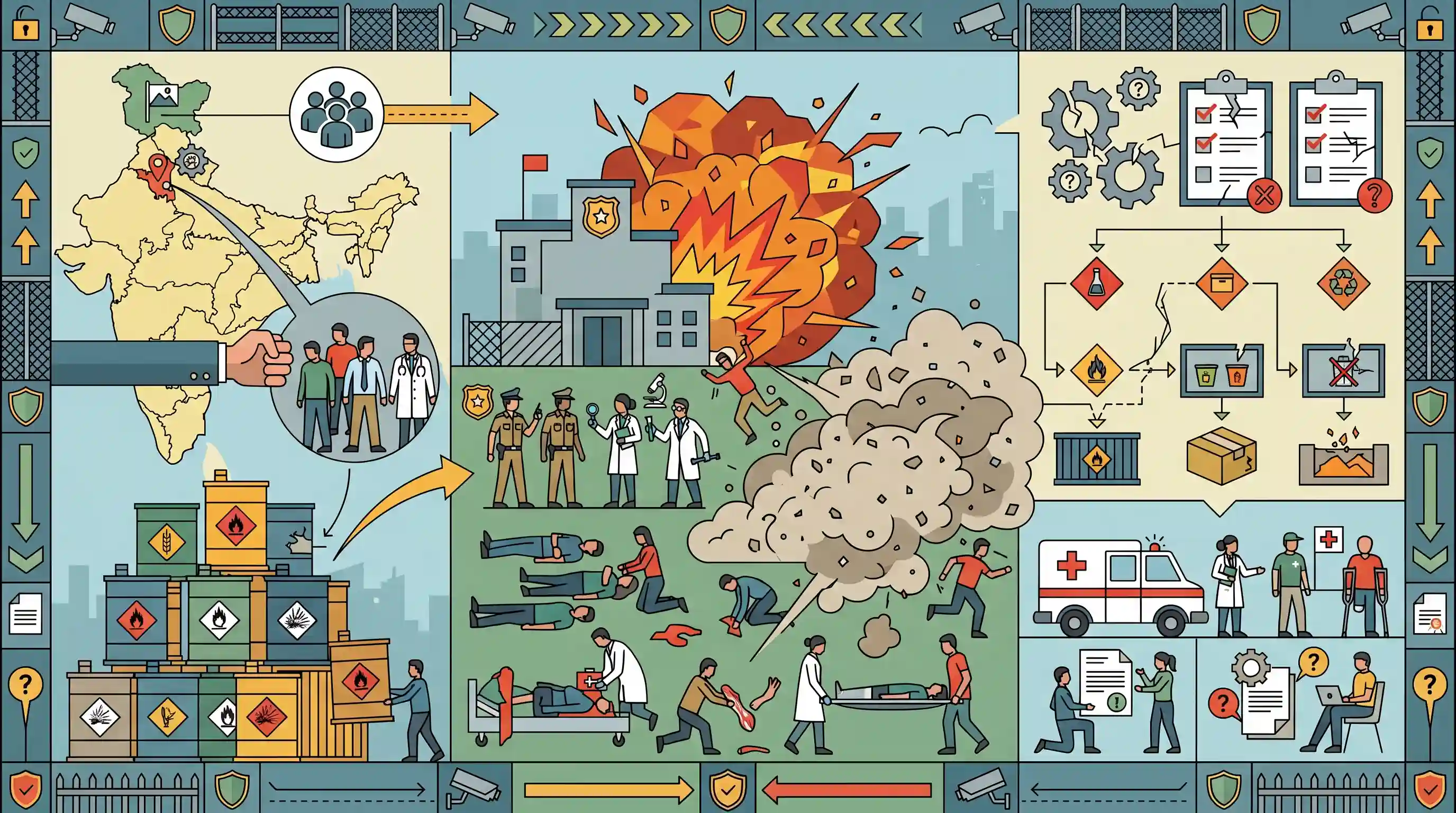
The incident acts as a tragic reminder of the infrastructural and procedural inadequacies in handling massive hauls of confiscated explosives. It bridges internal security operations (busting inter-state terror modules) with disaster management (chemical/explosive hazard mitigation), highlighting the need for specialized storage and disposal protocols to protect law enforcement personnel and civilians.
Summary
A massive accidental explosion at the Nowgam Police Station in Jammu & Kashmir killed nine individuals and injured 32 others. The blast occurred when a joint team of J&K Police and the Forensic Science Laboratory (FSL) was examining approximately 2,900 kg of improvised explosive device (IED) materials, primarily ammonium nitrate, recently confiscated from Faridabad, Haryana. The explosives were linked to an inter-state Jaish-e-Muhammad terror module dismantled earlier, leading to the arrest of multiple suspects, including two doctors. The tragedy underscores significant concerns regarding the standard operating procedures for handling, storing, and disposing of large hauls of hazardous explosive materials by law enforcement agencies.
Key Points
- An accidental explosion at the Nowgam Police Station in Srinagar killed nine people and injured 32 others.
- The blast occurred when police and Forensic Science Laboratory (FSL) teams were surveying around 2,900 kg of explosive materials, including ammonium nitrate.
- The explosives were seized during recent raids in Faridabad, Haryana, exposing an inter-state terror network.
- The materials were linked to a Jaish-e-Muhammad (JeM) module involved in fundraising, logistics, and arms procurement, which led to the arrest of several suspects including two doctors.
- The incident highlights critical gaps in the safe handling, storage, and disposal of highly volatile confiscated materials by law enforcement agencies.
Important Terms
Jaish-e-Muhammad (JeM)

A Pakistan-based Deobandi-jihadist militant group active in Jammu and Kashmir, aiming for the region's separation from India. It is designated as a terrorist organization globally.
UPSC context
GS Paper III (Internal Security); relevant for cross-border terrorism, non-state actors, and major security threats like the Pulwama attack.
Ammonium Nitrate
A chemical compound (NH4NO3) used as fertilizer and industrial explosive. It is a dual-use substance that becomes a powerful explosive when mixed with fuel oil or sensitizers.
UPSC context
GS Paper III (Security/Science); pertains to explosive regulations (Ammonium Nitrate Rules, 2012) and their misuse in domestic terror incidents.
Forensic Science Laboratory (FSL)
Scientific institutions that analyze evidence (biological, chemical, digital) from crime scenes to provide expert opinions for investigations and courts, operating under Central or State administrative control.
UPSC context
GS Paper II (Governance/Justice); tests the role of scientific evidence in the criminal justice system and the Directorate of Forensic Science Services.
Petroleum and Explosives Safety Organisation (PESO)
The nodal agency under the Ministry of Commerce and Industry that regulates the safety of manufacture, storage, and transport of explosives and hazardous substances in India.
UPSC context
GS Paper II & III (Governance/Disaster Management); tests knowledge of regulatory bodies ensuring public safety against industrial and explosive hazards.
Improvised Explosive Device (IED)
A non-conventional, often homemade explosive weapon used by insurgent groups, typically comprising an explosive charge, a detonator, and a switch or trigger mechanism.
UPSC context
GS Paper III (Internal Security); central to understanding asymmetric warfare, radicalization, and challenges in counter-terrorism operations.
Standard Operating Procedure (SOP)
Established, step-by-step instructions designed to ensure safety and uniformity in high-risk police or military operations, such as the handling and disposal of hazardous materials.
UPSC context
GS Paper III (Internal Security/Disaster Management); emphasizes administrative protocol, safety compliance, and crisis management in law enforcement.
Prelims Trap
Ammonium Nitrate is regulated under the Environment (Protection) Act, 1986 by the Ministry of Home Affairs.
Ammonium nitrate is actually regulated under the Ammonium Nitrate Rules, 2012 (Explosives Act, 1884), and overseen by PESO under the Ministry of Commerce and Industry.
Static Concepts Connected
What is the mandate and nodal ministry of PESO?
- Nodal Ministry: Functions as a subordinate office under DPIIT, Ministry of Commerce and Industry.
- Statutory Mandate: Administers the Explosives Act 1884 and Petroleum Act 1934 to ensure safety in manufacturing, storage, transport, and handling of hazardous substances.
- Key Rules: Oversees critical frameworks like the Ammonium Nitrate Rules 2012, Gas Cylinders Rules, and Petroleum Rules.
Why is ammonium nitrate considered a dual-use internal security challenge?
- Legitimate Use: Widely used legitimately in agriculture as a high-nitrogen fertilizer and in mining as an industrial explosive.
- Weaponization: When mixed with fuel oil (creating ANFO), it acts as a powerful oxidizer for manufacturing Improvised Explosive Devices (IEDs).
- Regulatory Challenge: Balancing agricultural/industrial availability with strict supply-chain monitoring to prevent diversion by organized crime networks.
Cross-Topic Patterns
Inter-state terror logistics & dual-use goods
The seizure of explosives in Haryana linked to J&K highlights how terror groups exploit inter-state organized crime networks to procure and transport dual-use industrial chemicals across borders.
Confiscated hazards as man-made disasters
Improper storage of volatile evidence in urban police stations bridges internal security with disaster management, demonstrating the severe risks of ignoring SOPs for hazardous material disposal.

Expect a 2026 multi-statement Prelims question on PESO's mandate, dual-use agricultural chemicals, and the Ammonium Nitrate Rules 2012.
Linked PYQs · 3
Linked PYQs · 3
- 2025MainsGS3
Terrorism is a global scourge. How has it manifested in India? Elaborate with contemporary examples. What are the counter measures adopted by the State? Explain.
- 2021MainsGS3
Analyse the complexity and intensity of terrorism, its causes, linkages and obnoxious nexus. Also suggest measures required to be taken to eradicate the menace of terrorism.
- 2023MainsGS3
Winning of 'Hearts and Minds' in terrorism-affected areas is an essential step in restoring the trust of the population. Discuss the measures adopted by the Government in this respect as part of the conflict resolution in Jammu and Kashmir.
