NGO coalition warns of escalating mass starvation across Gaza
Source:The Hindu ↗
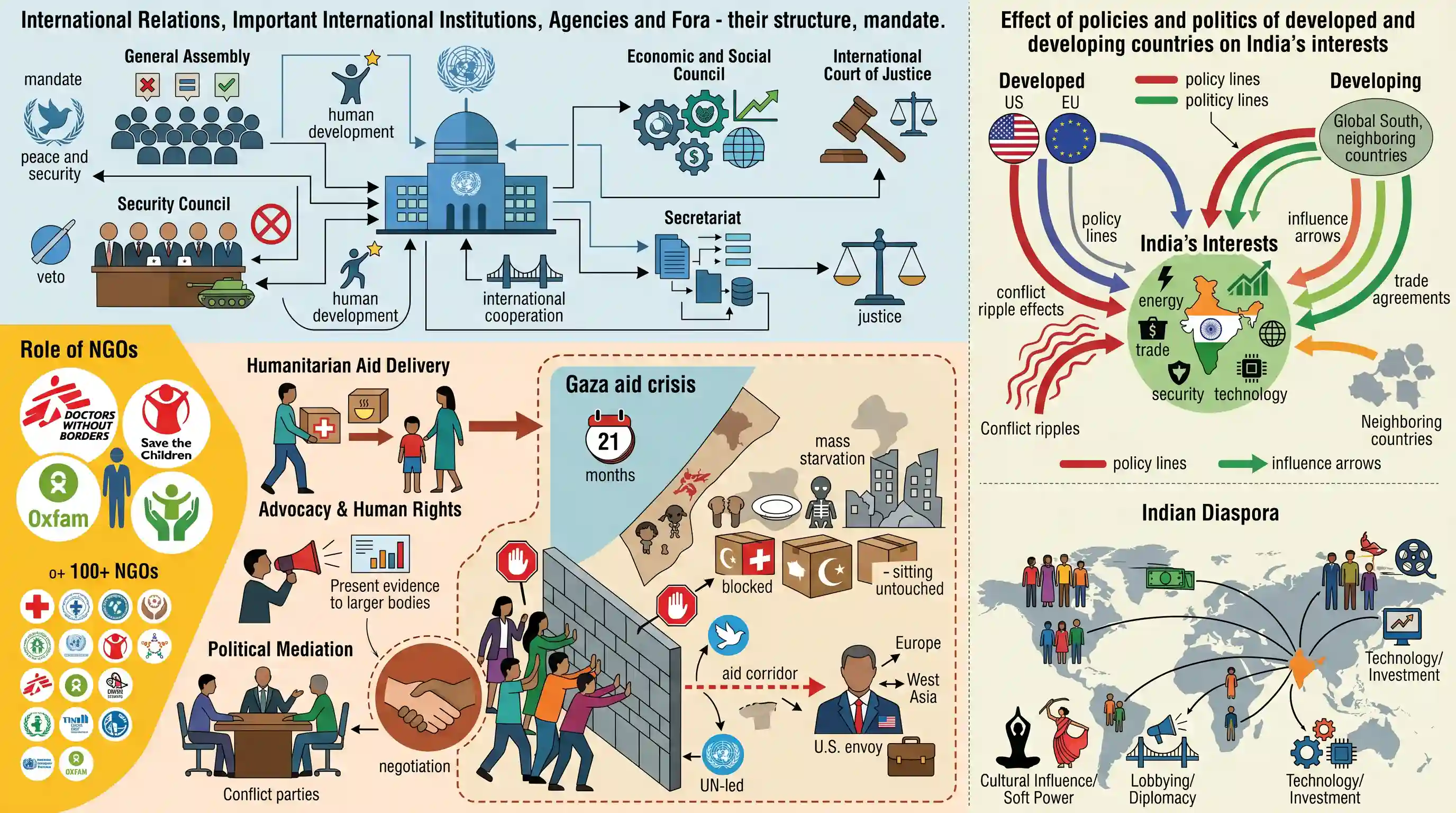
Why It Matters
The article highlights the profound limitations and geopolitical challenges facing international organizations (UN) and INGOs in mitigating humanitarian crises in active conflict zones. It underscores the recurring UPSC themes of human rights, global health security, and the necessity of multilateral mechanisms for conflict resolution and humanitarian aid delivery.
Summary
Over 100 aid organizations and human rights groups, including Doctors Without Borders (MSF), Save the Children, and Oxfam, have issued a dire warning about the rapid spread of "mass starvation" in Gaza following 21 months of conflict. The NGOs emphasized that despite international pressure on Israel, massive shipments of essential supplies remain blocked or sitting untouched outside the territory, leaving over two million people in desperate need. The groups are demanding an immediate negotiated ceasefire and the free flow of humanitarian assistance through UN-led mechanisms, as U.S. envoy Steve Witkoff heads to Europe and West Asia to mediate talks on an aid corridor.
Key Points
- A coalition of over 100 NGOs, including Doctors Without Borders (MSF) and Oxfam, has warned that mass starvation is spreading across Gaza after 21 months of conflict.
- More than two million people in Gaza are facing severe shortages of food and essential goods, exacerbated by blocked humanitarian supplies and inaccessible warehouses.
- The organizations are urgently calling for an immediate negotiated ceasefire, the opening of all land crossings, and the unimpeded flow of aid through UN-led mechanisms.
- At least 21 children recently died due to starvation at Gaza's largest hospital over a three-day period.
- U.S. envoy Steve Witkoff is traveling to Europe and West Asia to negotiate a potential ceasefire and establish an aid corridor.
Important Terms
United Nations (UN)

A universal intergovernmental organization established in 1945 to maintain international peace, security, and cooperation. It coordinates global humanitarian responses and mediates conflicts through agencies like OCHA and the Security Council.
UPSC context
GS Paper II: Important International institutions, agencies and fora; crucial for understanding global governance and multilateral diplomacy.
UNRWA
A specialized UN agency established in 1949 to provide relief, health, and education services specifically to Palestinian refugees. It is the primary humanitarian actor in the Gaza Strip.
UPSC context
GS Paper II: International Relations; tests knowledge of specific mandates and the role of agencies in regional conflicts.
Doctors Without Borders (MSF)
An independent international humanitarian NGO that provides emergency medical assistance in conflict zones and disaster areas. It received the Nobel Peace Prize in 1999 for its pioneering humanitarian work.
UPSC context
GS Paper II: Role of NGOs; frequently appears in Prelims regarding international humanitarian efforts and medical ethics.
Oxfam International
A global confederation of 21 independent NGOs working in over 80 countries to end the injustice of poverty and provide lifesaving aid during crises and natural disasters.
UPSC context
GS Paper II: Role of NGOs and Social Justice; relevant for poverty alleviation and disaster management strategies.
Save the Children
A leading international NGO founded in 1919 dedicated to protecting children's rights and providing humanitarian aid, education, and healthcare to children affected by conflict and poverty worldwide.
UPSC context
GS Paper II: Social Justice and NGOs; tests understanding of specialized agencies focused on vulnerable populations like children.
Prelims Trap
"Doctors Without Borders (MSF) is a specialized UN agency for medical relief."
MSF is a fully independent international medical NGO, not a UN agency. It operates independently of both governments and the UN system.
Static Concepts Connected
What is the IPC scale for measuring food crises?
- Multi-agency metric: A standardized global tool used by the UN and NGOs to classify the severity of food insecurity and malnutrition.
- 5-Phase Scale: Ranges from Phase 1 (Minimal) to Phase 5 (Famine/Catastrophe), triggered only when strict mortality and malnutrition thresholds are crossed.
- Legal implication: Under the Rome Statute of the International Criminal Court (ICC), intentionally starving civilians is explicitly classified as a war crime.
How does UNRWA's mandate differ from UNHCR's?
- Specific mandate: UNRWA exclusively serves Palestine refugees from the 1948 conflict operating in Jordan, Lebanon, Syria, and Palestinian territories.
- Global mandate: UNHCR handles all other refugee and displacement crises globally, highlighting a uniquely bifurcated UN refugee framework.
Cross-Topic Patterns
Humanitarian Aid vs State Sovereignty
The Gaza blockade highlights the GS2 tension between International Humanitarian Law (Geneva Conventions) protecting civilian aid, and a nation-state's enforcement of border sovereignty during active conflicts.
Conflict-driven vs Climate-driven Famines
While the Horn of Africa faces climate-induced IPC Phase 5 famines, Gaza represents a purely conflict-driven Phase 5, testing different global governance and ICC legal mechanisms.

Expect Prelims questions distinguishing UNRWA vs UNHCR mandates, or matching international NGOs (MSF, Oxfam) to their core missions.
Linked PYQs · 4
Linked PYQs · 4
- 2016PrelimsGS1
'Doctors Without Borders (Medecins Sans Frontieres)', often in the news, is
- 2006PrelimsGS1
What is Médecins Sans Frontiers (MSF)?
- 2025MainsGS2
"The reform process in the United Nations remains unresolved, because of the delicate imbalance of East and West and entanglement of the USA vs. Russo-Chinese alliance.” Examine and critically evaluate the East-West policy confrontations in this regard.
- 2018MainsGS2
“India’s relations with Israel have, of late, acquired a depth and diversity, which cannot be rolled back.” Discuss.
