West Bengal Martyrs Day Commemoration and Political Splits
Source:The Hindu ↗
কেন এটি গুরুত্বপূর্ণ
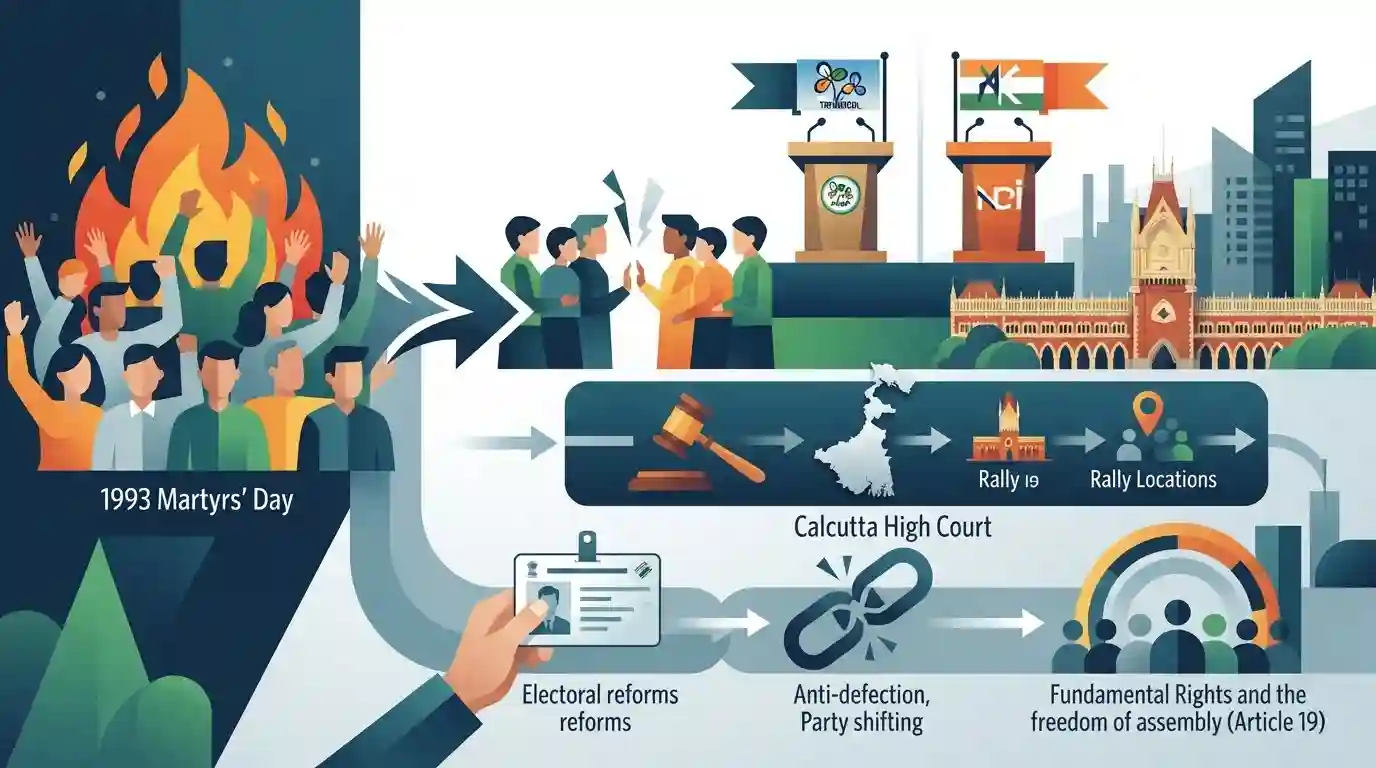
The event connects contemporary political dynamics in West Bengal (party splits and mergers) with fundamental rights (freedom of assembly via High Court intervention) and the historical context of electoral reforms (Voter ID cards).
সারসংক্ষেপ
Martyrs' Day 2026 became a battleground for rival factions of the Trinamool Congress in West Bengal, reflecting deep political divisions following their recent Assembly election loss. The day traditionally honors 13 activists killed in 1993 while demanding mandatory Voter ID cards. This year, the party splintered, with several leaders merging into the NCPI and the Calcutta High Court stepping in to adjudicate rally venues, emphasizing the legal dimensions of political assembly.
মূল বিষয়
- Rival factions of the Trinamool Congress (TMC) observed Martyrs’ Day separately in 2026, marking a significant split in the party after losing the recent West Bengal Assembly elections.
- Martyrs’ Day commemorates July 21, 1993, when 13 Youth Congress workers were killed in police firing while protesting to make Voter Identity Cards mandatory.
- A breakaway TMC faction led by Ritabrata Banerjee, including MP Kakoli Ghosh Dastidar and 19 others, merged with the Nationalist Citizens Party of India (NCPI) and held events in Delhi.
- The Calcutta High Court intervened to allow the Mamata Banerjee-led faction to hold its rally near the Birla Planetarium after denying permission for Victoria House.
গুরুত্বপূর্ণ শব্দ
Trinamool Congress (TMC)

A major regional political party in India, historically dominant in West Bengal, which is currently facing a severe organizational crisis and major splintering following its defeat in the 2026 Assembly elections.
UPSC context
GS Paper 2 (Political Parties). Relevant for questions on anti-defection laws, regional party fragmentation, and state politics.
Nationalist Citizens Party of India (NCPI)
A previously obscure Registered Unrecognised Political Party (RUPP) that gained sudden national prominence in 2026 after a large faction of rebel Trinamool Congress MPs and MLAs merged into it.
UPSC context
GS Paper 2 (Elections/RPA). Tests knowledge of RUPPs, party mergers under the Tenth Schedule, and parliamentary representation.
Youth Congress
The youth wing of the Indian National Congress. Its 1993 Kolkata march demanding mandatory photo voter ID cards resulted in police firing, killing 13 activists, which is commemorated as Martyrs' Day.
UPSC context
GS Paper 2 (Electoral Reforms). Connects historical political agitations for free and fair elections with the evolution of voter ID rules.
Calcutta High Court
The oldest High Court in India, with jurisdiction over West Bengal. It recently intervened to adjudicate venue disputes among rival political factions seeking to hold Martyrs' Day rallies in Kolkata.
UPSC context
GS Paper 2 (Fundamental Rights). Explores the judicial balancing of the Article 19 right to peaceful assembly against public order and traffic concerns.
Election Commission
The constitutional authority responsible for administering elections in India. The 1993 Kolkata protests were historically aimed at pressing the Election Commission to mandate photo voter ID cards to stop rigging.
UPSC context
GS Paper 2 (Constitutional Bodies). Important for understanding the Commission's mandate under Article 324 and the history of electoral reforms in India.
প্রিলিমস ফাঁদ
Under the Tenth Schedule, a breakaway faction representing one-third of a party's legislators is exempt from disqualification.
The 91st Constitutional Amendment Act (2003) completely deleted the 'one-third split' exemption. Today, only a 'merger' approved by two-thirds of the legislative party protects against defection.
সংযুক্ত স্থির ধারণা
What are the permissible restrictions on the Right to Assemble under Article 19(1)(b)?
- Fundamental Right: Article 19(1)(b) guarantees all citizens the right to assemble peaceably and without arms, protecting non-violent political protests.
- Specific Grounds: Under Article 19(3), restrictions can be imposed only on two grounds: the sovereignty and integrity of India, and public order.
- Exclusions: Unlike freedom of speech (Article 19(2)), assembly cannot be restricted on grounds of 'morality', 'decency', or 'friendly relations with foreign states'.
How did the 91st Amendment modify the Anti-Defection Law (Tenth Schedule)?
- Original Split Rule: The 52nd Amendment (1985) protected a breakaway faction from disqualification if it constituted at least one-third of the legislative party.
- Deletion of Split: The 91st Amendment (2003) deleted this split provision entirely because it was frequently used to legitimize bulk defections.
- Merger Threshold: Currently, members are protected only in the event of a merger, which requires at least two-thirds of the legislative party to agree.
আন্তঃবিষয় প্যাটার্ন
Street mobilization & electoral reform history
Historic street protests demanding mandatory photo voter identity cards (EPICs) directly influenced ECI's implementation of major electoral reforms under T.N. Seshan.
Judicial oversight of executive assembly bans
High Courts increasingly arbitrate the venue and timing of political rallies, balancing executive public order concerns under Article 19(3) with fundamental democratic expression.

MCQs contrasting assembly restrictions (Art 19(3)) with speech (Art 19(2)), and Tenth Schedule merger thresholds, are key 2026 targets.
সংযুক্ত PYQ · 3
সংযুক্ত PYQ · 3
- 2014WBCS_PRELIMSGS1
The Election Commission of India celebrates the National Voters Day on
- 2023WBCS_PRELIMSGS1
After the Surat Split in 1907, the second split in the Congress took place in 1918 on the issue of
- 2019WBCS_PRELIMSGS1
Which Article of the Constitution of India guarantees to all citizens the freedom of speech and expression?
