Deepwater Transshipment Ports and Maritime Infrastructure
Source:The Hindu ↗
Why It Matters
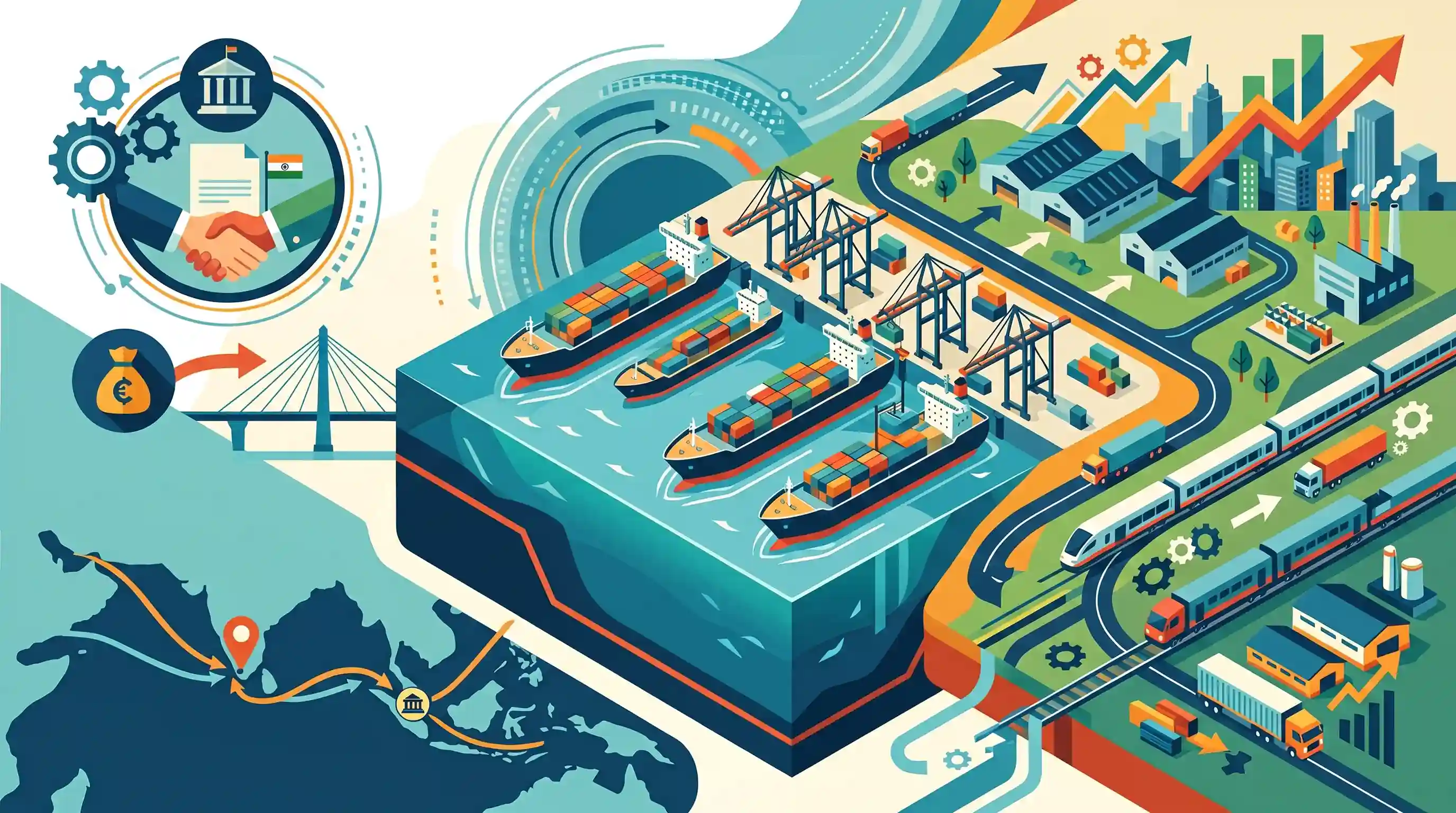
Highlights the strategic and economic necessity of developing deepwater transshipment hubs to boost India's supply chain independence, trade competitiveness, and port infrastructure modernization. Demonstrates the real-world application of PPP and Viability Gap Funding in mega-infrastructure.
Summary
The commissioning of the Vizhinjam International Transhipment Deepwater Multipurpose Seaport in Kerala, developed under a public-private partnership, marks a significant milestone in India's maritime sector. As India's first semi-automated port with a 20-metre natural draft, it is strategically located near the east-west shipping axis, offering the potential to reduce India's reliance on foreign transshipment hubs like Colombo and Singapore. Supported by Viability Gap Funding, the port's success now hinges on timely investments in rail and road connectivity, logistics, and warehousing to fully unlock its economic benefits.
Key Points
- Vizhinjam port, developed by APSEZ and the Kerala government under a PPP model, addresses India's heavy reliance on foreign ports for transshipment cargo.
- Its strategic location on the east-west shipping axis and 20-metre natural draft allow ultra-large container vessels to berth with minimal dredging.
- As India's first semi-automated port with an AI-powered vessel management system, it promises significantly reduced turnaround times.
- The project utilized a Viability Gap Fund loan from the Union government, highlighting the role of state support in long-gestation infrastructure projects.
- Future success and full utilization depend heavily on developing robust rail and road connectivity to the South Indian hinterland, along with warehousing and logistics facilities.
Important Terms
Public-Private Partnership (PPP)

A collaborative framework where government and private entities partner to deliver public infrastructure or services, sharing risks and resources. Notable models include Build-Operate-Transfer (BOT) and Hybrid Annuity Model (HAM).
UPSC context
GS Paper III: Investment Models. Tests understanding of resource pooling and risk distribution in national development.
Viability Gap Funding (VGF)
A government grant provided to infrastructure projects that are economically essential but financially unviable. It bridges the gap between capital costs and user-fee revenues to attract private investment.
UPSC context
GS Paper III: Infrastructure and Investment. Tests knowledge of fiscal tools used to support long-gestation projects.
Transshipment Hub
An intermediary maritime hub where cargo is transferred from large 'mother vessels' to smaller feeder ships for regional distribution. It reduces long-haul shipping costs and improves logistics efficiency.
UPSC context
GS Paper III: Infrastructure/Economy. Crucial for understanding India's strategy to reduce reliance on foreign ports like Colombo.
Natural Draft
The distance between the waterline and the bottom of a ship's hull. A 'natural draft' of 20 meters allows mega-vessels to dock without expensive, artificial dredging operations.
UPSC context
GS Paper I/III: Geography and Infrastructure. Tests technical advantages that determine the strategic value of major port locations.
Maritime India Vision 2030
A 10-year blueprint (2021-2030) to modernize India's maritime sector. It targets world-class port infrastructure, higher domestic transshipment shares, and increased cargo capacity to boost global trade competitiveness.
UPSC context
GS Paper III: Infrastructure and Industrial Policy. A key government roadmap for maritime and logistical reforms.
Adani Ports and Special Economic Zone Ltd (APSEZ)
India's largest private port operator and the private partner in the Vizhinjam seaport project, developing the port under a Design, Build, Finance, Operate, and Transfer (DBFOT) agreement.
UPSC context
GS Paper III: Infrastructure/Investment. Illustrates the role of lead private players in executing strategic national projects.
Latin Church
A religious institution representing local fishing communities in Vizhinjam that led protests against the port. Concerns focused on coastal erosion and the loss of livelihoods due to construction.
UPSC context
GS Paper III/IV: Social and Environmental Impacts. Tests awareness of social conflicts and ethics in large-scale infrastructure development.
Prelims Trap
"Vizhinjam is India's newest Major Port, fully regulated by the Union government."
Despite its scale and international transshipment capability, Vizhinjam is a 'non-major port' under the jurisdiction of the Kerala State Maritime Board, not the Union government.
Static Concepts Connected
What is Viability Gap Funding (VGF) for PPP infrastructure projects?
- Core definition: Capital grant for infrastructure projects that are economically justified but financially unviable without initial government support.
- Funding cap: The Central government funds up to 20% of the Total Project Cost (TPC); the sponsoring State authority can add another 20%.
- Significance: Enables critical long-gestation projects to attract private developers under Design, Build, Finance, Operate, and Transfer (DBFOT) models.
How does a transshipment port functionally differ from a gateway port?
- Hub-and-Spoke model: Transshipment ports transfer cargo between ultra-large mother vessels and smaller feeder ships, unlike gateway ports that directly process end-point hinterland trade.
- Draft requirements: Demands deep natural drafts (e.g., Vizhinjam's 20m) to berth massive container ships without incurring high capital dredging costs.
- Forex retention: Captures domestic cargo revenue previously lost to foreign intermediate hubs like Colombo, Singapore, and Dubai.
Cross-Topic Patterns
Transshipment + PM Gati Shakti
A deepwater port's viability hinges on hinterland connectivity. Mains answers linking Vizhinjam's multi-modal road/rail integration directly to PM Gati Shakti's National Master Plan demonstrate advanced logistical understanding.
Strategic autonomy + IOR geopolitics
Shifting transshipment cargo from Colombo to a domestic hub reduces India's vulnerability to supply chain disruptions and counters growing Chinese maritime influence in the Indian Ocean Region.

Expect a 2026 prelims question mixing Vizhinjam’s 'non-major' port status, Viability Gap Funding limits, and deep-water natural drafts.
Linked PYQs · 3
Linked PYQs · 3
- 2014MainsGS3
Explain how Private Public Partnership arrangements, in long gestation infrastructure projects, can transfer unsustainable liabilities to the future. What arrangements need to be put in place to ensure that successive generations' capacities are not compromised?
- 2022MainsGS3
Why is Public Private Partnership (PPP) required in infrastructural projects ? Examine the role of PPP model in the redevelopment of Railway Stations in India.
- 2023PrelimsGS1
Consider the following pairs: Port Well known as 1. Kamarajar Port: First major port in India registered as a company 2. Mundra Port: Largest privately owned port in India 3. Visakhapatnam Port: Largest container port in India How many of the above pairs are correctly matched?
