Marine Resources as Global Commons Under Maritime Law
Source:Indian Express ↗
Why It Matters
The principle of oceans as global commons is a recurring theme in UPSC, linking international law (UNCLOS) with geopolitics (Indo-Pacific disputes), maritime security, and economic geography (marine resources).
Summary
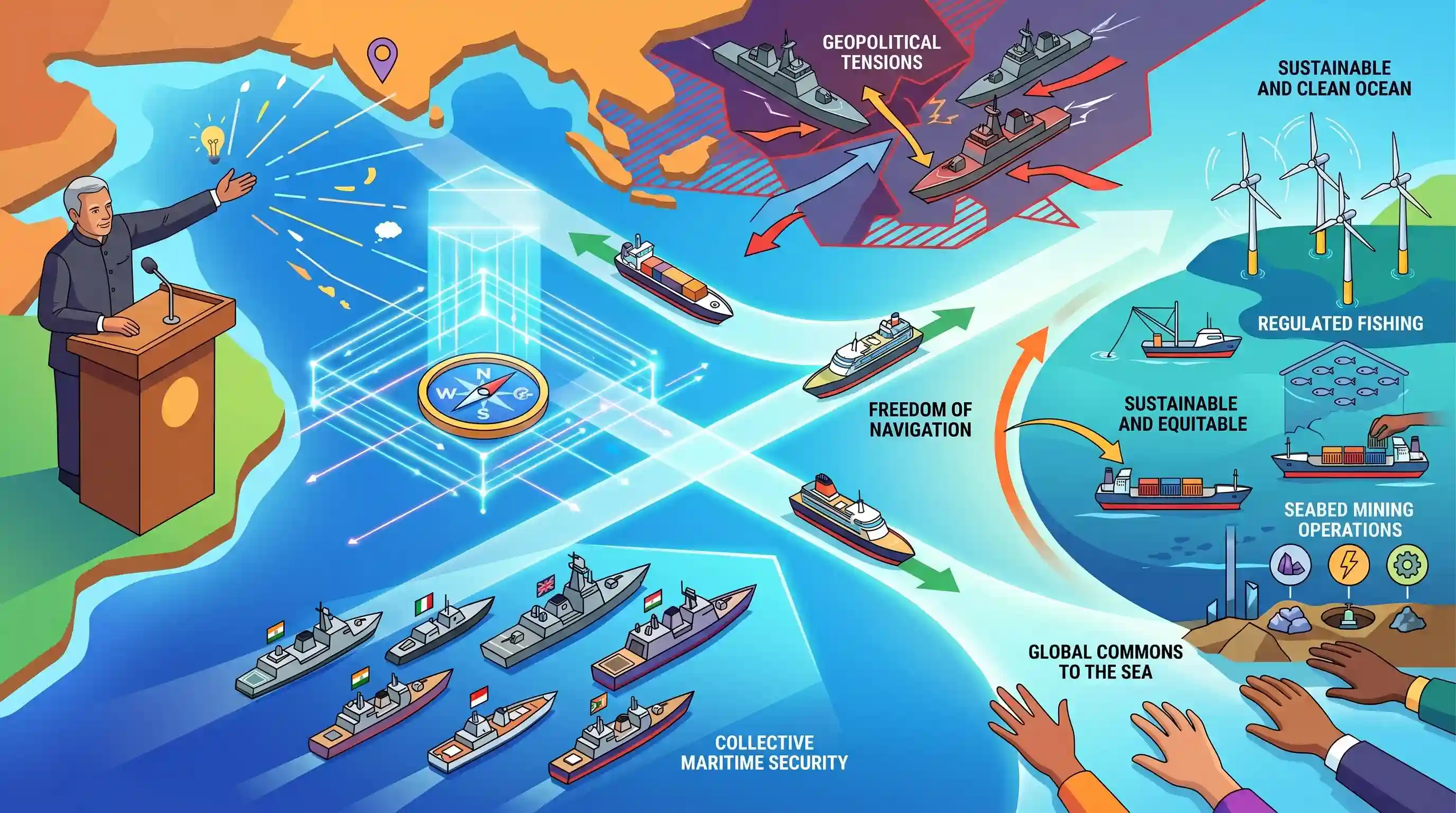
Defence Minister Rajnath Singh stated in Goa that marine resources belong to all humanity and are not the exclusive property of any single nation. This assertion highlights India's firm commitment to a rules-based international maritime order governed by UNCLOS. Against the backdrop of increasing geopolitical tensions and territorial disputes in the Indo-Pacific, the statement underscores the importance of treating the oceans as a global common. It advocates for freedom of navigation, collective maritime security, and the sustainable and equitable harnessing of Blue Economy resources, implicitly countering any unilateral hegemonic claims over maritime territories.
Key Points
- Defence Minister Rajnath Singh emphasized that marine resources are global commons and cannot be claimed as the exclusive property of any single nation.
- The statement reinforces India's commitment to the United Nations Convention on the Law of the Sea (UNCLOS), advocating for a rules-based maritime order, freedom of navigation, and equitable resource sharing.
- Such strategic posturing is vital in the context of rising geopolitical assertiveness and territorial disputes in regions like the South China Sea and the broader Indo-Pacific.
- Recognizing oceans as shared heritage aligns with India's maritime diplomacy, its focus on the Blue Economy, sustainable deep-sea mining, and its role as a net security provider in the Indian Ocean Region.
Important Terms
UNCLOS (United Nations Convention on the Law of the Sea)

An international treaty (1982) defining the rights and responsibilities of nations regarding ocean use. It establishes maritime zones—including Territorial Seas and Exclusive Economic Zones—to ensure a rules-based international maritime order.
UPSC context
GS Paper II (International Relations); tests knowledge of maritime law and its role in resolving territorial disputes like the South China Sea.
Indo-Pacific
A strategic geopolitical region integrating the Indian and Pacific Oceans. It is a primary hub for global trade and the central theater for 21st-century maritime security and great power competition.
UPSC context
GS Paper II (International Relations); essential for discussing India's Act East Policy, QUAD, and regional security architecture.
Blue Economy
The sustainable use of ocean resources for economic growth, improved livelihoods, and jobs while preserving marine ecosystem health. It includes fisheries, maritime transport, and renewable energy aligned with conservation goals.
UPSC context
GS Paper III (Economy/Environment); tests knowledge of sustainable development (SDG 14) and India’s Deep Ocean Mission.
Global Commons
Resource domains that fall outside the political jurisdiction of any single nation-state, such as the High Seas, atmosphere, and outer space. They require collective international management for sustainable use.
UPSC context
GS Paper II (Global Governance); tests understanding of international cooperation and the equitable management of shared planetary resources.
Freedom of Navigation (FON)
A principle of international law allowing ships from any state to transit international waters without interference. It is a cornerstone of global trade, codified under UNCLOS to prevent maritime hegemony.
UPSC context
GS Paper II (International Relations); critical for analyzing maritime security challenges and India’s strategic interests in sea lanes.
Exclusive Economic Zone (EEZ)
A maritime zone extending 200 nautical miles from a coast where a country has sovereign rights to explore and exploit natural resources, including fisheries and undersea minerals.
UPSC context
GS Paper III (Geography/Security); tests understanding of maritime boundaries and the legal rights of coastal states over marine wealth.
Prelims Trap
"Under UNCLOS, all marine resources are classified as global commons and the common heritage of mankind."
Only resources in "The Area" (seabed beyond national jurisdiction) are global commons. Coastal states have exclusive sovereign rights to explore and exploit resources within their EEZ.
Static Concepts Connected
How does UNCLOS divide maritime jurisdictions and resource ownership?
- Territorial Sea: Coastal states hold absolute sovereignty over the water, airspace, and seabed up to 12 nautical miles from the baseline.
- Exclusive Economic Zone: Extends up to 200 nautical miles. Coastal states have sovereign rights for exploring and exploiting natural marine resources.
- The Area: The seabed beyond national jurisdiction. Its resources are legally defined as the "common heritage of mankind" and managed by the ISA.
What is the International Seabed Authority (ISA)?
- Mandate & Origin: An autonomous international organization established under the 1982 UNCLOS framework, headquartered in Kingston, Jamaica.
- Function: It organizes, regulates, and controls all mineral-related activities in 'The Area' for the benefit of mankind as a whole.
- India's Role: India holds exclusive ISA contracts to explore for polymetallic nodules in the Central Indian Ocean Basin.
Cross-Topic Patterns
Deep Ocean Mission + Strategic Autonomy
India's Deep Ocean Mission leverages UNCLOS provisions for polymetallic nodules, blending scientific exploration with securing critical minerals to reduce reliance on Chinese supply chains.
Global Commons Governance Frameworks
UPSC frequently links maritime governance (UNCLOS) with outer space (Outer Space Treaty) and Antarctica (Antarctic Treaty) regimes under the umbrella of 'Global Commons'.

Expect a 2026 question merging UNCLOS zones, the ISA's mandate on polymetallic nodules, and 'Global Commons' vs EEZ definitions.
Linked PYQs · 5
Linked PYQs · 5
- 2014MainsGS2
With respect to the South China sea, maritime territorial disputes and rising tension affirm the need for safeguarding maritime security to ensure freedom of navigation and over flight throughout the region. In this context, discuss the bilateral issues between India and China.
- 2022PrelimsGS1
With reference to the United Nations Convention on the Law of Sea, consider the following statements : 1. A coastal state has the right to establish the breadth of its territorial sea up to a limit not exceeding 12 nautical miles, measured from baseline determined in accordance with the convention. 2. Ships of all states, whether coastal or land-locked, enjoy the right of innocent passage through the territorial sea. 3. The Exclusive Economic Zone shall not extend beyond 200 nautical miles from the baseline from which the breadth of the territorial sea is measured. Which of the statements given above are correct?
- 2021PrelimsGS1
Consider the following statements : 1. The Global Ocean Commission grants licences for seabed exploration and mining in international waters. 2. India has received licences for seabed mineral exploration in international waters. 3. 'Rare earth minerals' are present on seafloor in international waters. Which of the statements given above are correct?
- 2014MainsGS1
Critically evaluate the various resources of the oceans which can be harnessed to meet the resource crisis in the world.
- 2022MainsGS3
What are the maritime security challenges in India ? Discuss the organisational, technical and procedural initiatives taken to improve the maritime security.
