Security Forces Anti Naxal Operations and Elimination of Top Commander
Source:The Hindu ↗
Why It Matters
This event is highly relevant for GS Paper 3 (Internal Security) as it illustrates the operational successes of security forces against Left Wing Extremism. The Union Government's stated goal of eliminating LWE by 2026 relies on major intelligence-based operations like 'Operation Sambhav'. Also touches on GS Paper 1 (Geography) as the Papikonda National Park and the Eastern Ghats form the complex geographical terrain where these operations occur.
Summary
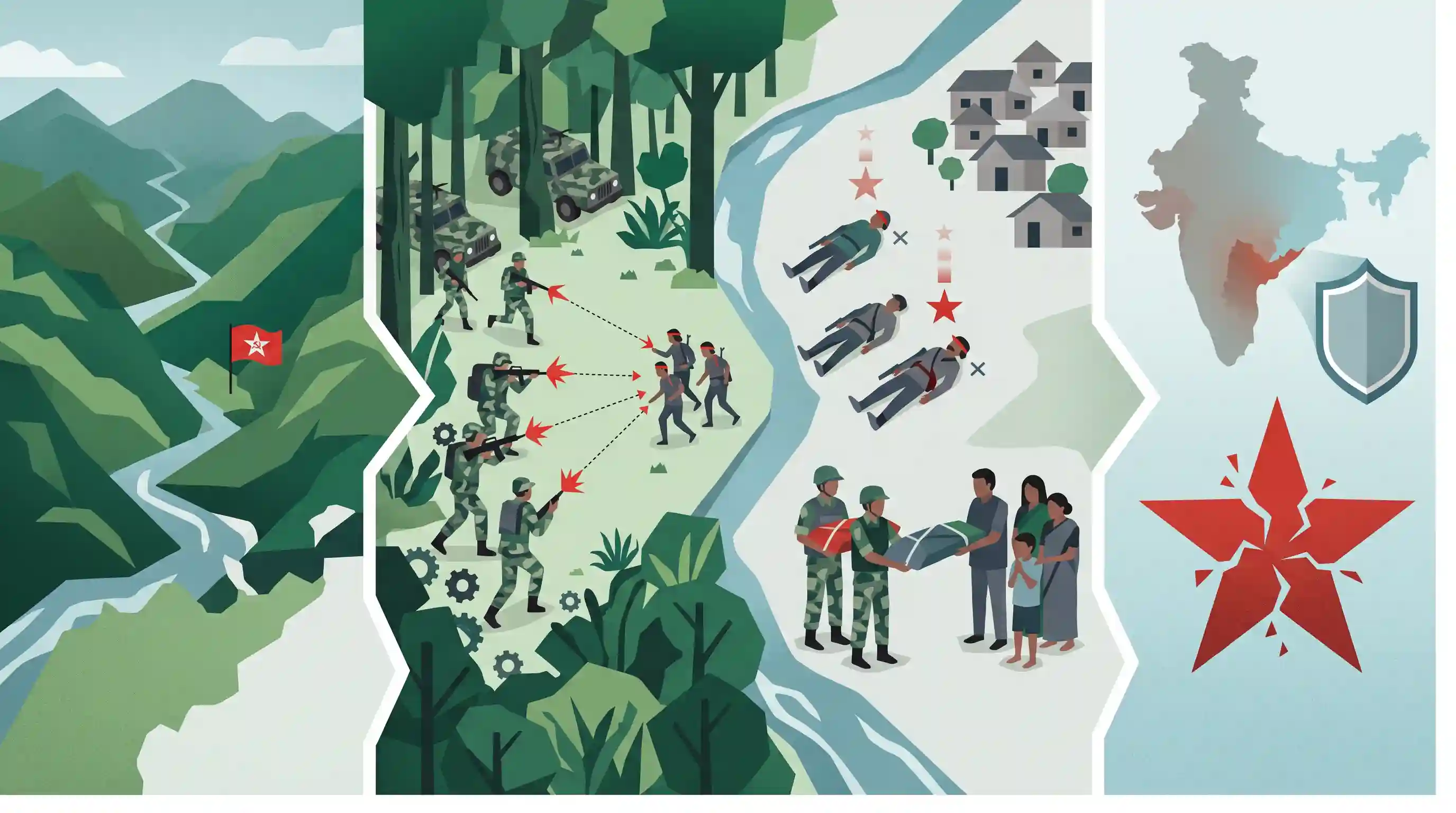
The article reports on the aftermath of 'Operation Sambhav', a major anti-Maoist operation carried out by security forces in the Papikonda National Park area of Andhra Pradesh's Alluri Sitarama Raju district. The operation resulted in the deaths of six Maoists, including the highly wanted CPI (Maoist) Central Committee member Madvi Hidma and his wife Madakam Raje. Their mortal remains were subsequently handed over to family members at Maredumilli. The elimination of Hidma, who operated extensively in the Bastar region and evaded forces for years, represents a critical milestone in India's broader internal security campaign to eradicate Left Wing Extremism.
Key Points
- The mortal remains of top CPI (Maoist) commander Madvi Hidma, his wife, and four other Maoists were handed over to their families after being killed in an encounter.
- The exchange of fire took place during anti-naxal 'Operation Sambhav' within the limits of Papikonda National Park in Andhra Pradesh's ASR district.
- Hidma was a Central Committee member of the CPI (Maoist) and one of the most wanted Left Wing Extremist leaders in India, orchestrating operations primarily from the Bastar region.
- This encounter marks a significant breakthrough for security forces like the Greyhounds in their efforts to dismantle LWE infrastructure and leadership.
Important Terms
Operation Sambhav

A major 2025 anti-Maoist offensive by Andhra Pradesh police and CRPF in the Alluri Sitarama Raju district, aimed at preventing extremists from establishing new bases in the Maredumilli forests.
UPSC context
GS III (Internal Security). Tests knowledge of contemporary counter-insurgency operations and the state's strategic goal to eliminate Maoism by 2026.
CPI (Maoist)
A banned militant organization (designated under UAPA) formed in 2004 through a merger of Naxalite groups, seeking to overthrow the Indian state via "Protracted People’s War."
UPSC context
GS III (Internal Security). Tests understanding of non-state actors, extremist ideologies, and the internal security challenges posed by the "Red Corridor."
Greyhounds
An elite special police unit of Andhra Pradesh and Telangana, raised in 1989; it is world-renowned for its expertise in guerilla and jungle warfare against Naxalite-Maoist insurgents.
UPSC context
GS III (Internal Security). Tests awareness of specialized security forces and sub-national success stories in curbing domestic insurgencies.
Madvi Hidma
A high-ranking member of the CPI (Maoist) Central Committee and commander of Battalion No. 1, wanted for numerous high-profile attacks on security forces before his elimination in 2025.
UPSC context
GS III (Internal Security). Illustrates the significance of neutralizing high-value targets to disrupt the command-and-control hierarchy of extremist organizations.
Left Wing Extremism (LWE)
A form of armed insurgency (Naxalism/Maoism) primarily active in central and eastern India, driven by far-left ideologies and socio-economic grievances in tribal-dominated regions.
UPSC context
GS III (Internal Security). A core syllabus topic testing the link between development and the spread of extremism.
Prelims Trap
"Greyhounds is a specialized Central Armed Police Force (CAPF) under the Ministry of Home Affairs."
Greyhounds is actually an elite state police special force created by Andhra Pradesh in 1989 for jungle warfare, not a central CAPF like the CRPF.
Static Concepts Connected
What are the core geographic features of Papikonda National Park?
- Location: Situated in the Papi Hills of the Eastern Ghats in Andhra Pradesh (Alluri Sitarama Raju district).
- River System: The park is prominently bisected by the Godavari River as it flows through the Eastern Ghats.
- Vegetation: Dominated by tropical moist deciduous and dry deciduous forests, providing dense canopy cover.
What are the key State-level specialized anti-Naxal forces?
- Greyhounds: Elite jungle warfare unit of the Andhra Pradesh and Telangana state police forces.
- DRG (Chhattisgarh): The District Reserve Guard utilizes local tribal youth and surrendered Maoists for tactical advantage in Chhattisgarh.
- SOG (Odisha): Special Operation Group raised by the Odisha state police specifically for counter-insurgency.
Cross-Topic Patterns
LWE & Protected Areas
Dense national parks in Central/Eastern India (Papikonda, Indravati) double as insurgent sanctuaries, making environmental geography an essential constraint and operational factor in internal security strategy.
Operation Sambhav & SAMADHAN Doctrine
Tactical successes like 'Sambhav' execute the 'Aggressive Strategy' pillar of the MHA's broader SAMADHAN doctrine, reflecting a shift toward intelligence-based kinetic operations to meet the 2026 target.

With the 2026 deadline to end LWE, expect a GS3/Prelims multi-statement question fusing the SAMADHAN doctrine with Red Corridor geography.
Linked PYQs · 4
Linked PYQs · 4
- 2025MainsGS3
The Government of India recently stated that Left Wing Extremism (LWE) will be eliminated by 2026. What do you understand by LWE and how are the people affected by it? What measures have been taken by the government to eliminate LWE?
- 2022MainsGS3
Naxalism is a social, economic and developmental issue manifesting as a violent internal security threat. In this context, discuss the emerging issues and suggest a multilayered strategy to tackle the menace of Naxalism.
- 2018MainsGS3
Left Wing Extremism (LWE) is showing a downward trend, but still affects many parts of the country. Briefly explain the Government of India's approach to counter the challenges posed by LWE.
- 2019PrelimsGS1
Consider the following pairs: Wildlife Naturally found in 1. Blue-finned Mahseer : Cauvery River 2. Irrawaddy Dolphin : Chambal River 3. Rusty-spotted Cat : Eastern Ghats Which of the pairs given above are correctly matched?
