United States Sanctions Waivers on Russian Oil and Energy Security
Source:Indian Express ↗
Why It Matters
The closure of the Strait of Hormuz and the corresponding US waivers on Russian oil sanctions are direct examples of how Middle East geopolitics and superpower policies impact India's macroeconomic stability and energy security. This highlights the vulnerability of India's crude oil supply chains.
Summary
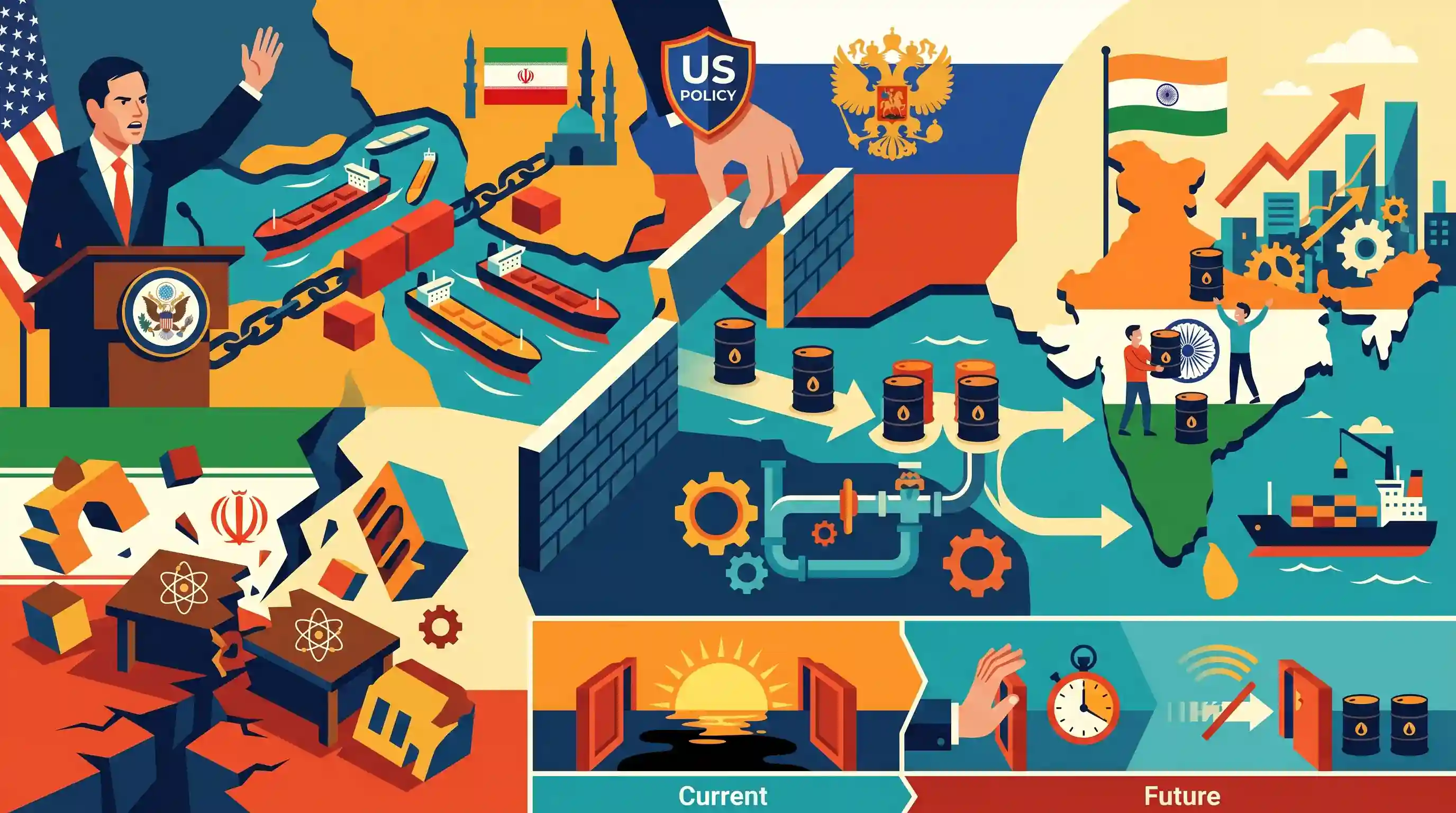
During a Senate testimony on the FY27 State Department Budget, US Secretary of State Marco Rubio addressed several global crises, notably the situation with Iran. Rubio highlighted that Iran has shown a willingness to negotiate its nuclear program, though domestic instability makes concluding a reliable deal difficult. Crucially for global markets, he condemned Iran's closure of the Strait of Hormuz but noted that the US is currently utilizing temporary waivers on Russian oil sanctions to alleviate global supply shortages. These waivers directly benefit major importers like India, though the US intends to terminate them once the crisis subsides.
Key Points
- US Secretary of State Marco Rubio testified that Iran has expressed willingness to negotiate aspects of its nuclear programme amidst ongoing conflict.
- The US condemned Iran's blockade of the Strait of Hormuz as illegal and demands its reopening, though Rubio dismissed the threat of Iran's navy.
- Due to global oil shortages exacerbated by the Strait of Hormuz closure, the US has issued temporary waivers allowing imports of Russian oil (currently sanctioned).
- These waivers are critical for countries like India that rely on imported crude, but the US intends to end them as soon as global supply stabilizes.
Important Terms
US Senate Foreign Relations Committee

A standing committee of the US Senate responsible for overseeing foreign policy legislation, confirming diplomatic appointments (like Secretary of State), and reviewing international treaties.
UPSC context
GS Paper 2: Important for understanding how legislative oversight in developed countries influences global diplomacy and India's bilateral interests.
US State Department
The executive department of the U.S. federal government responsible for the country's foreign policy and international relations, equivalent to India's Ministry of External Affairs.
UPSC context
GS Paper 2: Testing knowledge of institutions that shape the policies of developed countries toward developing nations like India.
Strait of Hormuz
A strategic maritime chokepoint between the Persian Gulf and the Gulf of Oman, through which approximately 20% of the world's oil supply transits daily.
UPSC context
GS Paper 1 & 2: Critical for geography (major chokepoints) and energy security, directly impacting India's oil import stability.
Russian Oil Waiver
Temporary exemptions granted by the US government allowing specific countries to continue importing oil from a sanctioned entity (like Russia) without facing secondary sanctions.
UPSC context
GS Paper 2 & 3: Tests understanding of global sanctions regimes and their effect on India's macroeconomic stability and energy pricing.
Strategic Autonomy
The ability of a nation to pursue its national interests and adopt a foreign policy without being constrained by other states or international alliances.
UPSC context
GS Paper 2: A core principle of Indian foreign policy tested when balancing relations between the US, Russia, and Iran.
Secondary Sanctions
Penalties imposed by a country (typically the US) on third-party individuals or nations that engage in trade or financial transactions with a sanctioned target.
UPSC context
GS Paper 2: Crucial for understanding the risks India faces when dealing with sanctioned countries like Iran or Russia.
Energy Security
The uninterrupted availability of energy sources at an affordable price, involving both physical supply and economic factors like price volatility.
UPSC context
GS Paper 3: A major pillar of economic development; tests India's vulnerability to global supply chain disruptions.
Prelims Trap
The Strait of Hormuz connects the Persian Gulf to the Red Sea.
Aspirants often confuse Hormuz with Bab el-Mandeb. Hormuz connects the Persian Gulf to the Gulf of Oman/Arabian Sea, while Bab el-Mandeb links the Red Sea.
Static Concepts Connected
Which maritime chokepoints dominate West Asian energy transit?
- Strait of Hormuz: Situated between Iran and Oman, it connects the Persian Gulf to the Gulf of Oman and carries roughly 20% of global oil.
- Bab el-Mandeb: Located between Yemen and Djibouti/Eritrea, it connects the Red Sea to the Gulf of Aden and the wider Indian Ocean.
- Suez Canal: An artificial sea-level waterway in Egypt connecting the Mediterranean Sea directly to the Red Sea.
What is CAATSA and how does its waiver mechanism work?
- CAATSA Framework: A US federal law imposing sanctions on countries that conduct significant transactions with the defense or intelligence sectors of Russia, Iran, or North Korea.
- Waiver Diplomacy: Waivers (like those for oil or S-400 missiles) are temporary, conditional carve-outs granted by the US Executive based on national security, not permanent statutory rights.
Cross-Topic Patterns
Hormuz blockade & India's SPR
Supply shocks via Hormuz reinforce the urgency of expanding India's Strategic Petroleum Reserves (ISPRL) and establishing resilient, alternative energy corridors like IMEC.
US sanctions & Rupee internationalization
The geopolitical volatility of US sanctions and temporary waivers acts as a catalyst for India's push toward Rupee-denominated trade and Special Rupee Vostro Accounts (SRVA).

Expect a Prelims pairs question linking West Asian chokepoints to bordering nations, and a Mains probe on energy sovereignty vs US sanctions.
Linked PYQs · 2
Linked PYQs · 2
- 2025MainsGS2
"Energy security constitutes the dominant kingpin of India's foreign policy, and is linked with India's overarching influence in Middle Eastern countries.” How would you integrate energy security with India's foreign policy trajectories in the coming years?
- 2024PrelimsGS1
Consider the following statements : Statement-I : Sumed pipeline is a strategic route for Persian Gulf oil and natural gas shipments to Europe. Statement-II : Sumed pipeline connects the Red Sea with the Mediterranean Sea. Which one of the following is correct in respect of the above statements?
