Jammu and Kashmir Statehood Restoration Demand
Source:Indian Express ↗
Why It Matters
Highlights the ongoing political debate over the structural changes introduced by the Jammu and Kashmir Reorganization Act, 2019. It links to broader constitutional concepts under GS2, such as asymmetric federalism, the rights of Union Territories versus States, and the fundamental right to assemble and protest under Article 19.
Summary
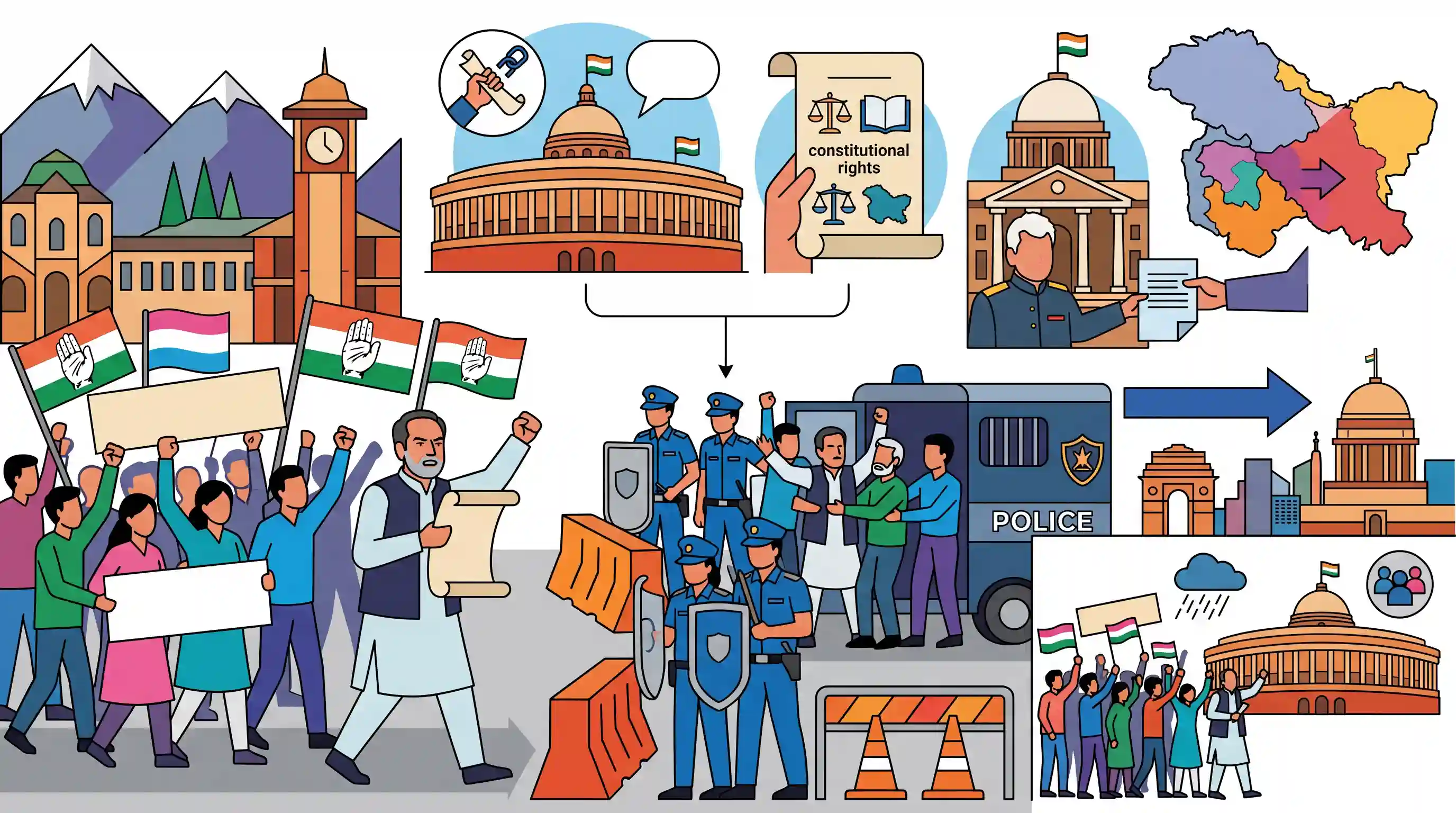
The Jammu and Kashmir Congress organized a protest march in Srinagar demanding the immediate restoration of statehood for the Union Territory. Led by J&K Congress president Tariq Hamid Karra under the campaign “Hamari Riyasat Hamara Haq,” leaders attempted to march to the Raj Bhavan to submit a memorandum to Lieutenant Governor Manoj Sinha but were detained by the police. The Congress asserted that restoring statehood is a constitutional right and an unfulfilled promise made by the Union government on the floor of Parliament. The party has threatened to escalate the protest to Delhi during the Monsoon Session if their demands remain unmet.
Key Points
- The J&K Congress launched a march under the banner “Hamari Riyasat Hamara Haq” demanding the restoration of Jammu and Kashmir's statehood.
- Key Congress leaders, including J&K president Tariq Hamid Karra, were detained by police while marching to submit a memorandum to Lieutenant Governor Manoj Sinha.
- The demand highlights the unfulfilled promise made by the Prime Minister and Home Minister in Parliament regarding the restoration of statehood after the 2019 reorganization.
- The Congress plans to escalate the issue by marching to Parliament ('Delhi challo') during the upcoming Monsoon Session if statehood is not restored.
Important Terms
Jammu and Kashmir Reorganization Act 2019

The 2019 law that bifurcated the state of Jammu and Kashmir into two Union Territories—J&K (with legislature) and Ladakh (without legislature)—and effectively repealed the region's special status under Article 370.
UPSC context
GS II (Polity) - Reorganization of states and center-state relations; tests knowledge of the 2019 constitutional shift.
Legislative Assembly (J&K)
The unicameral law-making body of the UT of Jammu and Kashmir. It can legislate on most State List items except 'Public Order' and 'Police,' which are reserved for the Union.
UPSC context
GS II (Polity) - Functions of state/UT legislatures; tests understanding of restricted legislative powers in UTs.
Lieutenant Governor (LG)
The President-appointed administrator of a Union Territory. In J&K, the LG acts as the executive head with extensive discretionary powers over police, public order, and bureaucracy.
UPSC context
GS II (Polity) - Comparison of the constitutional positions of Governors and LGs.
Article 3 of the Constitution
The constitutional provision empowering Parliament to form new states, alter areas, or change boundaries and names of existing states by a simple majority.
UPSC context
GS II (Polity) - Union and its Territory; tests concepts of an 'indestructible Union of destructible states.'
Federalism
A basic structure of the Constitution involving power-sharing between the Centre and States. J&K's statehood demand centers on restoring this balance from its current UT status.
UPSC context
GS II (Polity) - Federalism as a 'Basic Structure' feature and issues in center-state relations.
Prelims Trap
A constitutional amendment under Article 368 is mandatory to downgrade a full-fledged State into a Union Territory.
Parliament can form new states, alter boundaries, or downgrade states into UTs via a simple majority. It is explicitly exempted from being considered a constitutional amendment.
Static Concepts Connected
How does Parliament alter state boundaries or status under Article 3?
- Prior Recommendation: Any Bill seeking such changes must be introduced in Parliament only with the prior recommendation of the President.
- State Views: The President refers the Bill to the concerned State Legislature for its views, though these views are not binding on Parliament.
- Ordinary Majority: The Bill can be passed by a simple majority in Parliament and does not require a special majority under Article 368.
How does a UT with a legislature (like J&K) differ from a full State?
- Restricted Domain: Unlike States, UT legislatures like J&K cannot legislate on specific State List subjects such as 'Public Order' and 'Police'.
- LG's Discretion: The Lieutenant Governor acts as the administrator on behalf of the President and enjoys wider discretionary powers compared to a State Governor.
- Parliamentary Override: Parliament retains the paramount power to make laws on any subject in the State List for a Union Territory.
Cross-Topic Patterns
UT downgrades vs. Article 371 asymmetry
While J&K experienced a unique downgrade from State to UT, regions like Northeast India enjoy upgraded asymmetric federalism under Article 371 to protect distinct regional identities and local laws.
Protest rights vs. Public Order restrictions
Detentions during political marches highlight the continuous friction between Article 19(1)(b) (peaceful assembly) and the state's power to impose reasonable restrictions under Article 19(3) in the name of public order.

Expect a 2026 multi-statement Prelims question comparing the specific legislative powers of UTs (Delhi vs J&K vs Puducherry).
Linked PYQs · 3
Linked PYQs · 3
- 2025MainsGS2
Discuss the nature of Jammu and Kashmir Legislative Assembly after the Jammu and Kashmir Reorganization Act, 2019. Briefly describe the powers and functions of the Assembly of the Union Territory of Jammu and Kashmir.
- 2024MainsGS2
What changes has the Union Government recently introduced in the domain of Centre-State relations ? Suggest measures to be adopted to build the trust between the Centre and the States and for strengthening federalism.
- 2022MainsGS2
“Right of movement and residence throughout the territory of India are freely available to the Indian citizens, but these rights are not absolute.” Comment.
