Maharashtra Marathi Language Mandate: Internal Migration Rights
Source:Indian Express ↗
Why It Matters
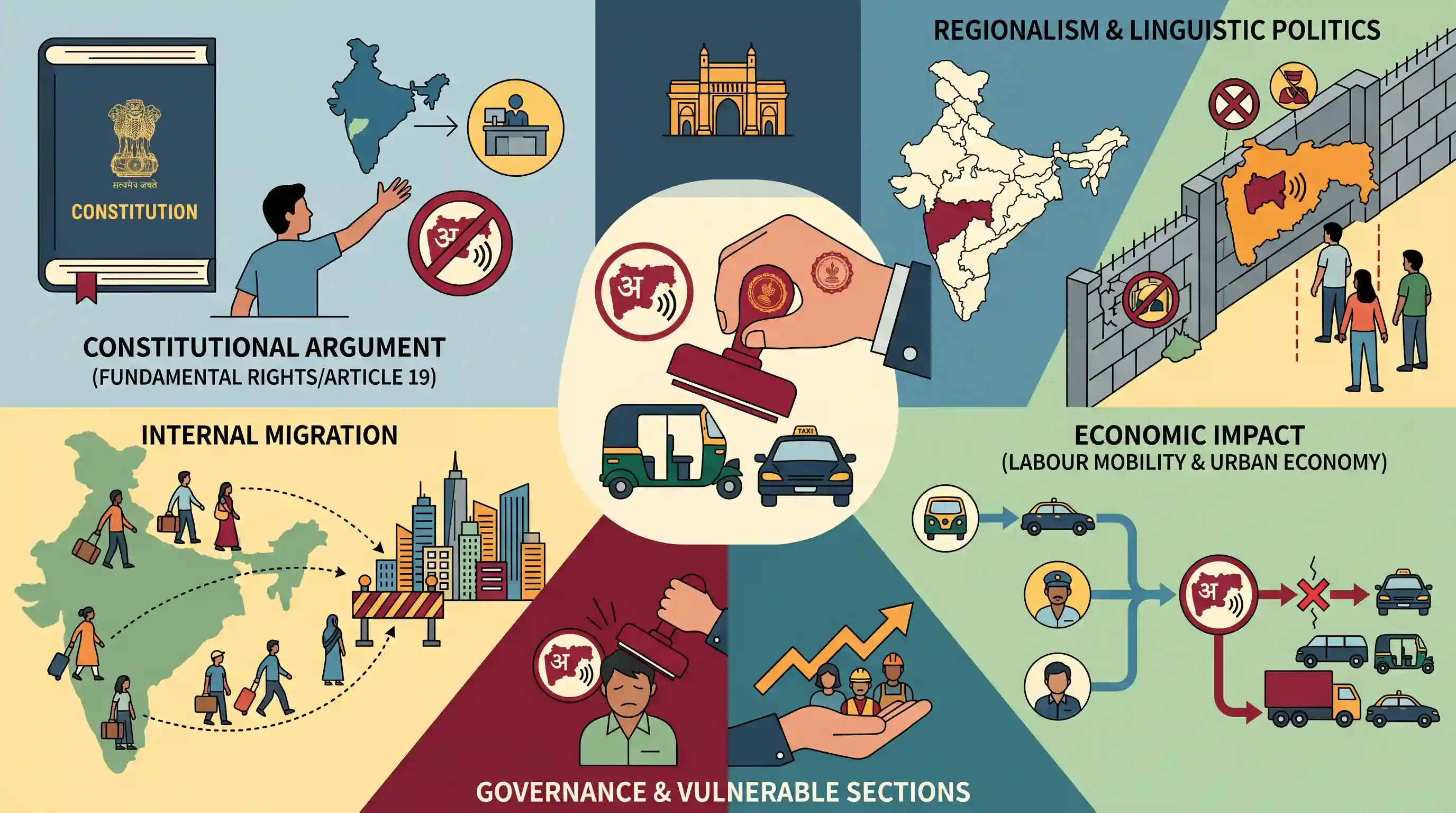
The article highlights the tension between constitutionally guaranteed freedoms (like movement and profession) and regional political mandates. It provides a contemporary example for questions on regionalism, linguistic chauvinism, internal migration rights, and the balance between state policies and fundamental rights.
Summary
The editorial criticizes the Maharashtra government's decision to make Marathi-language proficiency mandatory for auto and taxi drivers. It argues that the policy is constitutionally flawed because it infringes upon the fundamental rights of internal migrants to move freely and practice their profession anywhere in India. Economically, the mandate hinders labour mobility, which is crucial for a unified market and the efficient functioning of urban transport systems. The author highlights that such narrow linguistic politics and parochialism disproportionately target vulnerable migrant workers, urging policymakers to prioritize inclusive growth over regional chauvinism.
Key Points
- The Maharashtra government mandated basic Marathi-language proficiency for auto and taxi drivers, a move criticized as constitutionally tenuous.
- The mandate creates informal barriers against internal migrants, infringing on the constitutional freedom of mobility and the right to practice any profession across India.
- Economically, restricting labour mobility subverts the concept of a unified national market, which is essential for urban transport efficiency and growth.
- The policy reflects a history of language being weaponized for narrow political gains and parochialism in Maharashtra by political parties.
- Such linguistic mandates disproportionately harm vulnerable migrant workers who lack basic social and economic protections, hindering inclusive growth.
Important Terms
Article 19 (Constitution of India)

Constitutional provision guaranteeing six freedoms, including the right to move freely (19(1)(d)), reside anywhere (19(1)(e)), and practice any profession or trade (19(1)(g)) throughout India.
UPSC context
GS II (Polity); central to debates on the legality of state-level domicile or linguistic mandates for employment.
Internal Migration
The movement of people within national borders for employment or social reasons. It is a fundamental right that supports economic growth and urban development in receiver states like Maharashtra.
UPSC context
GS I (Society) & GS III (Economy); tests knowledge of demographic trends and the socio-economic rights of migrant workers.
Regionalism
A political ideology prioritizing regional identity (language, culture) over national identity. In its negative form, it manifests as parochialism or hostility toward migrants from other states.
UPSC context
GS I (Social Issues); essential for understanding threats to national integration and the rise of sub-nationalism.
Sons of the Soil Doctrine
A political doctrine asserting that a state’s resources and jobs belong primarily to its native linguistic or ethnic group, often leading to discriminatory policies against "outsiders."
UPSC context
GS I (Society) & GS II (Social Justice); critical for analyzing ethnic conflicts and exclusionary regional policies.
Labor Mobility
The ease with which workers can move geographically to find employment. It is vital for a unified national market and efficient urban transport systems.
UPSC context
GS III (Economy); tests understanding of workforce dynamics and the economic costs of regional protectionism.
Reasonable Restrictions
Legal caveats under Article 19(2)-(6) that allow the State to limit fundamental rights for reasons like public order, morality, or the sovereignty of India.
UPSC context
GS II (Polity); key to determining if a government policy (like language mandates) is constitutionally valid.
Prelims Trap
State governments can restrict the freedom of movement under Article 19 to protect the linguistic identity of the local population.
Article 19(5) permits restrictions on movement only in the 'interests of the general public' or to protect 'Scheduled Tribes'. Linguistic preservation is not a constitutionally listed ground.
Static Concepts Connected
What are the constitutional limits on restricting freedom of movement and profession?
- Movement (Art 19(5)): Can only be restricted in the interests of the general public or for protecting the interests of any Scheduled Tribe.
- Profession (Art 19(6)): Restricted via general public interest, prescribing technical/professional qualifications, or creating state monopolies. Language is rarely a valid 'technical' qualification for informal work.
What are the primary drivers of 'Sons of the Soil' regionalism in India?
- Resource Scarcity: Intense competition for limited urban infrastructure, housing, and informal jobs triggers nativist resentment against internal migrants.
- Vote-bank Politics: Regional parties weaponize linguistic or cultural identity to consolidate local electoral support, especially during economic stagnation.
- Uneven Development: High interstate distress migration from less-developed states creates demographic anxieties in richer destination states like Maharashtra.
Cross-Topic Patterns
Private sector domicile quotas
Mirrors the quashed Haryana 75% local quota law, highlighting a broader governance trend of states legally fracturing India's unified labour market for political gains.
Gig economy and informal worker vulnerability
Linguistic barriers further marginalize urban transport and gig workers, compounding their structural vulnerabilities and lack of protections under the new Labour Codes.

Expect a Mains GS1/GS2 question linking 'Sons of the Soil' policies, informal labor mobility, and the violation of Article 19 freedoms.
Linked PYQs · 4
Linked PYQs · 4
- 2022MainsGS2
“Right of movement and residence throughout the territory of India are freely available to the Indian citizens, but these rights are not absolute.” Comment.
- 2016MainsGS1
What is the basis of regionalism? Is it that unequal distribution of benefits of development on regional basis eventually promotes regionalism? Substantiate your answer.
- 2015MainsGS1
Discuss the changes in the trends of labour migration within and outside India in the last four decades.
- 2024MainsGS1
Why do large cities tend to attract more migrants than smaller towns? Discuss in the light of conditions in developing countries.
