Maratha Reservation Demands Clash with Legal Ceilings and OBC Politics
Source:Indian Express ↗
Why It Matters
Reservation demands by dominant castes (like Marathas, Patidars, and Jats) form a recurring theme in UPSC GS1 (Society) and GS2 (Social Justice/Polity). Understanding the legal limitations, such as the 50% cap and Article 335, is crucial for both Prelims and Mains.
Summary
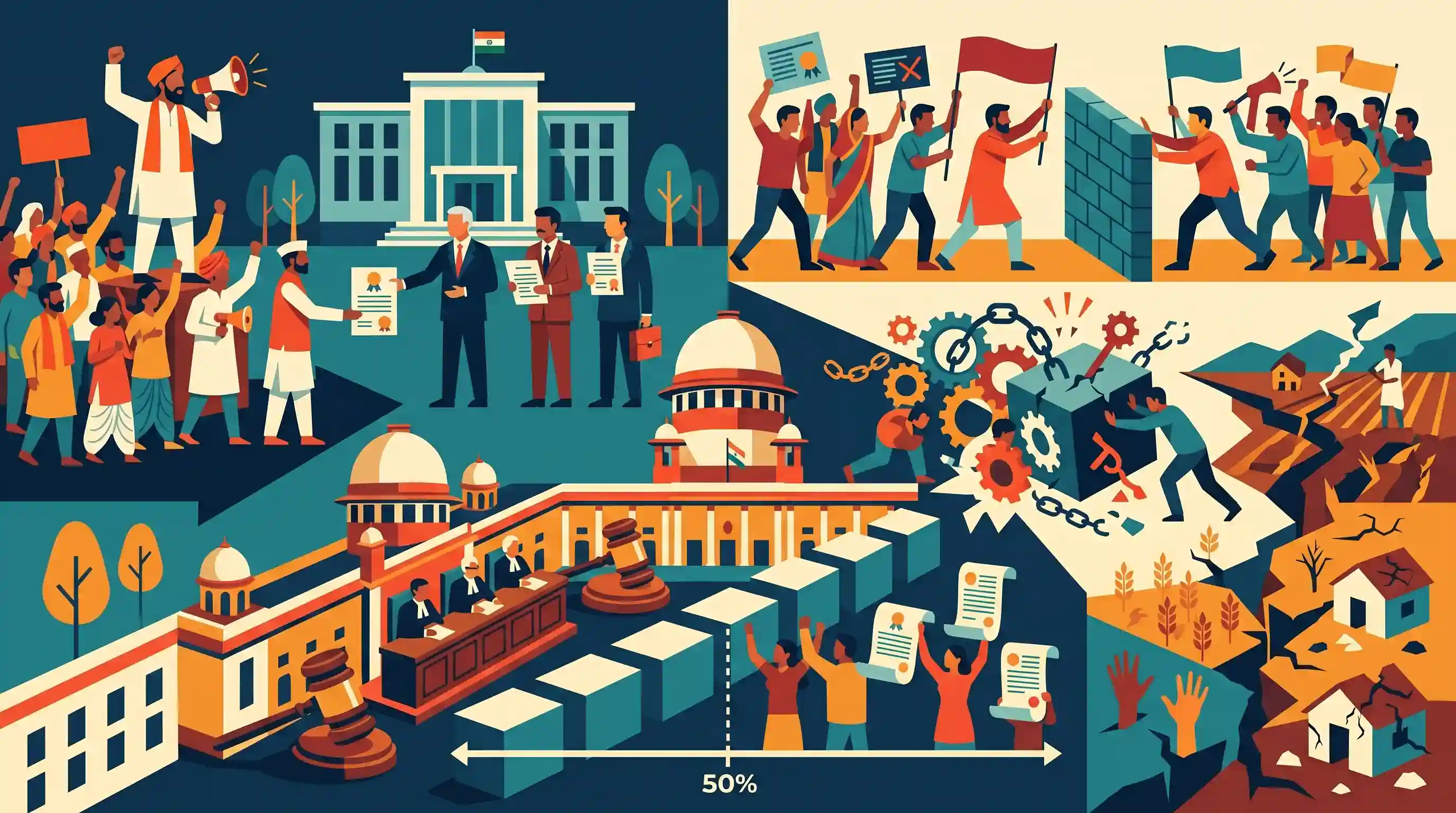
The article analyzes the political and legal deadlock surrounding the Maratha quota agitation in Maharashtra. Activist Manoj Jarange-Patil has secured repeated assurances from the state government regarding the issuance of Kunbi (OBC) certificates to Marathas and their blood relatives. However, fulfilling these promises is nearly impossible due to fierce opposition from existing OBC communities and formidable legal barriers, primarily the Supreme Court's 50% cap on reservations stemming from the Indra Sawhney judgment. The situation underscores the complex dynamics of caste politics and the socio-economic distress of dominant agrarian communities.
Key Points
- Manoj Jarange-Patil has been leading a sustained agitation demanding OBC status for Marathas via the issuance of Kunbi caste certificates.
- The Maharashtra government has issued assurances, notably concerning the inclusion of 'sage-soyare' (blood relatives) of those with Kunbi records, but implementing this is legally and politically difficult.
- Existing Other Backward Classes (OBC) leaders strongly oppose diluting their quota by including the politically and numerically dominant Maratha community.
- Any separate Maratha reservation faces severe legal scrutiny, as the Supreme Court previously struck it down for breaching the 50% reservation ceiling established in the 1992 Indra Sawhney judgment.
- The agitation highlights the socio-economic anxieties of traditionally agrarian dominant castes seeking the safety net of government jobs and education quotas.
Important Terms
Kunbi Caste Certificate

A document identifying an individual as belonging to the Kunbi community, an agrarian sub-caste already classified as Other Backward Classes (OBC) in Maharashtra.
UPSC context
GS Paper II: Social Justice and Politiy; tests understanding of caste-based affirmative action and sub-categorization within OBCs.
Indra Sawhney Judgment (1992)
The landmark 1992 Supreme Court verdict that capped total reservations at 50% and introduced the 'creamy layer' concept to exclude affluent members from OBC benefits.
UPSC context
GS Paper II: Constitution and Judiciary; critical for questions on the evolution of reservation policy and judicial limits.
National Commission for Backward Classes (NCBC)
A constitutional body (Article 338B) empowered to examine requests for inclusion/exclusion in the OBC list and investigate grievances regarding backward classes' rights.
UPSC context
GS Paper II: Constitutional Bodies; tests knowledge of the 102nd Amendment and its impact on federalism.
Economically Weaker Sections (EWS) Quota
A 10% reservation in jobs and education for individuals from the General category with an annual family income below ₹8 lakh, introduced via the 103rd Amendment.
UPSC context
GS Paper II: Constitution; relevant for discussions on economic vs. social backwardness as a criterion for reservation.
Socially and Educationally Backward Classes (SEBC)
A legal category (Article 342A) used by states to provide reservations to groups identified as disadvantaged, such as the Marathas under the struck-down 2018 Act.
UPSC context
GS Paper II: Social Justice; focuses on the criteria for identifying backwardness and the 105th Amendment's restoration of state powers.
Sage-Soyare (Blood Relatives)
The 'sage-soyare' demand refers to the inclusion of blood relatives of Marathas who possess Kunbi records into the OBC category to broaden reservation eligibility.
UPSC context
GS Paper II: Governance/Social Justice; tests understanding of administrative challenges in implementing caste-based policies.
Prelims Trap
The 105th Constitutional Amendment empowers state governments to bypass the 50% reservation ceiling for SEBCs.
The 105th Amendment restored the power of states to identify SEBCs, but it did absolutely nothing to remove or bypass the 50% ceiling established by Indra Sawhney.
Static Concepts Connected
What did the Indra Sawhney judgment (1992) rule on reservation ceilings?
- 50% Ceiling: Capped vertical reservations at 50% to ensure the rule of equality is not completely consumed by exceptions under Article 16(4).
- Exceptional Circumstances: The 50% limit can only be breached for far-flung, remote areas or unique communities completely outside the national mainstream.
How did the 102nd and 105th Amendments alter SEBC identification?
- 102nd Amendment (2018): Granted constitutional status to the NCBC. The SC later interpreted it as stripping States' power to identify their own SEBC lists.
- 105th Amendment (2021): Explicitly restored the power of State governments to identify and notify their own SEBC lists, completely separate from the Central list.
Cross-Topic Patterns
Dominant Castes + Agrarian Distress
Shrinking farm incomes push dominant land-owning castes (Marathas, Jats, Patidars) to seek secure public employment via quotas, heavily linking agricultural economics with social justice movements.
Quota Capture vs. OBC Sub-categorization
Existing OBCs oppose Maratha inclusion fearing quota capture. This mirrors the underlying rationale of the Rohini Commission's push to sub-categorize OBCs for equitable distribution of benefits.

Expect a 2026 Prelims question interlinking the 105th Amendment, Article 342A, and the Indra Sawhney 'exceptional circumstances' test.
Linked PYQs · 3
Linked PYQs · 3
- 2020MainsGS1
Has caste lost its relevance in understanding the multi-cultural Indian Society? Elaborate your answer with illustrations.
- 2023PrelimsGS1
Consider the following statements: Statement-I: The Supreme Court of India has held in some judgements that the reservation policies made under Article 16(4) of the Constitution of India would be limited by Article 335 for maintenance of efficiency of administration. Statement-II: Article 335 of the Constitution of India defines the term 'efficiency of administration'. Which one of the following is correct in respect of the above statements?
- 2023PrelimsGS1
Consider the following organizations/bodies in India: 1. The National Commission for Backward Classes 2. The National Human Rights Commission 3. The National Law Commission 4. The National Consumer Disputes Redressal Commission How many of the above are constitutional bodies?
