Mass Surrenders of Maoists Advance Internal Security Goals
Source:The Hindu ↗
Why It Matters
LWE has historically been a major internal security threat in India. The widespread surrender of cadres directly responds to syllabus items on tackling internal security challenges and assessing the effectiveness of the state's rehabilitation/developmental policies (e.g., Niyad Nella Nar scheme) against extremist ideologies.
Summary
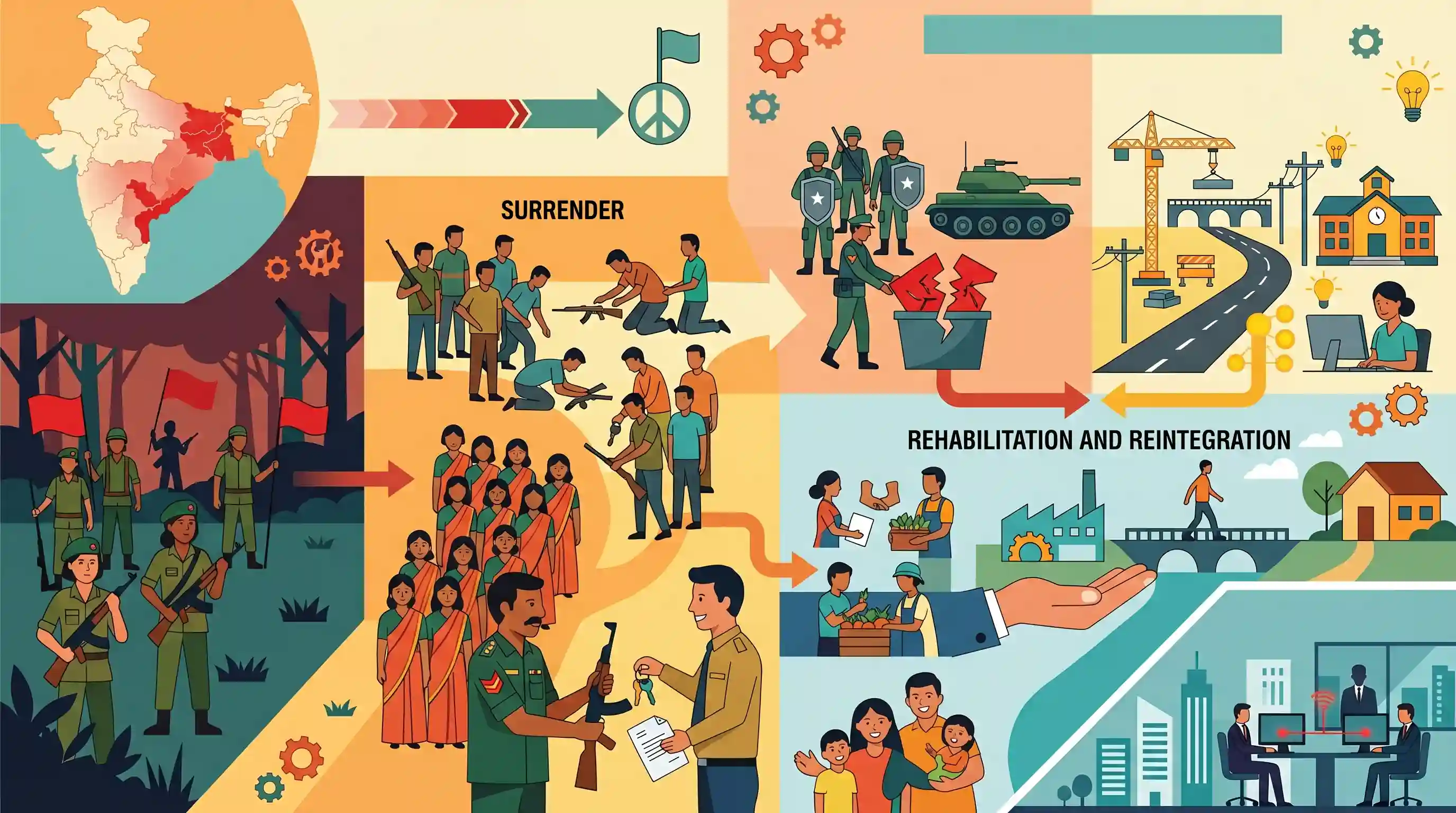
Mass surrenders in Chhattisgarh and Maharashtra mark a significant blow to the Left Wing Extremism (LWE) movement in India. In Chhattisgarh, 78 Maoist cadres (including 43 women) surrendered, while in Maharashtra, top leader Mallojula Venugopal Rao (Bhupati) and 60 others laid down their arms. Facilitated by the Chhattisgarh Naxalite Surrender Rehabilitation Policy and the Centre's twin strategy of punitive action paired with development, the success brings the country closer to the March 2026 deadline for eliminating Maoism in the Red Corridor. Authorities remain cautious, pointing to 'urban Naxalism' as an emerging challenge.
Key Points
- 78 Maoists, including 43 women, surrendered across three districts in Chhattisgarh (Sukma, Kanker, Kondagaon).
- In Maharashtra's Gadchiroli, prominent CPI (Maoist) central committee member Mallojula Venugopal Rao alias Bhupati and 60 cadres laid down their arms before CM Devendra Fadnavis.
- The surrenders are attributed to a twin strategy of targeted anti-Maoist operations and targeted rehabilitation policies, including the Niyad Nella Nar scheme and Chhattisgarh Naxalite Surrender Rehabilitation Policy.
- These mass surrenders are viewed as the beginning of the end for the Maoist movement in the Red Corridor, aligning with the Centre\'s target to make the region Maoism-free by March 2026.
- Over three dozen heavy weapons (including AK-47s, SLRs, and INSAS rifles) were recovered, and authorities warned the next major internal security challenge could be 'urban Naxalism'.
Important Terms
CPI (Maoist)

Banned far-left militant organization (since 2009) formed via a 2004 merger, aiming to overthrow the Indian state through 'protracted people's war.'
UPSC context
GS III: Internal Security; primary non-state actor challenging Indian sovereignty.
Chhattisgarh Naxalite Surrender Rehabilitation Policy
State framework (updated 2025) providing financial aid, land, and vocational training to Maoist cadres who abandon violence to reintegrate into mainstream society.
UPSC context
GS III: Internal Security/Policy Interventions; essential for 'Hearts and Minds' strategy.
Niyad Nella Nar scheme
'Your Good Village' initiative providing 25 basic amenities (roads, solar power, healthcare) to remote Chhattisgarh villages within a 5km radius of security camps.
UPSC context
GS II/III: Governance and LWE development-led security strategy.
C-60 commandos
Elite specialized anti-Naxal unit of the Maharashtra Police, primarily recruited from local tribal populations for superior jungle warfare and intelligence gathering.
UPSC context
GS III: Internal Security; tests knowledge of specialized state forces.
Urban Naxalism
The ideological expansion of Maoist support networks into cities via activism, logistics, and intellectual propaganda, requiring distinct legal and security responses.
UPSC context
GS III: Internal Security; emerging hybrid warfare and internal threat dimensions.
Red Corridor
Region in eastern and central India (e.g., Chhattisgarh, Jharkhand, Odisha) characterized by significant Naxalite–Maoist insurgency and socio-economic deprivation.
UPSC context
GS I: Geography; GS III: Security; geographical spread of LWE.
Prelims Trap
The Niyad Nella Nar scheme is a Centrally Sponsored Scheme implemented across all Red Corridor states.
It is actually a specific Chhattisgarh state government scheme aimed at developing remote villages near newly established security camps in Bastar, not a pan-India central scheme.
Static Concepts Connected
What are the key pillars of the Centre's strategy against Left Wing Extremism?
- Security measures: Deployment of CAPFs, specialized CoBRA battalions, and funding for state police modernization to physically dominate extremist strongholds.
- Development initiatives: Civic Action Programme (CAP), Security Related Expenditure (SRE), and the Road Requirement Plan (RRP) to build physical and social infrastructure.
- SAMADHAN doctrine: An overarching doctrine focusing on Smart leadership, Aggressive strategy, Motivation/Training, Actionable intel, Dashboard KPIs, Harnessing tech, Action plan, and No access to financing.
How does the Central Government framework for LWE surrender and rehabilitation work?
- Financial grant lock-in: The immediate surrender grant is kept in a fixed deposit, accessible only after a 3-year lock-in period subject to good behavior by the surrenderer.
- Vocational stipend: Surrendered cadres are provided a monthly stipend while they undergo mandatory vocational training for up to 3 years to ensure integration into the formal economy.
- Weapon incentives: Additional cash incentives are provided for surrendering with weapons, with the amount scaling based on the lethality of the weapon (e.g., AK-47 vs country-made).
Cross-Topic Patterns
LWE decline and Forest Rights (FRA)
The shrinking of the Red Corridor closely correlates with improved state implementation of PESA and the Forest Rights Act (FRA), addressing the historical land alienation of tribal populations.
Urban Naxalism and UAPA dynamics
As rural armed rebellion weakens, internal security focus has shifted to ideological fronts. This explains the rising invocation of UAPA to disrupt financial and logistical support networks in cities.

Mains 2026 will likely test the 'twin strategy' success against LWE, contrasting the rural insurgency decline with rising 'Urban Naxalism'.
Linked PYQs · 3
Linked PYQs · 3
- 2018MainsGS3
Left Wing Extremism (LWE) is showing a downward trend, but still affects many parts of the country. Briefly explain the Government of India's approach to counter the challenges posed by LWE.
- 2022MainsGS3
Naxalism is a social, economic and developmental issue manifesting as a violent internal security threat. In this context, discuss the emerging issues and suggest a multilayered strategy to tackle the menace of Naxalism.
- 2025MainsGS3
The Government of India recently stated that Left Wing Extremism (LWE) will be eliminated by 2026. What do you understand by LWE and how are the people affected by it? What measures have been taken by the government to eliminate LWE?
