Security Operations Constrict Left Wing Extremism in Chhattisgarh
Source:The Hindu ↗
Why It Matters
This is a major milestone in India's internal security landscape. The neutralization of top-tier Maoist leadership reflects the success of the government's multi-pronged strategy to combat Left Wing Extremism (LWE), a direct syllabus topic for GS Paper 3. Students should analyze how geographic constriction and leadership decapitation affect the future of LWE in India.
Summary
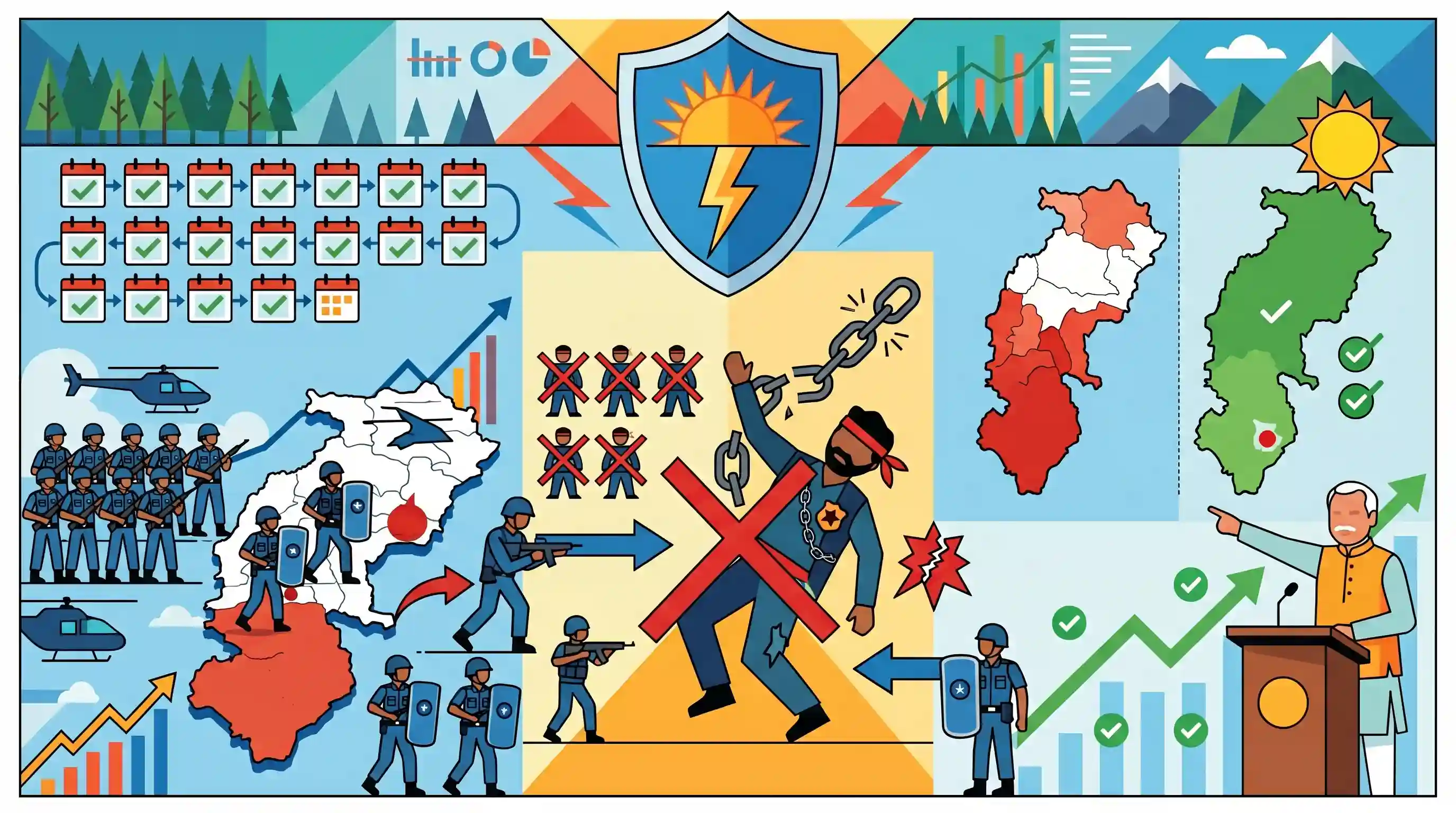
Following a massive 21-day security operation in Chhattisgarh, security forces neutralized 27 Maoists, including top CPI (Maoist) leader Nambala Keshav Rao (Basavaraju). This marks the first time in thirty years that a Maoist general secretary has been eliminated, delivering a decisive blow to the Left Wing Extremism (LWE) movement. Chief Minister Vishnu Deo Sai emphasized that Naxalism's operational footprint has now been confined to a very small area, reflecting the success of concentrated internal security measures in the Bastar and Bijapur regions.
Key Points
- Security forces in Chhattisgarh neutralized 27 Maoists in the Abujhmad area of Bastar, including CPI (Maoist) General Secretary Nambala Keshav Rao (Basavaraju).
- This marks the first time in three decades that a general secretary-rank Maoist has been neutralized, significantly crippling the group's leadership.
- The success follows a massive 21-day anti-Naxal operation along the Karegutta hills in Bijapur.
- Chhattisgarh Chief Minister Vishnu Deo Sai stated that these major blows have broken the back of Naxalism, confining Maoists to a very small geographic area in the state.
Important Terms
Communist Party of India (Maoist)

A banned militant organization (under UAPA) aiming to overthrow the Indian state through armed "Protracted People's War" and radical Maoist ideology.
UPSC context
GS III - Internal Security; tested as the primary organization behind India's Maoist insurgency.
Left Wing Extremism (LWE)
Armed insurgency by Naxalite groups against the state, often rooted in radical ideologies and fueled by developmental and governance deficits in tribal areas.
UPSC context
GS III - Internal Security; covers linkages between development and the spread of extremism.
Central Reserve Police Force (CRPF)
India's largest Central Armed Police Force (CAPF) and lead agency for internal security, specifically tasked with counter-insurgency and anti-Naxal operations.
UPSC context
GS III - Internal Security; various security forces and agencies and their mandates.
Union Ministry of Home Affairs (MHA)
The nodal ministry for internal security, responsible for managing the Central Armed Police Forces and coordinating the National Policy and Action Plan against LWE.
UPSC context
GS II - Governance; functions and responsibilities of various Union Ministries in maintaining security.
SAMADHAN Doctrine
A multi-pronged government strategy (Smart leadership, Aggressive strategy, Motivation, Actionable intelligence, Dashboard KPIs, Harnessing technology, Action plan, No access to financing) to tackle LWE.
UPSC context
GS III - Internal Security; specific government policy and operational frameworks to eliminate insurgency.
Bastar Region
A tribal-dominated region in southern Chhattisgarh, encompassing districts like Narayanpur and Bijapur, known as the last core stronghold of Maoist insurgents.
UPSC context
GS III - Internal Security; identification of geographical conflict zones and internal security challenges.
Prelims Trap
"The Abujhmad plateau, a prominent LWE stronghold, is located in the Malkangiri district of Odisha."
Aspirants often confuse LWE strongholds. Abujhmad is actually a dense, historically un-surveyed forest area situated in the Narayanpur district of Chhattisgarh's Bastar region, not Odisha.
Static Concepts Connected
What is the "Clear, Hold, and Build" strategy against LWE?
- Clear: Security forces conduct aggressive, intelligence-led kinetic operations to neutralize insurgents and secure the core geographical area.
- Hold: Establishment of Forward Operating Bases (FOBs) and permanent security camps to dominate the area and prevent insurgents from returning.
- Build: State agencies immediately execute developmental works (roads, telecom towers, schools, healthcare) to integrate the region and win local trust.
What are the core components of the SAMADHAN doctrine?
- Security Focus: Smart leadership, Aggressive strategy, Actionable intelligence, and Harnessing technology for precision anti-Naxal operations.
- Administrative Focus: Motivation & training, Dashboard-based KPIs for tracking, Action plans for specific theatres, and No access to financing for LWE networks.
Cross-Topic Patterns
LWE shrinkage + Aspirational Districts
Security gains in the shrinking "Red Corridor" are consolidated via the Aspirational Districts Programme, directly filling governance and infrastructure vacuums in erstwhile Maoist strongholds.
Dandakaranya geography + Guerilla tactics
The dense, unsurveyed canopy and undulating terrain of the Abujhmad plateau historically provided critical natural cover for the PLGA's "protracted people's war" against state forces.

Expect a GS-3 Mains question on India's transition from the 'Clear and Hold' to 'Build' phase in erstwhile LWE strongholds like Bastar.
Linked PYQs · 2
Linked PYQs · 2
- 2022MainsGS3
Naxalism is a social, economic and developmental issue manifesting as a violent internal security threat. In this context, discuss the emerging issues and suggest a multilayered strategy to tackle the menace of Naxalism.
- 2018MainsGS3
Left Wing Extremism (LWE) is showing a downward trend, but still affects many parts of the country. Briefly explain the Government of India's approach to counter the challenges posed by LWE.
