Security forces eliminate top Maoist commanders in Jharkhand
Source:The Hindu ↗
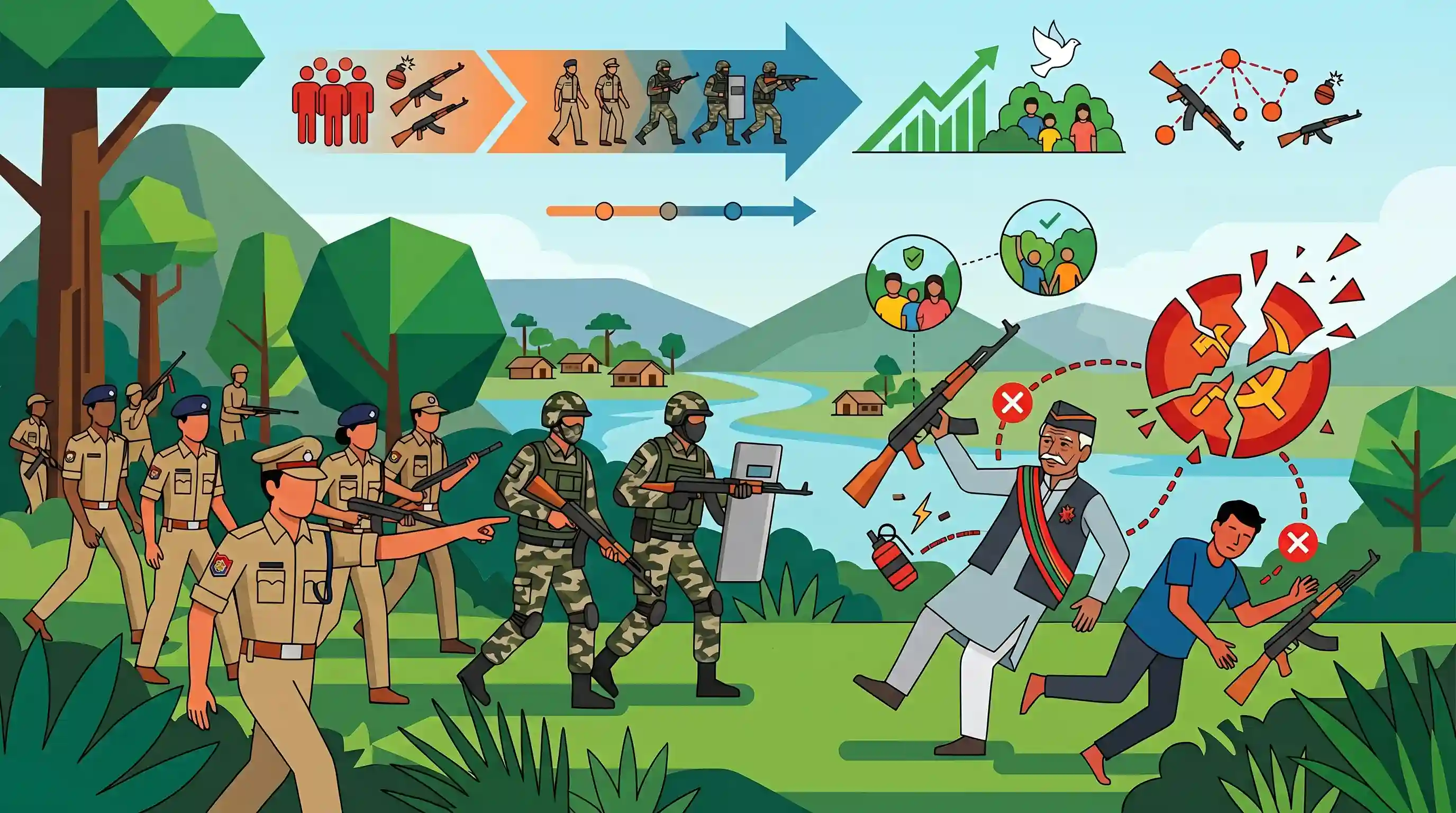
Why It Matters
The elimination of key Maoist leaders by security forces is vital for mitigating Left-Wing Extremism (LWE), a persistent internal security threat. It underscores the ongoing state efforts to restore law and order, which is a prerequisite for holistic socio-economic development in LWE-affected areas.
Summary
An anti-Maoist operation in Jharkhand's Latehar district led by a joint team of local police and CRPF personnel resulted in the killing of two Maoists. The deceased included Pappu Lohra, the chief of the Jharkhand Jan Mukti Parishad (JJMP)—a splinter group of the banned CPI(Maoist)—and his associate Prabhat Ghanju. This encounter is a significant milestone in curbing Left-Wing Extremism (LWE) in the state, potentially weakening the operational capabilities of extremist outfits in the region.
Key Points
- Two Maoists were killed in an encounter with security forces in Latehar district, Jharkhand.
- The deceased included Pappu Lohra (alias Suryadev Lohra), the self-styled supremo of the Jharkhand Jan Mukti Parishad (JJMP), a splinter group of the CPI(Maoist).
- The other Maoist killed was identified as Prabhat Ghanju.
- The joint operation was carried out by a team comprising local police and CRPF personnel.
- The operation marks a significant success for internal security forces aiming to dismantle Left-Wing Extremism (LWE) networks in the region.
Important Terms
Left-Wing Extremism (LWE)

Insurgency by far-left groups like Naxalites using violence to challenge state authority, primarily rooted in socio-economic grievances, tribal alienation, and land disputes in central/eastern India.
UPSC context
GS Paper III: Internal Security; focuses on the link between development deficits and the spread of extremism.
CPI(Maoist)
A banned far-left militant organization formed in 2004. It aims to overthrow the Indian state through "Protracted People's War" and is designated as a terrorist group under UAPA.
UPSC context
GS Paper III: Internal Security; tests knowledge of major non-state actors and their ideological challenges to the state.
Central Reserve Police Force (CRPF)
India's largest Central Armed Police Force (CAPF) under the Ministry of Home Affairs, serving as the lead agency for counter-insurgency operations in LWE-affected regions.
UPSC context
GS Paper III: Security Forces; focuses on the mandate and role of CAPFs in internal security.
Jharkhand Jan Mukti Parishad (JJMP)
A splinter group of the CPI(Maoist) active in Jharkhand. Such factions often complicate security through intra-militant turf wars, local extortion, and parallel governance attempts.
UPSC context
GS Paper III: Internal Security; illustrates the fragmentation of extremist groups and localized security dynamics.
SAMADHAN Doctrine
The Ministry of Home Affairs' comprehensive multi-pronged strategy to combat LWE, standing for Smart leadership, Aggressive strategy, Motivation, Actionable intelligence, Dashboard-based KPIs, Harnessing technology, Action plans, and No financing.
UPSC context
GS Paper III: Internal Security; evaluates government policies and strategic frameworks to tackle internal disturbances.
Jharkhand Police
The state's primary law enforcement agency that conducts joint operations with central forces like CRPF and CoBRA to neutralize extremist threats in difficult terrain.
UPSC context
GS Paper III: Security Forces; tests the coordination between state police and central agencies in federal security.
Prelims Trap
Left-Wing Extremism is solely orchestrated by a unified CPI (Maoist) central command.
The LWE landscape is highly fragmented. Splinter groups like JJMP and PLFI operate independently, often engaging in inter-group rivalries over extortion ("levy") that complicate state security efforts.
Static Concepts Connected
What is the SAMADHAN doctrine used to combat LWE?
- Smart Leadership: Emphasizes dynamic, proactive leadership and an aggressive operational strategy by security forces.
- Actionable Intelligence: Focuses on localized, intelligence-led joint operations between central paramilitary forces (CRPF) and state police.
- Harnessing Technology: Leverages drones, satellite mapping, and advanced communication tools for area domination and tracking.
- Choking Finances: Aims to systematically deny extremist networks access to extortion money ("levy") and illicit funding.
What geographical and administrative factors fuel LWE in the Red Corridor?
- Terrain Advantage: Dense forests (like those in Latehar/Saranda) and rugged topographies provide natural sanctuaries for guerrilla tactics.
- Governance Deficit: Inadequate implementation of PESA (1996) and the Forest Rights Act (2006) deepens systemic tribal alienation.
- Resource Exploitation: Displacement due to mining and infrastructure projects without adequate rehabilitation breeds severe local resentment.
Cross-Topic Patterns
LWE & Governance Deficits (Polity)
Security operations in Schedule V areas are deeply linked to the historical failure of PESA and FRA, making tribal land alienation a core driver of extremist recruitment.
Infrastructure as a Security Tool
Anti-Maoist strategies increasingly blend kinetic operations with the Road Requirement Plan and Mobile Tower Projects to establish permanent state administrative presence in remote forested areas.

Mains 2026: Expect a question on how LWE fragmentation into splinter groups (like JJMP) complicates intelligence & state security ops.
Linked PYQs · 2
Linked PYQs · 2
- 2022MainsGS3
Naxalism is a social, economic and developmental issue manifesting as a violent internal security threat. In this context, discuss the emerging issues and suggest a multilayered strategy to tackle the menace of Naxalism.
- 2020MainsGS3
What are the determinants of left-wing extremism in Eastern part of India? What strategy should Government of India, civil administration and security forces adopt to counter the threat in the affected areas?
