Security forces neutralize Maoist commander in Jharkhand encounter
Source:The Hindu ↗
Why It Matters
Provides a concrete, recent example of security forces' operations against Left Wing Extremism (LWE) splinter groups, highly relevant for illustrating points in GS-3 Internal Security answers regarding the state's ongoing efforts to eliminate LWE by 2026.
Summary
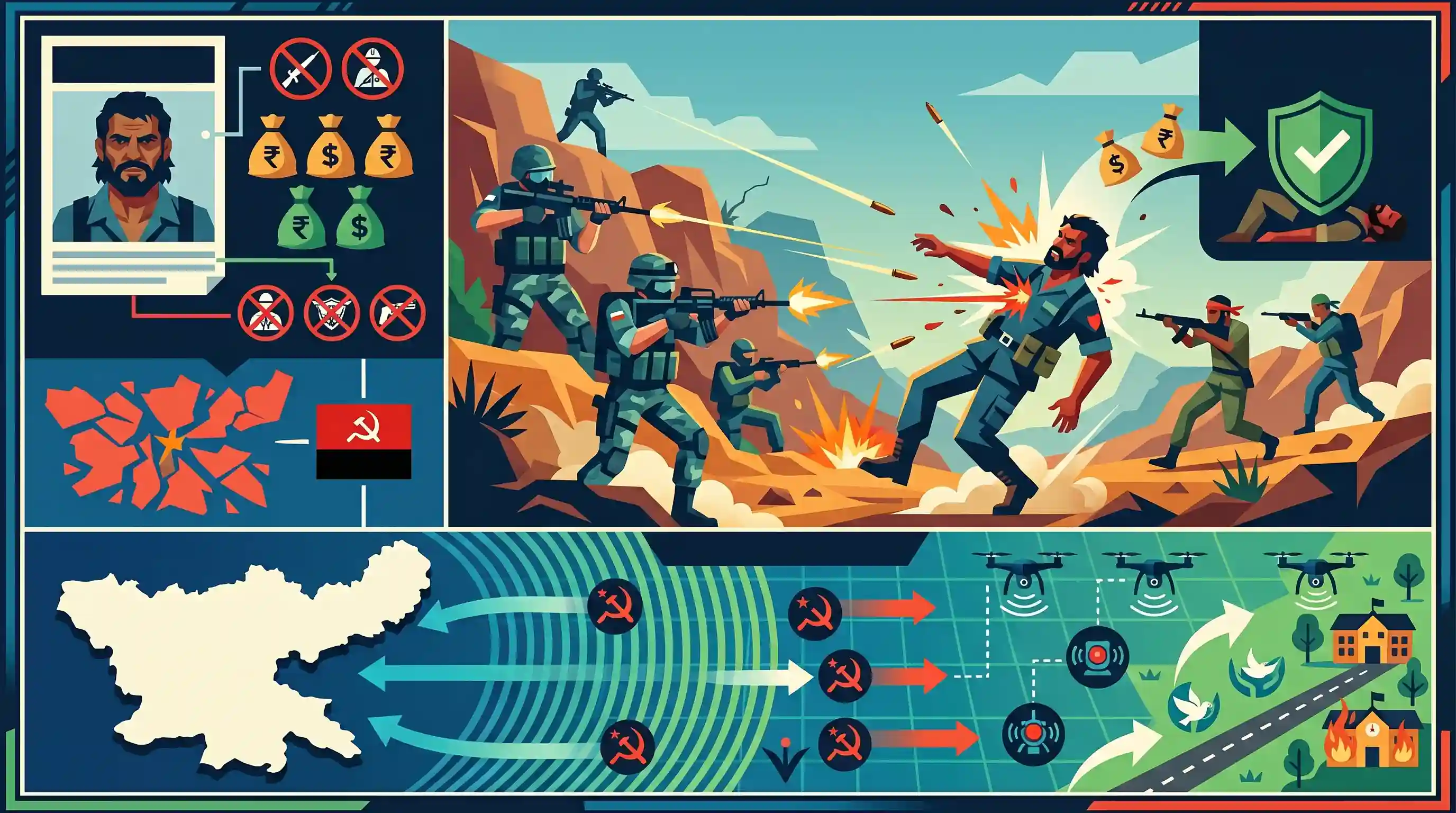
A wanted commander of the Maoist splinter group Tritiya Sammelan Prastuti Committee (TSPC), Mukhdev Yadav, was killed in a gunfight with security forces in the Palamu district of Jharkhand. Yadav, who carried a ₹5 lakh reward, was implicated in the recent killings of security personnel. The encounter is part of ongoing, targeted security operations aimed at neutralizing remaining Left Wing Extremism (LWE) elements and splinter factions in the region, reflecting the state's continued push to eliminate the LWE menace.
Key Points
- A self-styled commander of the Tritiya Sammelan Prastuti Committee (TSPC), a Maoist splinter group, was killed in an encounter with security forces in Jharkhand's Palamu district.
- The deceased, Mukhdev Yadav, carried a ₹5 lakh bounty and was allegedly involved in the recent murder of two security personnel.
- The gunfight demonstrates ongoing kinetic operations by security forces to neutralize remaining Left Wing Extremism (LWE) threats and splinter factions in the region.
Important Terms
Left Wing Extremism (LWE)

An armed insurgency against the State motivated by Maoist ideologies, aiming to overthrow parliamentary democracy through violent revolution to establish a communist society.
UPSC context
GS Paper 3: Internal Security. Tests understanding of the origins, status, and challenges of India's gravest internal security threat.
Tritiya Sammelan Prastuti Committee (TSPC)
A Maoist splinter group active in Jharkhand that broke away from the parent MCCI/CPI (Maoist) in 2002, primarily over caste-based internal leadership disputes.
UPSC context
GS Paper 3: Internal Security. Tests knowledge of extremist group fragmentation and its impact on localized security and extortion networks.
Splinter Group
A smaller faction that separates from a larger organization due to ideological, operational, or leadership disagreements, often leading to violent inter-group rivalries.
UPSC context
GS Paper 3: Internal Security. Tests comprehension of group dynamics, factionalism, and the 'divide and rule' challenges in counter-insurgency.
SAMADHAN Framework
The comprehensive multi-pronged strategy launched by the Ministry of Home Affairs in 2017 to combat LWE through leadership, technology, intelligence, and financial restriction.
UPSC context
GS Paper 3: Internal Security. Tests knowledge of the government's specific operational and developmental initiatives to neutralize Maoist threats.
Red Corridor
The geographic region in eastern and central India affected by Naxalite-Maoist violence, typically characterized by dense forests, tribal populations, and a development-security deficit.
UPSC context
GS Paper 3: Internal Security. Tests the geographical and socio-economic mapping of domestic extremist activities in India.
Internal Security
The act of maintaining peace and the rule of law within a country's borders by defending against domestic threats like insurgency and terrorism.
UPSC context
GS Paper 3 Core Topic. Tests the ability to analyze linkages between development and extremism and state-actor roles.
Prelims Trap
"Jharkhand Jaguar and Greyhounds are centrally sponsored schemes for big cat and canine conservation."
These are actually specialized anti-Naxal/LWE commando forces raised by the Jharkhand and Andhra Pradesh state police respectively, not ecological or wildlife initiatives.
Static Concepts Connected
What is the SAMADHAN doctrine in India's internal security strategy?
- Origin: Launched by the Ministry of Home Affairs in 2017 as a comprehensive, multi-pronged strategy to combat Left Wing Extremism (LWE).
- Core Pillars: Stands for Smart Leadership, Aggressive Strategy, Motivation/Training, Actionable Intelligence, Dashboard KPIs, Harnessing Technology, Action plans, and No access to financing.
- Operational Shift: Mandates a shift to aggressive, intelligence-based kinetic operations by security forces while choking extremist funding and accelerating local development.
Cross-Topic Patterns
Ideological Extremism to Organized Crime
Splinter LWE factions like TSPC and PLFI increasingly act as local extortion cartels. This bridges the GS3 Extremism syllabus directly with 'Linkages of Organized Crime with Terrorism'.
Resource Curse and the Red Corridor
The overlap between India's critical mineral belts (Jharkhand, Chhattisgarh) and LWE presence highlights the 'resource curse', tribal alienation, and developmental deficit themes recurring in both GS2 and GS3.

With the March 2026 target to eliminate LWE, expect a GS-3 Mains question analyzing its transition from ideology to extortion mafias.
Linked PYQs · 4
Linked PYQs · 4
- 2025MainsGS3
The Government of India recently stated that Left Wing Extremism (LWE) will be eliminated by 2026. What do you understand by LWE and how are the people affected by it? What measures have been taken by the government to eliminate LWE?
- 2022MainsGS3
Naxalism is a social, economic and developmental issue manifesting as a violent internal security threat. In this context, discuss the emerging issues and suggest a multilayered strategy to tackle the menace of Naxalism.
- 2020MainsGS3
What are the determinants of left-wing extremism in Eastern part of India? What strategy should Government of India, civil administration and security forces adopt to counter the threat in the affected areas?
- 2018MainsGS3
Left Wing Extremism (LWE) is showing a downward trend, but still affects many parts of the country. Briefly explain the Government of India's approach to counter the challenges posed by LWE.
