Bijapur Encounter and Surrenders in Left Wing Extremism Strategy
Source:The Hindu ↗
Why It Matters
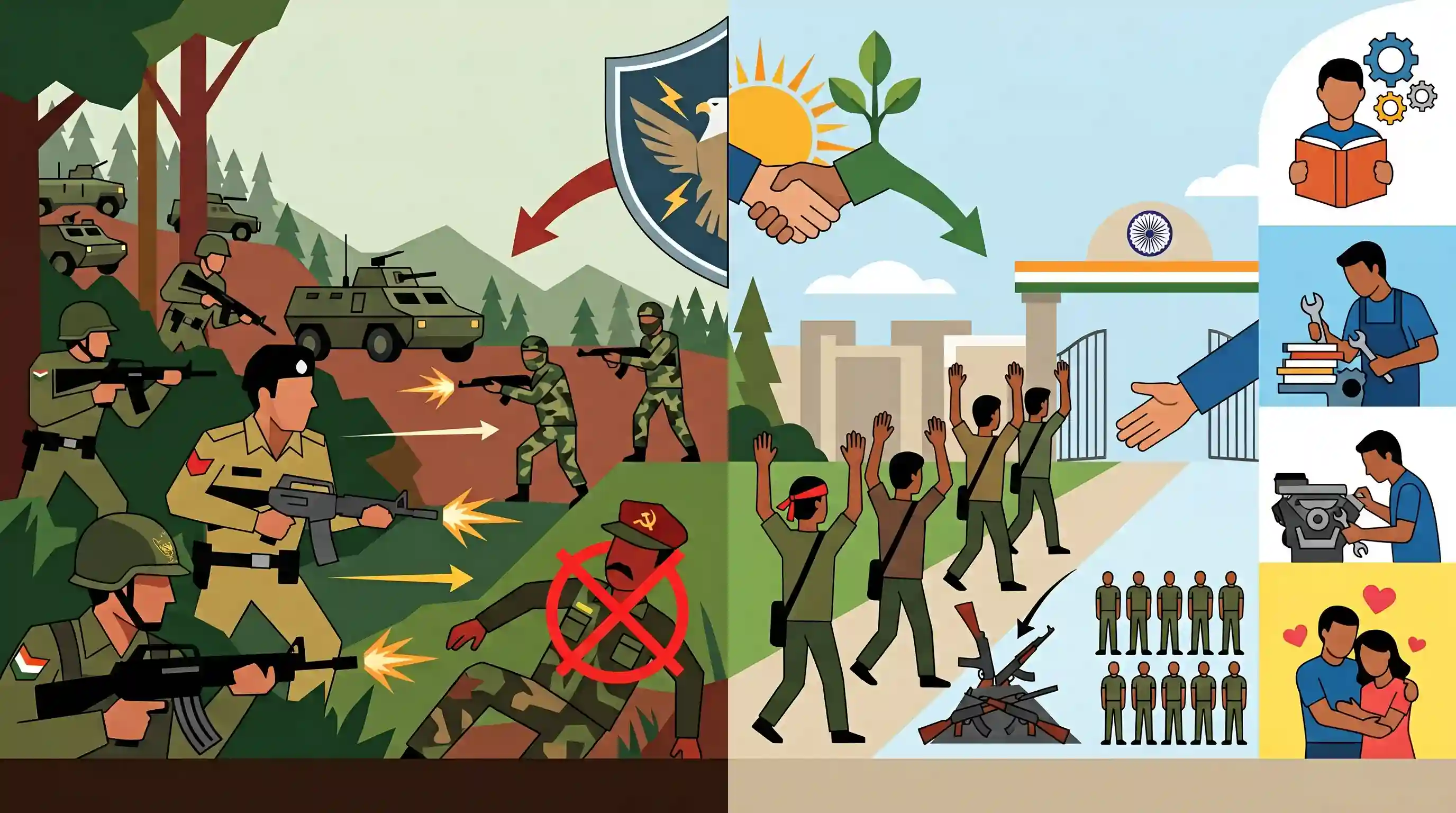
Left-Wing Extremism remains a critical internal security challenge for India. This development illustrates the practical application of the government's dual-track approach—combining forceful operations by specialized units with policies encouraging surrender and rehabilitation—which is highly relevant for GS Paper 3.
Summary
A senior Maoist leader was killed in a joint security operation by the District Reserve Guards (DRG) and CoBRA forces in Chhattisgarh's Bijapur district. Alongside the kinetic operation, 12 Maoist cadres surrendered to the authorities under the official rehabilitation and surrender policy of the state and central governments. The events highlight India's continued two-pronged strategy to combat Left-Wing Extremism (LWE) through tactical neutralization and societal reintegration.
Key Points
- A senior CPI (Maoist) leader, Udham Singh, carrying a ₹8 lakh reward, was killed in an encounter with security forces in Bijapur, Chhattisgarh.
- The successful operation was jointly executed by the District Reserve Guards (DRG) and CoBRA personnel based on specific intelligence.
- Concurrently, 12 Maoist cadres with a combined reward of ₹54 lakh surrendered to authorities in Bijapur.
- The surrenders were facilitated by the joint rehabilitation and surrender policy of the Chhattisgarh government and the Government of India aimed at mainstreaming extremists.
Important Terms
Communist Party of India (Maoist)

A major banned far-left extremist organization formed in 2004. It aims to overthrow the Indian state through armed insurgency and "Protracted People’s War," following Maoist ideology.
UPSC context
GS Paper 3 (Internal Security); tests knowledge of the primary organizational threat behind Left-Wing Extremism in India.
District Reserve Guards (DRG)
A specialized unit of the Chhattisgarh Police primarily comprising local tribal youth and surrendered Maoists. They leverage "son of the soil" terrain knowledge for anti-Naxal operations.
UPSC context
GS Paper 3 (Security Forces); assesses understanding of state-level specialized forces and the importance of local intelligence in counter-insurgency.
CoBRA (Commando Battalion for Resolute Action)
An elite specialized unit of the Central Reserve Police Force (CRPF) trained in guerrilla tactics and jungle warfare. It is the premier central force for combating Maoist insurgents.
UPSC context
GS Paper 3 (Role of Security Forces); key for questions on the mandate and capabilities of Central Armed Police Forces (CAPFs).
Rehabilitation and Surrender Policy
A government framework providing financial aid, vocational training, and legal incentives to insurgents who renounce violence. It aims to deplete Maoist cadres by facilitating their societal reintegration.
UPSC context
GS Paper 3 (Internal Security - LWE); evaluates the "soft-power" and developmental components of the government's multi-pronged anti-insurgency strategy.
Left-Wing Extremism (LWE)
An internal security challenge involving armed insurgency by Maoist/Naxalite groups against the Indian state. It is rooted in socio-economic grievances and aims to replace democracy with a communist system.
UPSC context
GS Paper 3 (Challenges to Internal Security); a core syllabus topic regarding the link between development and the spread of extremism.
Prelims Trap
CoBRA and the District Reserve Guard (DRG) are both specialized units under the Central Armed Police Forces (CAPFs).
DRG is a specialized anti-Naxal unit of the Chhattisgarh State Police, whereas CoBRA is a specialized jungle warfare unit of the Central Reserve Police Force (CRPF).
Static Concepts Connected
What is India's multi-pronged strategy to tackle Left-Wing Extremism?
- SAMADHAN Doctrine: An overarching strategy focusing on Smart leadership, Aggressive strategy, Actionable intelligence, Technology utilization, and choking off terror financing to holistically counter LWE.
- Development Initiatives: Implementation of Special Central Assistance (SCA), Road Requirement Plan (RRP), and LWE Mobile Tower Project to bridge acute infrastructure deficits in affected zones.
- Security Force Upgradation: Reimbursing states for security-related expenditure (SRE scheme) and heavily deploying specialized CAPF units like CoBRA for intelligence-based kinetic operations.
What are the core features of the central Surrender-cum-Rehabilitation scheme for LWE?
- Financial Grant: Higher rank cadres receive ₹5 lakh and middle/lower ranks receive ₹2.5 lakh, kept in a fixed deposit for 3 years subject to good behavior.
- Skill Development: A monthly stipend of ₹6,000 is provided for up to 36 months alongside vocational training to facilitate socio-economic integration and prevent recidivism.
- Weapons Incentive: Additional specific cash incentives are provided for surrendering functional weapons, ammunition, and IEDs.
Cross-Topic Patterns
LWE overlap with Fifth Schedule areas
Resource extraction and land alienation in Fifth Schedule tribal areas provide ideological fuel for Maoists, directly linking Forest Rights Act deficits (Polity/Governance) to Internal Security challenges.
Salwa Judum to DRG evolution
Unlike the unconstitutional civilian militia 'Salwa Judum' (banned by the Supreme Court), the District Reserve Guard formalized local tribal recruitment directly into the legitimate state police framework.

With the Govt's March 2026 LWE elimination target, expect a mains Q evaluating the shift from kinetic ops to socio-economic integration.
Linked PYQs · 3
Linked PYQs · 3
- 2022MainsGS3
Naxalism is a social, economic and developmental issue manifesting as a violent internal security threat. In this context, discuss the emerging issues and suggest a multilayered strategy to tackle the menace of Naxalism.
- 2020MainsGS3
What are the determinants of left-wing extremism in Eastern part of India? What strategy should Government of India, civil administration and security forces adopt to counter the threat in the affected areas?
- 2018MainsGS3
Left Wing Extremism (LWE) is showing a downward trend, but still affects many parts of the country. Briefly explain the Government of India's approach to counter the challenges posed by LWE.
