Government assessment on decline of Left Wing Extremism in India
Source:The Hindu ↗
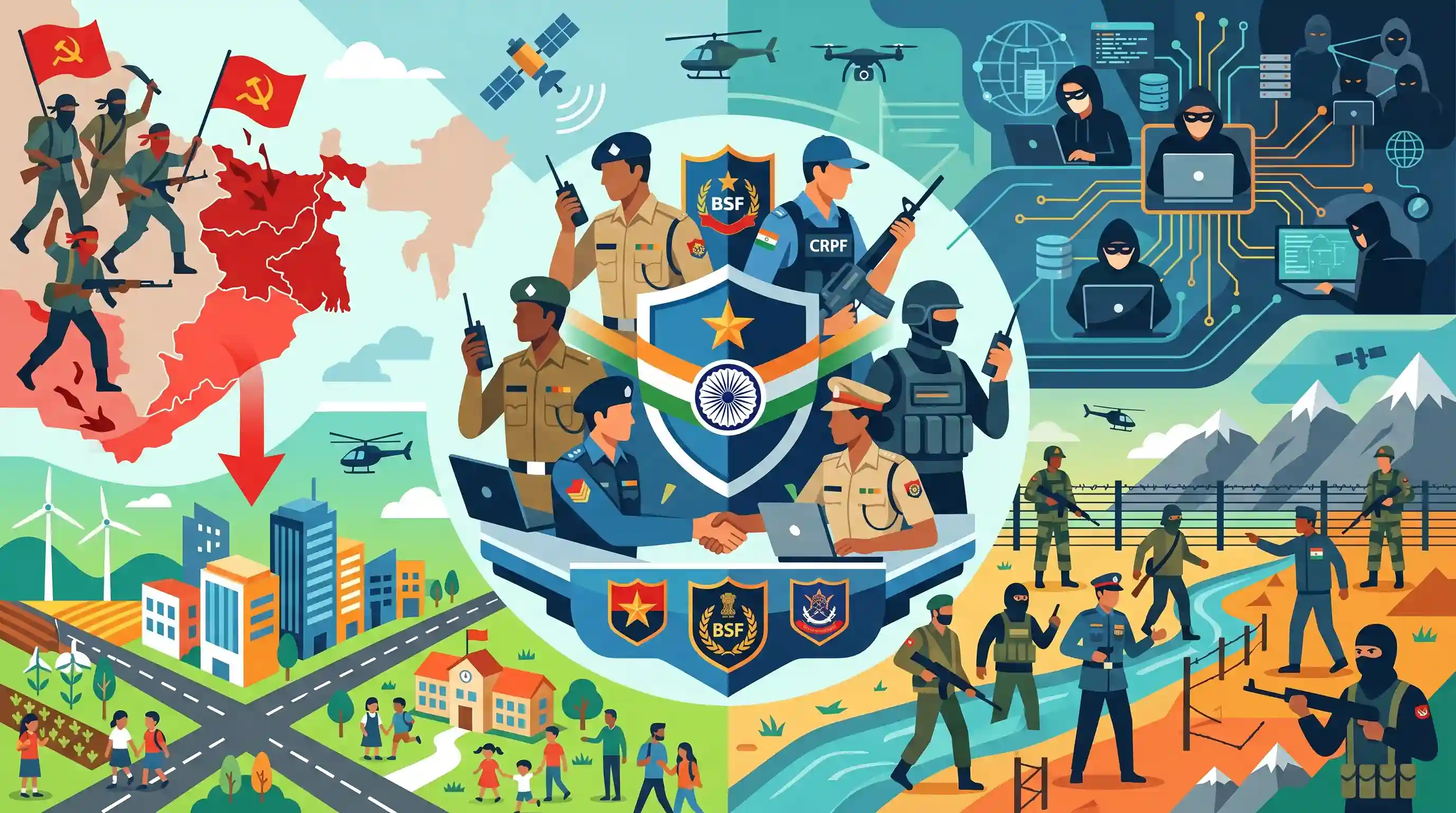
Why It Matters
The article provides a high-level government assessment of India's internal security landscape. It highlights the successful containment of Left Wing Extremism (LWE) and identifies evolving threats such as organised crime, border instability, and complex terrorism. This is highly relevant for GS3 Internal Security, where candidates must evaluate the state's strategies, successes against Naxalism, and preparedness for emerging security challenges.
Summary
Speaking on Police Commemoration Day, Union Defence Minister Rajnath Singh declared that Left Wing Extremism (Maoism) is nearing its end in India, with affected districts reducing significantly and the 'Red Corridor' transitioning into a growth hub. He commended the coordinated efforts of central and local security forces for this success. However, he also cautioned against emerging internal security threats, noting that modern crimes have become more organised, invisible, and complex, alongside persistent challenges like border instability and terrorism.
Key Points
- Union Defence Minister Rajnath Singh announced that Maoism (Left Wing Extremism) is in its final stages, with a drastic reduction in affected districts.
- The so-called 'Red Corridor' is transforming into a growth and educational corridor due to the surrender of top Naxalites and ongoing development efforts.
- He commended the coordinated efforts of the CRPF, BSF, and state police on Police Commemoration Day.
- Modern security threats were highlighted, including crime becoming more organised, invisible, and complex, aimed at creating societal chaos.
- Ongoing internal security challenges include border instability, new types of crime, terrorism, and ideological wars.
Important Terms
Left Wing Extremism (LWE)

A socio-political and security challenge involving ideology-driven armed rebellion (Maoism/Naxalism) against the state, primarily in central and eastern India, aiming to overthrow the government through 'protracted people's war'.
UPSC context
GS Paper III: Internal Security. Tests understanding of non-state actors, developmental deficits, and state response strategies like Operation SAMADHAN.
Central Reserve Police Force (CRPF)
India’s largest Central Armed Police Force (CAPF) under the Ministry of Home Affairs, functioning as the primary force for counter-insurgency, anti-Naxal operations, and maintaining internal law and order.
UPSC context
GS Paper III: Security forces and their mandates. Crucial for understanding internal security architecture and specialized units like CoBRA.
Red Corridor
Term used to describe the contiguous region in central and eastern India (e.g., Chhattisgarh, Jharkhand, Odisha) significantly affected by Maoist insurgency; now shrinking due to intensified security and development efforts.
UPSC context
GS Paper III: Internal Security management. Relevant for mapping security challenges and evaluating the success of counter-insurgency policies.
Intelligence Bureau (IB)
India’s premier internal intelligence agency under the Ministry of Home Affairs, responsible for gathering domestic intelligence on counter-terrorism, counter-insurgency, and maintaining internal security through proactive threat assessment.
UPSC context
GS Paper III: Security agencies and their mandate. Vital for studying the role of intelligence in preventing internal conflicts and terrorism.
Border Security Force (BSF)
India’s 'First Line of Defence,' a CAPF primarily guarding borders with Pakistan and Bangladesh, but also deployed for internal security duties and Anti-Naxal Operations in specific affected zones.
UPSC context
GS Paper III: Security forces and their mandates. Relevant for border management and its intersection with internal security tasks.
Police Commemoration Day
Annual observance on October 21st to honor policemen who died in the line of duty; it commemorates the 10 personnel killed during a 1959 ambush by Chinese troops in Ladakh.
UPSC context
General Studies/Prelims: Recognition of sacrifices in security services and the historical context of India-China border tensions (1959 Hot Springs incident).
Prelims Trap
"Police Commemoration Day marks the sacrifice of forces during domestic anti-terror operations."
It actually commemorates the October 21, 1959 ambush at Hot Springs, Ladakh, where 10 CRPF personnel were martyred by Chinese troops.
Static Concepts Connected
What is the SAMADHAN doctrine for Left Wing Extremism?
- Core Strategy: The Ministry of Home Affairs' 2017 comprehensive, multi-pronged strategy to eliminate Naxalism in India.
- Key Pillars: Includes Smart leadership, Aggressive strategy, Actionable intelligence, Dashboard-based KPIs, Harnessing technology, and No access to financing.
- Timebound Target: The official target set by the Union Government is the complete elimination of LWE by March 2026.
What are the primary mandates of India's key Central Armed Police Forces (CAPFs)?
- CRPF: India's lead internal security force, extensively deployed for counter-insurgency and anti-Naxal operations (includes the specialized CoBRA battalion).
- BSF: Primarily deployed to guard India's international borders with Pakistan and Bangladesh, though occasionally requisitioned for internal law and order.
- ITBP: Created post the 1962 war, it is specifically tasked with guarding the high-altitude Indo-Tibetan (China) border.
Cross-Topic Patterns
LWE and Aspirational Districts Programme
The rapid shrinking of the Red Corridor closely mirrors targeted infrastructure and governance interventions under the Aspirational Districts Programme, showcasing a security-development nexus.
Terror-Crime-Cyber Nexus
The Defence Minister's warning on 'invisible' crimes highlights the modern convergence of traditional extremism with dark web financing, crypto-laundering, and transnational organized crime.

Expect a 2026 GS3 Mains question evaluating the SAMADHAN doctrine's success in replacing the Red Corridor with a growth corridor.
Linked PYQs · 5
Linked PYQs · 5
- 2022MainsGS3
Naxalism is a social, economic and developmental issue manifesting as a violent internal security threat. In this context, discuss the emerging issues and suggest a multilayered strategy to tackle the menace of Naxalism.
- 2022MainsGS3
Discuss the types of organised crimes. Describe the linkages between terrorists and organised crime that exist at the national and transnational levels.
- 2023MainsGS3
What are the internal security challenges being faced by India? Give out the role of Central Intelligence and Investigative Agencies tasked to counter such threats.
- 2020MainsGS3
Analyze internal security threats and transborder crimes along Myanmar, Bangladesh and Pakistan borders including Line of Control (LoC). Also discuss the role played by various security forces in this regard.
- 2021MainsGS3
Analyse the complexity and intensity of terrorism, its causes, linkages and obnoxious nexus. Also suggest measures required to be taken to eradicate the menace of terrorism.
