Occupational Hazards and Regulatory Lapses in Fireworks Units
Source:The Hindu ↗
Why It Matters
The incident serves as a critical case study for UPSC aspirants regarding man-made disasters, industrial safety regulations, and the vulnerability of workers in informal hazardous sectors. It highlights the practical importance of pre-disaster risk assessment, adherence to safety frameworks, and the broader socio-economic impacts of industrial negligence.
Summary
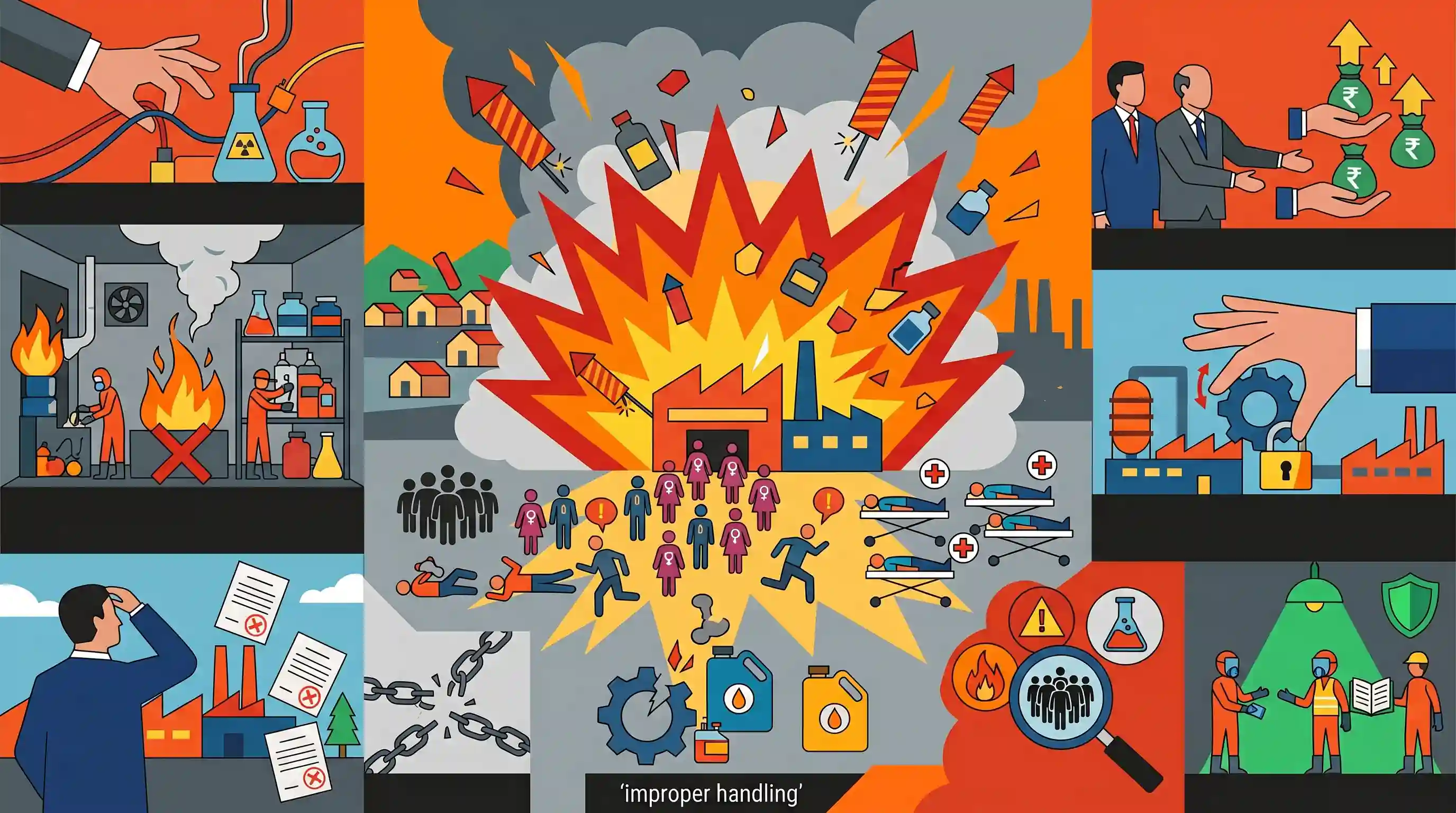
A devastating explosion at a firecracker manufacturing unit in Vetlapalem village, Kakinada district (Andhra Pradesh), resulted in the deaths of 20 workers, including 9 women, and left 9 others critically injured. The blast, likely triggered by improper handling of explosive chemicals, highlights the acute vulnerability of workers in hazardous, poorly regulated industries. Prompting widespread condolences and a ₹20 lakh ex gratia from the state government, the incident exposes severe lapses in occupational safety, disaster preparedness, and industrial compliance, necessitating robust risk assessment and stringent regulatory oversight.
Key Points
- A massive explosion at a firecracker manufacturing unit in Vetlapalem village, Kakinada district, killed at least 20 workers, including 9 women, and injured 9 others.
- The incident is suspected to have been caused by the unsafe handling of explosive chemicals during peak seasonal production.
- The Andhra Pradesh government announced an ex gratia of ₹20 lakh for the families of the deceased, alongside promises of free medical care for the injured.
- The tragedy underscores systemic failures in enforcing occupational safety standards, risk assessment protocols, and regulatory oversight in hazardous industries.
- Authorities have arrested the unit owner, prompting calls for stricter enforcement of the Explosives Act and improved disaster mitigation strategies for informal industrial setups.
Important Terms
Ex-gratia Payment

A voluntary, goodwill-based payment made by a government or authority without any legal obligation, typically to provide immediate relief following tragedies or disasters.
UPSC context
GS Paper II/III (Governance/Disaster Management); tests understanding of administrative relief mechanisms vs. legal compensation.
Industrial Disaster
An unplanned event in an industrial setting, such as a chemical leak or factory blast, resulting in life, property, or environmental loss due to safety or regulatory failures.
UPSC context
GS Paper III (Disaster Management); requires knowledge of risk mitigation and institutional frameworks like NDMA.
Occupational Safety, Health and Working Conditions Code, 2020
A 2020 legislation consolidating 13 central labor laws to simplify safety, health, and working conditions across various sectors and industries.
UPSC context
GS Paper III (Economy/Industrial Growth); crucial for questions on labor reforms and worker welfare.
Factories Act, 1948
The primary legislation in India regulating safety, health, and welfare of workers in factories, including specific provisions for hazardous processes.
UPSC context
GS Paper III (Industrial Policy); tests historical regulatory frameworks and their modern enforcement challenges.
Explosives Act, 1884
A colonial-era law, along with its 2008 Rules, that regulates the manufacture, possession, use, sale, transport, and import of explosive substances, including firecrackers.
UPSC context
GS Paper III (Internal Security/Disaster Management); relevant for regulation of hazardous materials and industrial safety.
Government General Hospital (GGH)
State-run tertiary healthcare facilities in India that serve as primary centers for casualty management, emergency care, and post-mortem during large-scale disasters.
UPSC context
GS Paper II (Social Justice/Health); highlights the role of public health infrastructure in disaster response.
Prelims Trap
"Licensing and safety regulation of firecracker units are directly administered by the Ministry of Labour or NDMA."
PESO, operating under DPIIT (Ministry of Commerce and Industry), is the actual statutory authority responsible for the Explosives Act and safety licenses, not Labour or NDMA.
Static Concepts Connected
What is the Petroleum and Explosives Safety Organisation (PESO)?
- Nodal Ministry: Operates under DPIIT, Ministry of Commerce and Industry, not the Ministry of Labour or Home Affairs.
- Statutory Role: Administers the Explosives Act, 1884, and Petroleum Act, 1934 to regulate hazardous substances across India.
- Core Function: Grants safety licenses for manufacturing, storage, and transport of explosives, compressed gases, and petroleum products.
How does the OSH Code, 2020 address hazardous industries?
- Universal Applicability: Extends mandatory safety standards to any establishment carrying out hazardous activities, regardless of its size or the number of workers employed.
- Employer Obligations: Mandates rigorous risk assessments, free annual health checkups, and strict compliance with safety limits by the employers.
Cross-Topic Patterns
Constitutional DPSPs and hazardous labour
Disproportionate mortality of female workers in informal hazardous units highlights systemic failures to enforce Article 42 (just and humane work conditions) and Article 39(e) of the Directive Principles.
NDMA guidelines + urban buffer zones
NDMA mandates strict land-use policies to establish 'buffer zones' around hazardous units, a protocol frequently violated by informal, seasonal firecracker setups creeping into residential spaces.

Expect a 2026 Prelims question testing PESO's nodal ministry (DPIIT) and the OSH Code's applicability to unorganized hazardous sectors.
Linked PYQs · 3
Linked PYQs · 3
- 2019MainsGS3
Vulnerability is an essential element for defining disaster impacts and its threat to people. How and in what ways can vulnerability to disasters be characterized? Discuss different types of vulnerability with reference to disasters.
- 2013MainsGS3
How important are vulnerability and risk assessment for pre-disaster management ? As an administrator, what are key areas that you would focus on in a Disaster Management System.
- 2024MainsGS3
What is disaster resilience? How is it determined? Describe various elements of a resilience framework. Also mention the global targets of Sendai Framework for Disaster Risk Reduction (2015–2030).
