Danish Firms Shift From China to Prefer India for Investments
Source:The Hindu ↗
Why It Matters
The article illustrates the tangible effects of global supply chain realignment (China Plus One) and highlights India's competitive advantages over Southeast Asian peers. It provides contemporary examples of FDI inflows into manufacturing and green energy, which are highly relevant for GS3 answers concerning economic growth, infrastructure, and climate finance.
Summary
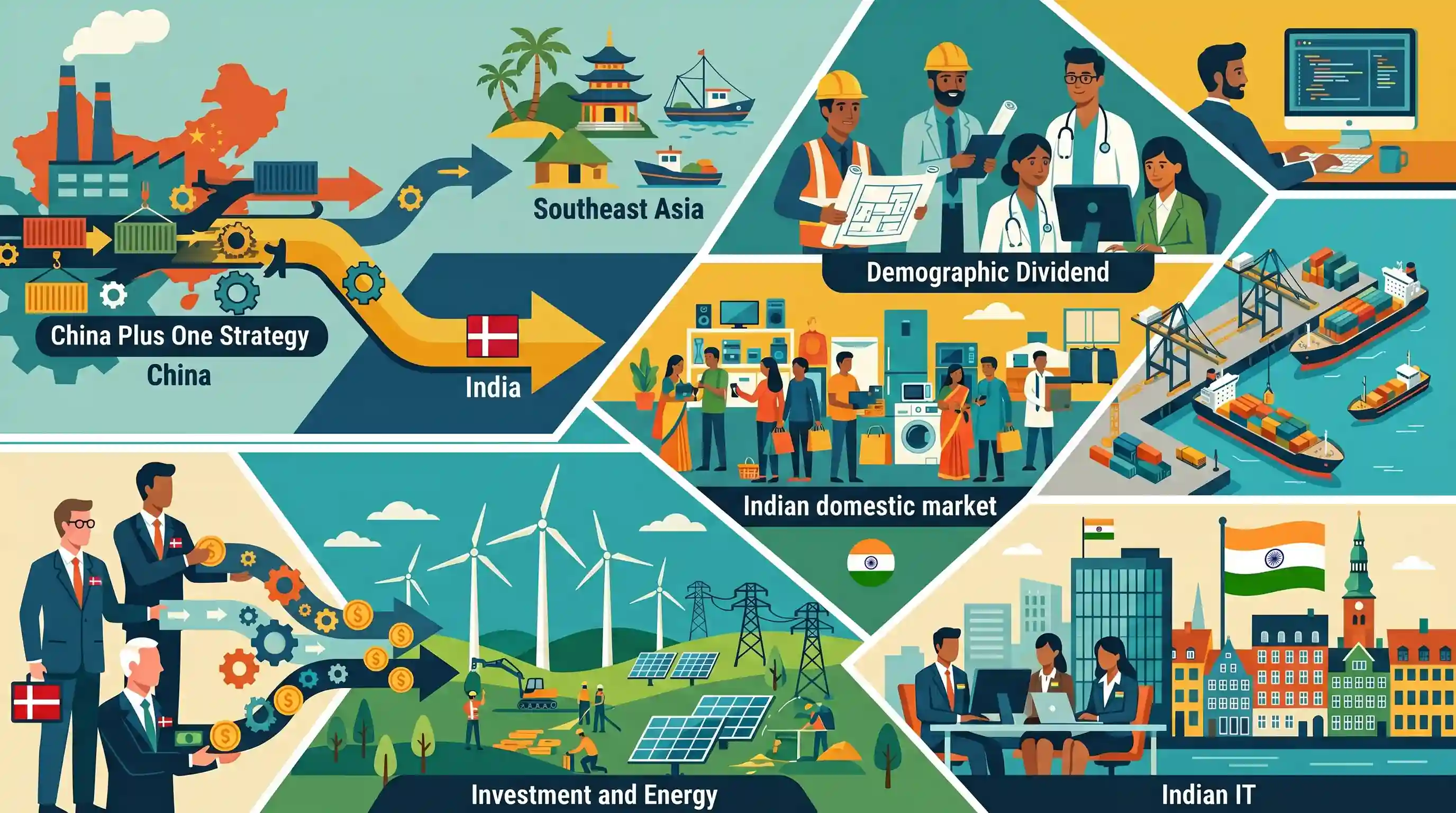
Danish companies are increasingly choosing India over Southeast Asian nations as their preferred destination under the 'China Plus One' strategy, driven by India's skilled talent pool, large domestic market, and export hub potential. Bilateral economic engagement is also deepening, characterized by significant Danish institutional investments in India's renewable energy sector and Indian IT firms using Denmark as a gateway to Northern Europe.
Key Points
- Danish firms adopting a 'China Plus One' strategy prefer India over Southeast Asian competitors like Vietnam, Thailand, and the Philippines.
- India attracts foreign companies through a 'compelling trinity': a vast talent pool (especially in engineering, IT, and HR), a growing local consumer market, and its potential as an export hub.
- Indian IT majors such as TCS, LTI Mindtree, and HCL Tech are utilizing Denmark as a strategic gateway for expansion into Northern Europe.
- Danish pension funds and institutions are channeling hundreds of millions of dollars into India's solar and onshore wind sectors, reflecting confidence in the market's returns and security.
- Danish corporations like Danfoss are increasing direct investments in Indian manufacturing and supply chain activities.
Important Terms
China Plus One Strategy

A global business diversification approach where companies reduce over-reliance on Chinese supply chains by establishing additional manufacturing and sourcing bases in alternative countries like India.
UPSC context
GS3 (Economy/Supply Chain Resilience). Tests understanding of global manufacturing shifts and India's emerging role as a supply chain alternative.
Copenhagen Infrastructure Partners (CIP)
The world's largest fund manager for greenfield renewable energy investments. It partners with Indian firms to develop large-scale wind and solar projects under the India-Denmark Green Strategic Partnership.
UPSC context
GS3 (Environment/Energy/Economy). Crucial for renewable energy targets and climate finance through bilateral cooperation.
Impact Fund Denmark
Denmark's government-owned development finance institution (formerly IFU) providing risk capital for sustainable projects. India has become its top global investment destination, primarily in green energy and infrastructure.
UPSC context
GS3 (Economy/FDI). Highlights the role of development finance and institutional investment in bilateral economic relations.
India Denmark Chamber of Commerce
An institutional bridge established in New Delhi (2026) to provide a structured platform for Danish companies to navigate the Indian market and facilitate trade-investment partnerships.
UPSC context
GS2 (International Relations). Exemplifies formal institutional mechanisms used to strengthen bilateral economic ties.
Danfoss
A Danish multinational specializing in energy-efficient cooling and heating solutions. Its Chennai-based Oragadam campus is a global benchmark for 'Make in India' and sustainable manufacturing.
UPSC context
GS3 (Economy/Manufacturing/Climate Change). Represents the integration of energy efficiency and industrial manufacturing in Indo-Danish ties.
TCS (Tata Consultancy Services)
India's largest IT services firm; it represents the service-sector dimension of bilateral ties, using Denmark as a strategic gateway for expansion into Northern Europe and the Nordic region.
UPSC context
GS3 (Economy/Services Sector). Tests knowledge of Indian outbound investment and service exports to Europe.
Prelims Trap
"India's 'Green Strategic Partnership' is a comprehensive bilateral framework established with the European Union."
Aspirants often confuse European climate agreements. India signed its first-ever 'Green Strategic Partnership' specifically with Denmark in 2020, not with the broader EU block.
Static Concepts Connected
What is the 'China Plus One' strategy in global trade?
- Core Meaning: A multinational business strategy to avoid investing exclusively in China and diversify manufacturing operations into other developing countries.
- Key Drivers: Driven by rising Chinese labor costs, geopolitical tensions, zero-COVID disruptions, and the strategic need for long-term supply chain resilience.
- Primary Beneficiaries: India, Vietnam, Thailand, and Mexico are prime beneficiaries, competing to attract relocated FDI through tax incentives and infrastructure boosts.
How does the PLI Scheme support supply chain relocation to India?
- Financial Incentive: Provides direct financial subsidies based on incremental sales from products manufactured domestically, helping offset the initial capital costs of factory relocation.
- Sectoral Focus: Targets 14 strategic sectors, including solar PV modules, electronics, and pharmaceuticals, aiming to integrate India into high-value global supply chains.
Cross-Topic Patterns
Pension Funds & Green Infrastructure
Danish pension funds investing heavily in Indian solar/wind highlights a broader trend: patient capital prioritizing stable yields and ESG mandates in emerging market green infrastructure.
Nordic Diplomacy & Services Export
Bilateral ties go beyond climate. Indian IT firms using Denmark as a gateway shows how diplomatic frameworks facilitate high-value service exports and digital integration into Northern Europe.

Supply chain relocation (China+1) combined with bilateral green frameworks (India-Denmark) is highly probable as a 2026 GS2/GS3 Mains Q.
Linked PYQs · 4
Linked PYQs · 4
- 2025MainsGS3
Discuss the rationale of the Production Linked Incentive (PLI) scheme. What are its achievements? In what way can the functioning and outcomes of the scheme be improved?
- 2023MainsGS3
Faster economic growth requires increased share of the manufacturing sector in GDP, particularly of MSMEs. Comment on the present policies of the Government in this regard.
- 2022MainsGS3
Do you think India will meet 50 percent of its energy needs from renewable energy by 2030 ? Justify your answer. How will the shift of subsidies from fossil fuels to renewables help achieve the above objective ? Explain.
- 2017MainsGS3
Account for the failure of manufacturing sector in achieving the goal of labour-intensive exports. Suggest measures for more labour-intensive rather than capital-intensive exports.
