PLI Scheme Bottlenecks in Renewable Energy Manufacturing
Source:The Hindu ↗
Why It Matters
The article highlights critical bottlenecks in India's transition to green energy and domestic manufacturing capabilities under Atmanirbhar Bharat. It exposes structural challenges in the PLI scheme concerning high-tech manufacturing, stressing the importance of technical know-how, technology transfer, and realistic policy targets for achieving the 500 GW renewable energy goal by 2030.
Summary
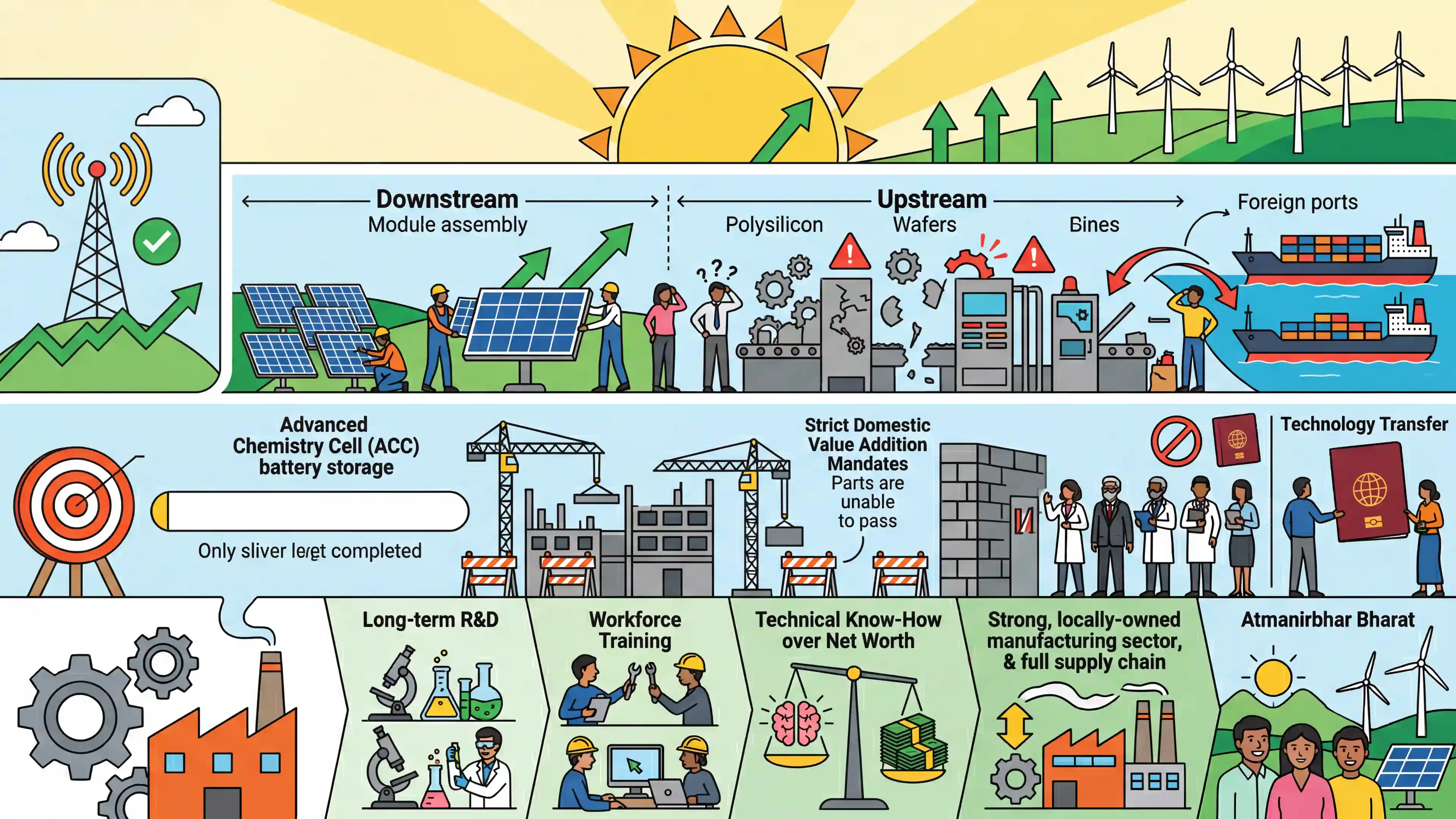
India's ambitious target of achieving 500 GW of non-fossil fuel capacity by 2030 relies heavily on Production Linked Incentive (PLI) schemes. However, while telecom PLIs succeeded, those for solar photovoltaics and advanced chemistry cell (ACC) battery storage face severe implementation hurdles. Despite robust downstream module assembly, the upstream segments like polysilicon and wafer manufacturing lag significantly due to reliance on imports and a lack of technical expertise. Similarly, ACC battery manufacturing has commissioned only 2.8% of its 50 GWh target, hindered by strict domestic value addition mandates, challenges in gigafactory construction, and visa issues for Chinese experts. The editorial argues that mere capital support is insufficient for high-tech manufacturing, emphasizing the need for long-term R&D, workforce training, and prioritizing technical know-how over net worth in PLI contract allocations.
Key Points
- India relies on Production Linked Incentive (PLI) schemes to achieve its 500 GW non-fossil fuel capacity target by 2030.
- While downstream solar module assembly is robust, critical upstream segments like polysilicon and wafer manufacturing are lagging significantly at just 14% and 10% of their respective targets.
- The PLI scheme for advanced chemistry cell (ACC) battery storage (₹18,000 crore outlay for 50 GWh) has been sluggish, with only 2.8% capacity commissioned by late 2025.
- Bottlenecks include stringent domestic value addition mandates, the immense technical barriers of gigafactory construction, and visa denials for Chinese technical experts.
- The editorial suggests that long-term R&D and prioritizing technical know-how over net worth are more critical than mere capital support for high-tech manufacturing.
Important Terms
Production Linked Incentive (PLI) Scheme

A performance-linked strategy providing 4-6% financial incentives on incremental sales of domestically manufactured goods across 14 strategic sectors to boost exports and self-reliance.
UPSC context
GS Paper 3: Industrial Policy and Growth. Tests understanding of manufacturing incentives and import substitution strategies.
Advanced Chemistry Cell (ACC) Battery Storage
High-performance battery technologies (e.g., Lithium-ion) with superior energy density and cycle life, critical for electric vehicles and grid-scale energy storage systems.
UPSC context
GS Paper 3: Infrastructure and Energy. Tests knowledge of the EV ecosystem and technology indigenization.
Non-Fossil Fuel Capacity Target (500 GW)
India's COP26 commitment to install 500 GW of power from non-fossil sources (solar, wind, hydro, nuclear) by 2030, aligning with its Net Zero 2070 goal.
UPSC context
GS Paper 3: Environment and Climate Change. Tests awareness of Nationally Determined Contributions (NDCs) and renewable targets.
Domestic Value Addition (DVA)
The percentage of a product's value created within India using local materials, labor, and design, distinguishing deep manufacturing from simple "screw-driver" assembly.
UPSC context
GS Paper 3: Manufacturing Sector. Tests the qualitative success of 'Make in India' and global value chain integration.
Upstream Solar Manufacturing
The capital-intensive, high-tech stages of the solar value chain—specifically polysilicon, ingot, and wafer production—currently characterized by high import dependency on China.
UPSC context
GS Paper 3: Energy Security. Tests knowledge of supply chain bottlenecks and technical hurdles in renewable energy.
Polysilicon and Wafers
The primary raw materials for solar cells; polysilicon is refined from silica, then melted into ingots and sliced into paper-thin wafers.
UPSC context
GS Paper 3: Science & Technology. Tests technical understanding of solar PV technology and industrial raw materials.
Gigafactory
Massive manufacturing facilities designed for high-volume production of batteries or high-tech components, requiring specialized expertise, huge capital, and reliable power.
UPSC context
GS Paper 3: Infrastructure. Tests familiarity with modern industrial terminology and large-scale manufacturing challenges.
Prelims Trap
India has achieved complete self-sufficiency in upstream solar components like polysilicon and wafers under the PLI scheme.
While India excels in downstream module assembly, it remains heavily import-dependent for upstream polysilicon and wafers, severely missing its PLI targets.
Static Concepts Connected
What are the core criteria for companies to receive PLI incentives?
- Incremental Sales: Incentives are given strictly on the incremental sales of goods manufactured domestically over a fixed base year.
- Domestic Value Addition: Certain high-tech sectors, such as ACC batteries, mandate a minimum percentage of localized sourcing to ensure supply chain deepening.
- Capex Thresholds: Firms must commit to and execute minimum threshold investments within a stipulated timeframe to qualify.
What distinguishes Advanced Chemistry Cell (ACC) batteries from traditional energy storage?
- Energy Density: ACCs (like Lithium-ion) store significantly more energy per unit weight and volume, making them crucial for EVs.
- Cycle Life: They offer vastly superior charge/discharge cycles without degrading quickly compared to traditional lead-acid equivalents.
- Mineral Dependency: Manufacturing ACCs relies heavily on critical minerals like lithium, cobalt, and nickel, necessitating complex global supply chains.
Cross-Topic Patterns
Atmanirbhar Bharat vs China Tech Reality
Visa denials for Chinese technical experts reveal the tension between India's geopolitical decoupling strategy and its practical reliance on Chinese know-how for building advanced green gigafactories.
ACC Batteries + Critical Minerals Strategy
The slow rollout of ACC battery gigafactories intersects directly with India's foreign policy push (via KABIL) to secure lithium and cobalt blocks abroad to feed domestic manufacturing.

Expect a 2026 multi-statement question linking ACC battery and solar upstream bottlenecks with PLI Domestic Value Addition (DVA) rules.
Linked PYQs · 5
Linked PYQs · 5
- 2025MainsGS3
Discuss the rationale of the Production Linked Incentive (PLI) scheme. What are its achievements? In what way can the functioning and outcomes of the scheme be improved?
- 2023MainsGS3
Faster economic growth requires increased share of the manufacturing sector in GDP, particularly of MSMEs. Comment on the present policies of the Government in this regard.
- 2022MainsGS3
Do you think India will meet 50 percent of its energy needs from renewable energy by 2030 ? Justify your answer. How will the shift of subsidies from fossil fuels to renewables help achieve the above objective ? Explain.
- 2016MainsGS3
Give an account of the current status and the targets to be achieved pertaining to renewable energy sources in the country. Discuss in brief the importance of National Programme on Light Emitting Diodes (LEDs).
- 2024PrelimsGS1
Consider the following: 1. Battery storage 2. Biomass generators 3. Fuel cells 4. Rooftop solar photovoltaic units How many of the above are considered "Distributed Energy Resources"?
