Supreme Court guidelines on AI use and fake citations in tribunals
Source:The Hindu ↗
Why It Matters
This article is highly relevant for GS2 (Judicial Reforms & Accountability, Tribunals) and GS3/GS4 (Ethics of AI & S&T governance). It provides a concrete case study of how AI hallucinations can cause a 'miscarriage of justice' and explains the regulatory boundary between AI as an assistive tool versus a decision-making tool.
Summary
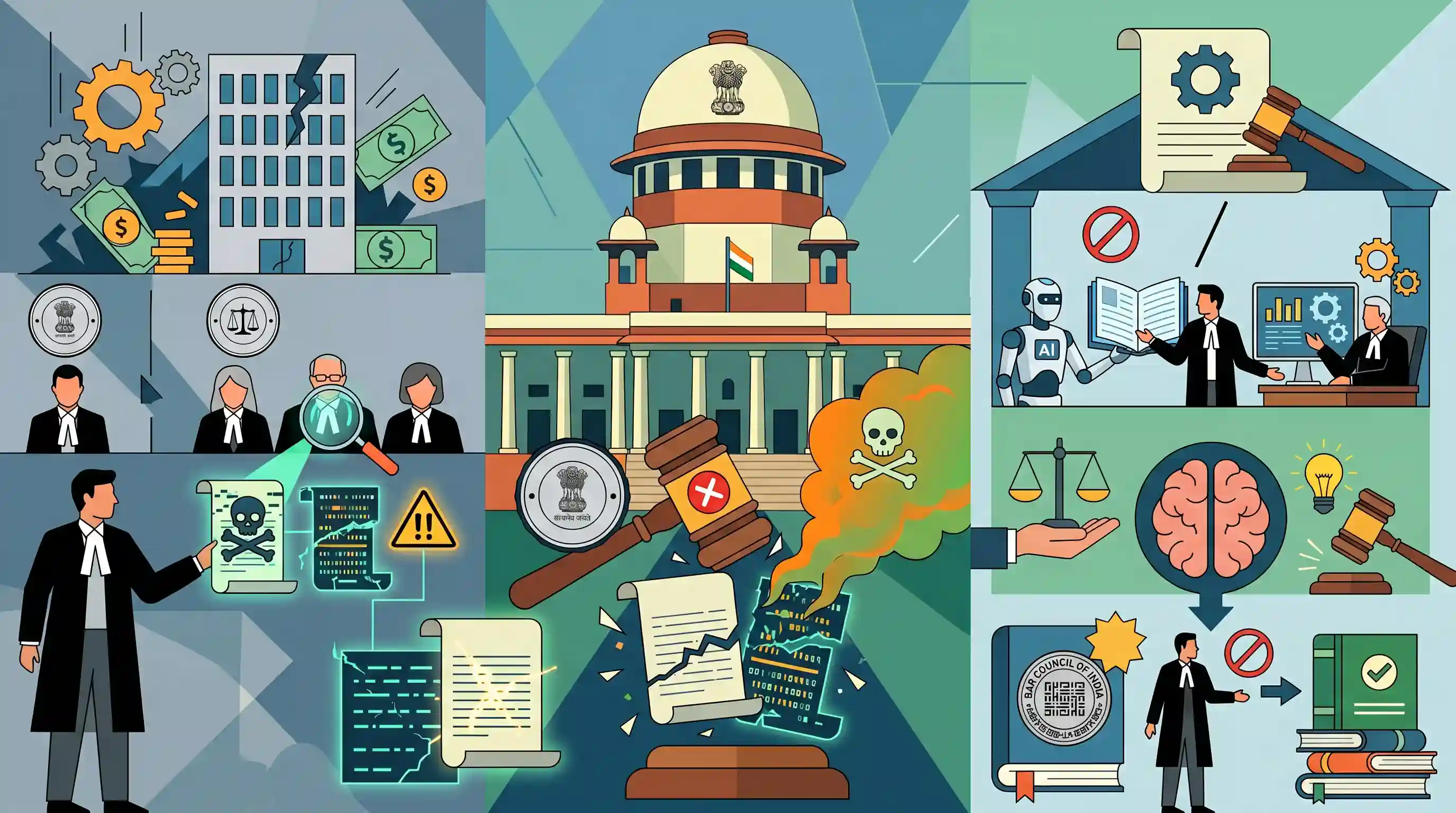
The article highlights the Supreme Court's critical caution against the use of Artificial Intelligence (AI) hallucinations and fake legal citations in India's judicial system. In an insolvency case, the Supreme Court set aside orders of the NCLT and NCLAT due to reliance on fictitious AI-generated case laws. Likening AI hallucinations to the deadly 'methyl isocyanate' gas of the Bhopal tragedy, the court ruled that presenting fabricated, machine-generated judgments constitutes professional misconduct. Under the draft 'Regulations for Use of Artificial Intelligence (AI) in Courts, 2026', AI is barred from direct judicial decision-making (adjudication, sentencing, etc.), emphasizing that AI can only assist but never replace human reasoning, judicial discretion, or professional accountability. Furthermore, the Bar Council of India has been directed to frame strict norms for lawyers using unverified AI materials.
Key Points
- The Supreme Court of India likened AI-generated hallucinations and fake citations in court proceedings to 'methyl isocyanate'—describing them as 'invisible, insidious, and catastrophic by the time anyone notices.'
- The Court set aside orders of the NCLT and NCLAT in an insolvency case after finding that the tribunal had relied on fictitious, AI-generated legal citations, a lapse that was overlooked by the appellate tribunal.
- Relying on or presenting AI-fabricated case laws has been defined by the Court as professional misconduct for advocates and a serious lapse of duty or 'judicial misconduct' for judges, rather than a mere error in decision-making.
- The Court emphasized that AI must only serve as an assistive tool to improve efficiency and can never replace independent human reasoning, judicial discretion, or professional accountability.
- The draft 'Regulations for Use of Artificial Intelligence (AI) in Courts, 2026' explicitly prohibits the use of AI in delivering actual judicial outcomes (such as adjudication, sentencing, deciding bail eligibility, and evaluating witness credibility).
- The Bar Council of India (BCI) has been directed to form a dedicated committee to establish strict norms and disciplinary guidelines for lawyers who submit unverified AI-generated citations.
Important Terms
Regulations for Use of Artificial Intelligence (AI) in Courts, 2026 (Draft)

A draft regulatory framework released by the Supreme Court of India's AI Committee to govern AI deployment in courts under the principle of 'human primacy', barring AI from independent judicial adjudication or sentencing.
UPSC context
GS Paper II (Judiciary & Governance) and GS III (Science & Tech); tests judicial reforms, tech integration, and ethical AI regulation.
National Company Law Tribunal (NCLT)
A specialized quasi-judicial body established under Section 408 of the Companies Act, 2013, to adjudicate corporate disputes, amalgamation schemes, and corporate insolvency resolution processes under the Insolvency and Bankruptcy Code.
UPSC context
GS Paper II (Polity & Statutory Bodies) and GS III (Economy); tests tribunalization, corporate governance, and insolvency resolution mechanisms.
National Company Law Appellate Tribunal (NCLAT)
A quasi-judicial appellate authority constituted under Section 410 of the Companies Act, 2013, to hear appeals against decisions made by the NCLT, IBBI, and Competition Commission of India.
UPSC context
GS Paper II (Statutory & Quasi-Judicial Bodies); tests hierarchy of corporate dispute resolution, administrative tribunals, and company law.
Bar Council of India (BCI)
A statutory body created under the Advocates Act, 1961, that regulates the legal profession and legal education in India, setting standards of professional conduct, etiquette, and disciplinary procedures for advocates.
UPSC context
GS Paper II (Statutory Bodies & Judicial Administration); tests regulation of legal practice, professional ethics, and institutional governance.
Supreme Court of India
The apex judicial body in India established under Article 124 of the Constitution, serving as the ultimate court of appeal, guardian of the Constitution, and protector of fundamental rights.
UPSC context
GS Paper II (Polity & Constitution); tests judicial powers, appellate jurisdiction, judicial activism, and judicial administration reforms.
Prelims Trap
The draft Regulations for Use of AI in Courts, 2026, allow AI-driven risk-scoring systems for determining bail eligibility if supervised by a judge.
The draft regulations explicitly prohibit using AI for risk-scoring for bail, recidivism, or evaluating witness credibility, asserting absolute human primacy in matters affecting personal liberty.
Static Concepts Connected
What is the statutory mandate and role of the Bar Council of India (BCI)?
- Statutory origin: Established under the Advocates Act, 1961, as a representative and regulatory body for legal practitioners.
- Disciplinary powers: Formulates standards of professional conduct and etiquette, exercising disciplinary control over misconduct.
- Legal education: Promotes and sets standards for legal education in India, granting recognition to universities.
Which constitutional provisions empower court rule-making and administration in India?
- Article 145: Empowers the Supreme Court to frame rules regulating its practice and procedure, subject to parliamentary law.
- Article 227: Grants High Courts power of superintendence over all subordinate courts and tribunals in their jurisdiction.
- Article 141: Declares that the Supreme Court's judgments are binding precedents on all courts within India.
Cross-Topic Patterns
AI ethics + Judicial bias
Algorithmic transparency in courts links GS-II (Judiciary) with GS-IV (Tech Ethics), highlighting how 'black-box' systems threaten the constitutional right to a reasoned trial.
Insolvency timeline + Tech bottlenecks
Setting aside NCLT/NCLAT decisions due to AI hallucinations demonstrates how unverified technology can delay corporate resolution timelines under the Insolvency and Bankruptcy Code.

Mains 2026 is likely to contrast India's 'human primacy' judicial AI regulations with global models on ethical guardrails for state tech.
Linked PYQs · 3
Linked PYQs · 3
- 2024MainsGS4
The application of Artificial Intelligence as a dependable source of input for administrative rational decision-making is a debatable issue. Critically examine the statement from the ethical point of view.
- 2025MainsGS2
Comment on the need of administrative tribunals as compared to the court system. Assess the impact of the recent tribunal reforms through rationalization of tribunals made in 2021.
- 2023MainsGS2
e-governance, as a critical tool of governance, has ushered in effectiveness, transparency and accountability in governments. What inadequacies hamper the enhancement of these features ?
