Fast Breeder Reactor Criticality and Digital Census Initiatives
Source:The Hindu ↗
Why It Matters
The criticality of the Fast Breeder Reactor proves India's self-reliance in advanced nuclear technology, essential for long-term energy security. The digital Census 2027 represents a major leap in e-governance, enhancing the efficiency and accuracy of massive demographic data collection.
Summary
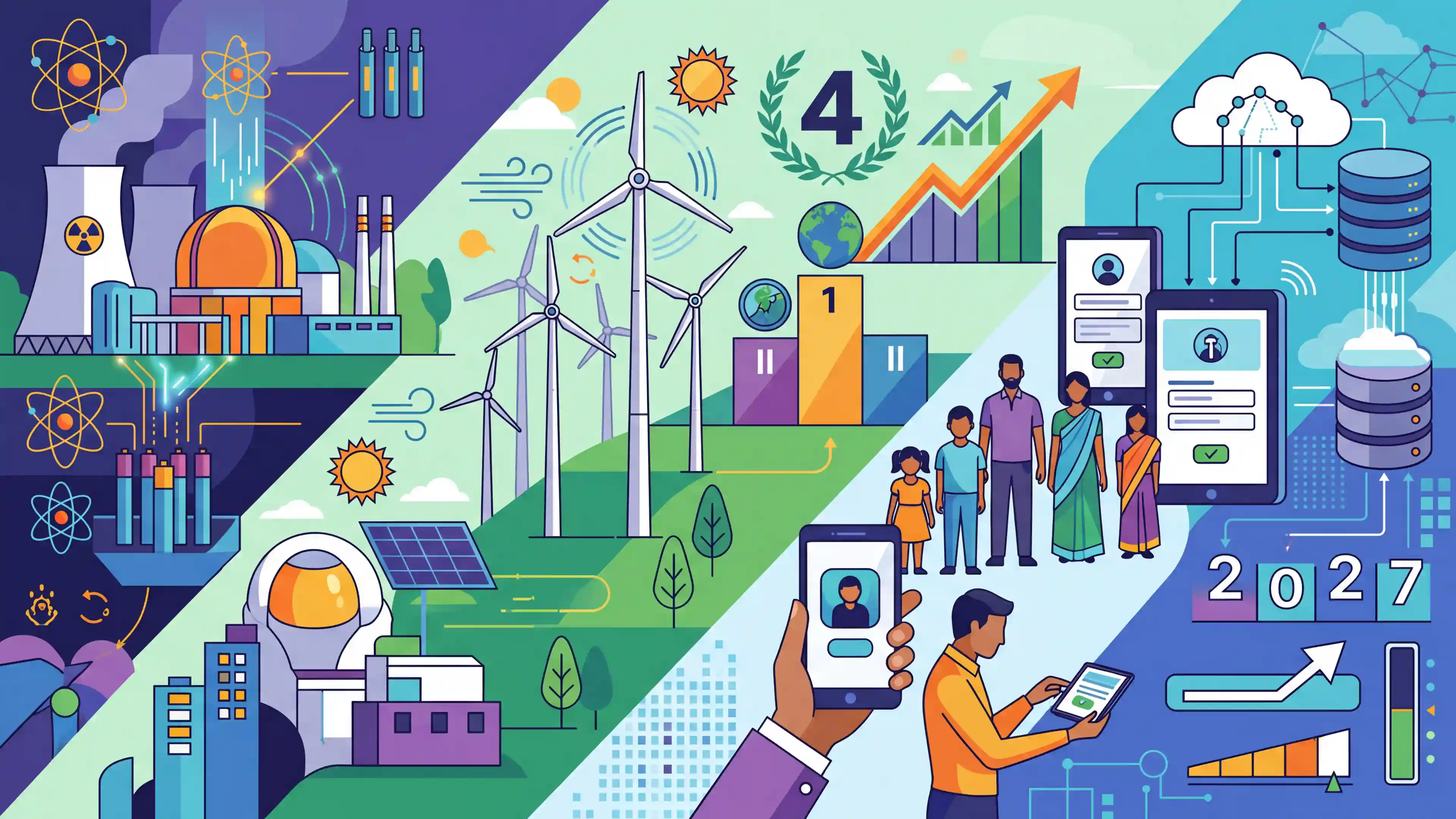
Prime Minister Narendra Modi’s "Mann ki Baat" address highlighted key milestones in India's technological and administrative landscape. He announced the criticality of the indigenous Fast Breeder Reactor in Kalpakkam, a crucial advancement for India's nuclear energy security. He also underscored the nation's progress in renewable energy, noting that India now ranks 4th globally in wind energy with a capacity exceeding 56 GW. Additionally, the PM discussed the upcoming Census 2027, detailing its transition into the world's largest digital enumeration process, which will include app-based data collection and a novel self-enumeration feature for citizens.
Key Points
- India's Fast Breeder Reactor (FBR) in Kalpakkam, built with indigenous technology, achieved criticality, marking a vital step in the nation's three-stage nuclear program.
- India's wind energy capacity has surpassed 56 GW, securing the 4th position globally, driven by states like Gujarat, Tamil Nadu, Maharashtra, and Rajasthan.
- Census 2027 will be the world's largest digital enumeration, featuring mobile app-based data collection and a self-enumeration option for citizens.
Important Terms
Census 2027

The 16th decennial census and India's first fully digital enumeration. It includes mobile app-based data collection, a self-enumeration facility, and the first comprehensive caste enumeration in independent India.
UPSC context
GS Paper I (Population/Demography) and GS Paper II (Governance). Tests knowledge of administrative reforms, data privacy, and demographic trends.
Prototype Fast Breeder Reactor (PFBR)
An indigenously developed 500 MWe reactor at Kalpakkam, Tamil Nadu, that produces more fissile material than it consumes. It reached criticality in April 2026, making India the second country to operate one commercially.
UPSC context
GS Paper III (Science & Tech/Energy). Critical for questions on India's energy security and indigenous technological milestones.
Three-Stage Nuclear Power Program
A roadmap for India’s energy independence using its vast thorium reserves. Stage 1 uses natural uranium; Stage 2 (current) uses plutonium in FBRs; Stage 3 will use thorium.
UPSC context
GS Paper III (Energy). Core syllabus topic regarding India’s unique strategy for long-term nuclear energy self-reliance.
Criticality
A milestone in nuclear physics where a reactor achieves a self-sustaining fission chain reaction. It signifies the transition of a reactor from construction to its operational phase.
UPSC context
GS Paper III (Science). Basic scientific concept frequently tested in the context of India's nuclear achievements.
Self-Enumeration
A digital feature of Census 2027 allowing citizens to voluntarily fill their demographic details via a secure portal 15 days before an enumerator's physical visit.
UPSC context
GS Paper II (E-Governance). Tests understanding of digital public infrastructure and citizen-centric governance initiatives.
India's Wind Energy Capacity
India's cumulative wind power reached 56.1 GW in 2026, ranking 4th globally. This was boosted by a record 6.1 GW addition in the 2025-26 financial year.
UPSC context
GS Paper III (Environment/Energy). Relevant for targets under the Paris Agreement and India’s goal of 500 GW non-fossil capacity by 2030.
Mann ki Baat
The Prime Minister’s monthly radio program serves as a platform for direct communication with citizens, highlighting grassroots innovations, social initiatives, and national achievements.
UPSC context
GS Paper II (Governance). Can be cited in essays or GS II as a tool for public engagement and behavior change communication.
Prelims Trap
"The Kalpakkam Fast Breeder Reactor uses Thorium to generate electricity."
Kalpakkam's PFBR represents Stage II, which uses Mixed Oxide (MOX - Plutonium + Uranium) fuel. Thorium utilization only happens in Stage III.
Static Concepts Connected
What are the three stages of India's nuclear power program?
- Stage I: Pressurized Heavy Water Reactors (PHWRs) use natural Uranium to produce electricity and Plutonium-239.
- Stage II: Fast Breeder Reactors (FBRs) use Plutonium-239 and Uranium-238 to generate power and breed more Plutonium than they consume.
- Stage III: Advanced Heavy Water Reactors (AHWRs) will eventually use Thorium-232 and Uranium-233 to generate power.
What is the legal and constitutional backing for the Indian Census?
- Constitutional backing: Article 246 establishes the Census as a Union subject (Entry 69 in the Union List of the Seventh Schedule).
- Statutory backing: The exercise is legally governed and conducted under the provisions of the Census Act, 1948.
- Nodal Authority: Executed by the Office of the Registrar General and Census Commissioner, under the Ministry of Home Affairs.
Cross-Topic Patterns
Nuclear Security + Monazite Reserves
The operationalization of Stage II FBRs is the prerequisite gateway to unlocking India's massive monazite-derived Thorium reserves (Stage III), geographically linking nuclear security to the Eastern coastal sands.
E-Governance + Demographic enumeration
Moving from paper to a centralized Census Management System mirrors the broader Digital India push, tying critical constitutional demographic exercises directly into India's evolving Digital Public Infrastructure (DPI) framework.

India's 3-stage nuclear fuel cycle (Uranium to Plutonium to Thorium) and FBR mechanics are prime targets for a 2026 Science & Tech MCQ.
Linked PYQs · 4
Linked PYQs · 4
- 2023PrelimsGS1
Consider the following statements: Statement-I: India, despite having uranium deposits, depends on coal for most of its electricity production. Statement-II: Uranium, enriched to the extent of at least 60%, is required for the production of electricity. Which one of the following is correct in respect of the above statements?
- 2016PrelimsGS1
India is an important member of the 'International Thermonuclear Experimental Reactor'. If this experiment succeeds, what is the immediate advantage for India?
- 2022PrelimsGS1
Consider the following statements: 1. Gujarat has the largest solar park in India. 2. Kerala has a fully solar powered International Airport. 3. Goa has the largest floating solar photovoltaic project in India. Which of the statements given above is/are correct?
- 2024MainsGS1
What is the concept of a 'demographic winter'? Is the world moving towards such a situation? Elaborate.
