Commemoration of Vande Mataram and Grassroots Conservation Efforts
Source:Indian Express ↗
Why It Matters
The article highlights key historical milestones (150 years of Vande Mataram and Sardar Patel's birth anniversary) that are directly relevant to Modern Indian History and Post-Independence Consolidation. It also touches upon grassroots environmental conservation efforts, making it highly relevant for Prelims and Mains GS1 and GS3.
Summary
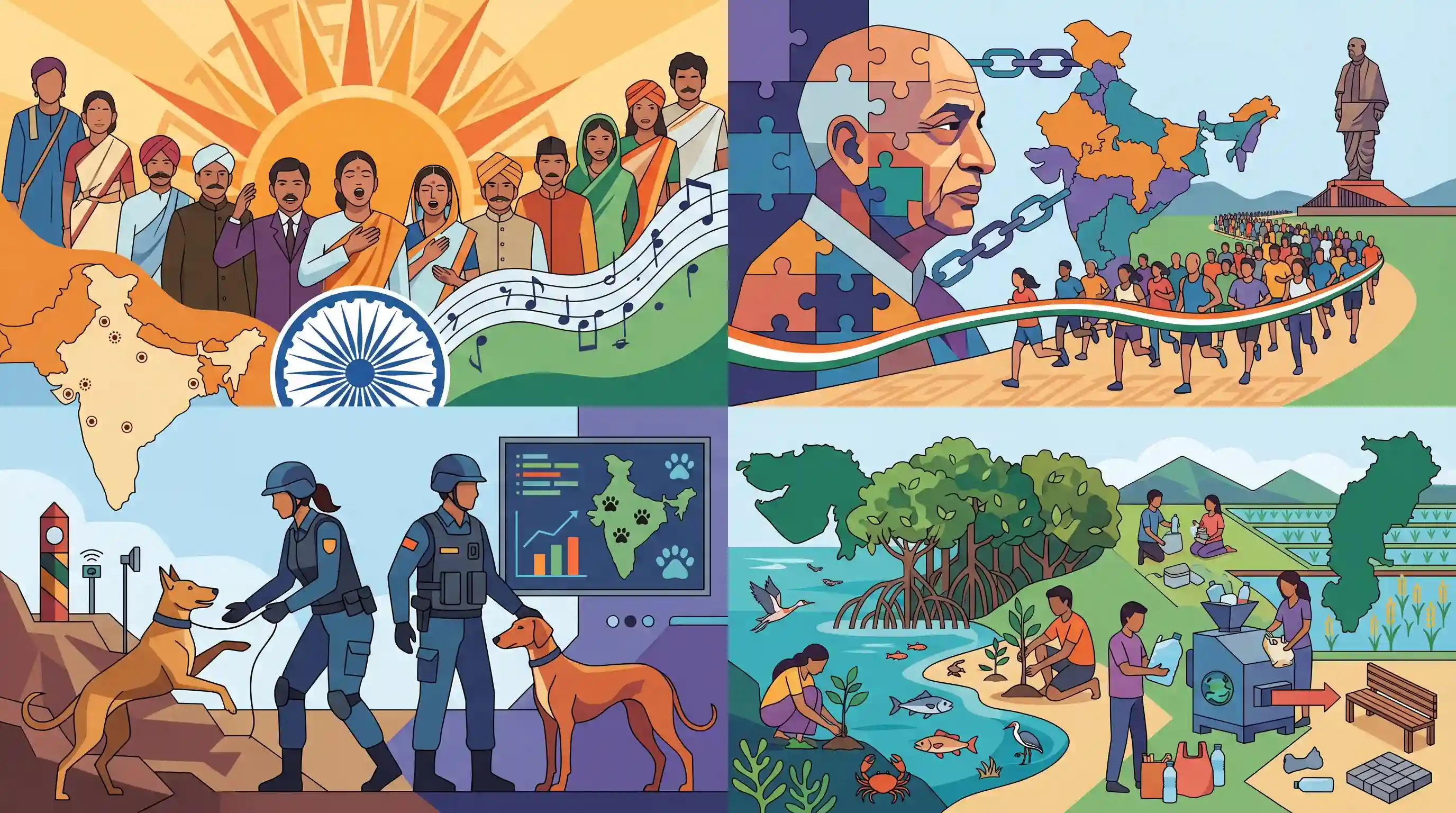
In his Mann Ki Baat address, PM Modi urged citizens to celebrate the 150th anniversary of 'Vande Mataram' and participate in the 'Run for Unity' for Sardar Patel's 150th birth anniversary. He praised security forces for adopting indigenous dog breeds and highlighted grassroots efforts like mangrove conservation in Gujarat and plastic waste management in Chhattisgarh.
Key Points
- PM Modi urged citizens to commemorate the 150th anniversary of the national song 'Vande Mataram', composed by Bankim Chandra Chattopadhyay in 1875.
- He also highlighted the upcoming 150th birth anniversary of Sardar Vallabhbhai Patel on October 31, urging participation in the 'Run for Unity'.
- Modi praised security forces (BSF, CRPF) for inducting and honoring indigenous Indian dog breeds.
- The address highlighted grassroots initiatives like Koraput coffee cultivation in Odisha, mangrove plantations in Gujarat, and a 'garbage cafe' in Chhattisgarh trading plastic waste for meals.
Important Terms
Vande Mataram

India’s National Song composed by Bankim Chandra Chattopadhyay in his 1882 novel Anandamath. First sung by Rabindranath Tagore at the 1896 Indian National Congress session.
UPSC context
GS Paper 1 (Modern Indian History). Tests knowledge of national symbols and the cultural aspect of the Indian National Movement.
Run for Unity
A nationwide marathon held annually on October 31 to commemorate Sardar Vallabhbhai Patel’s birth anniversary and promote the spirit of national integration.
UPSC context
GS Paper 1 (Post-Independence India). Relates to the integration of princely states and the legacy of Sardar Patel.
Rashtriya Ekta Diwas
Observed on October 31 since 2014, this day honors the 'Iron Man of India', Sardar Vallabhbhai Patel, for his pivotal role in unifying independent India.
UPSC context
GS Paper 1 (Important Personalities). Tests understanding of India’s political consolidation and national integrity.
Indigenous Dog Breeds
Native canine breeds like the Mudhol Hound and Rampur Hound being increasingly inducted into India’s security forces to promote indigenous resource adoption and climatic adaptability.
UPSC context
GS Paper 3 (Internal Security). Relevant to 'Atmanirbhar Bharat' and the modernization of Central Armed Police Forces.
MISHTI Scheme
The 'Mangrove Initiative for Shoreline Habitats & Tangible Incomes' aims at intensive mangrove plantation along India’s coastline and salt pans using community-based models.
UPSC context
GS Paper 3 (Environment & Ecology). Crucial for coastal disaster resilience and marine ecosystem conservation.
Garbage Cafe
An innovative waste-management model (pioneered in Ambikapur, Chhattisgarh) that incentivizes citizens to collect plastic waste in exchange for free nutritious meals.
UPSC context
GS Paper 3 (Environment/Waste Management). Tests knowledge of circular economy and community-led sustainable development practices.
Border Security Force (BSF)
India’s primary border-guarding force (under MHA) tasked with securing land borders with Pakistan and Bangladesh during peacetime and preventing trans-border crimes.
UPSC context
GS Paper 3 (Internal Security). Focuses on various security forces and their mandates.
Central Reserve Police Force (CRPF)
India’s largest Central Armed Police Force specialized in counter-insurgency, anti-Naxal operations, and assisting states in maintaining law and order and public safety.
UPSC context
GS Paper 3 (Internal Security). Tests awareness of major security agencies and internal security challenges.
Prelims Trap
"Vande Mataram was specifically composed by Bankim Chandra Chattopadhyay as the rallying cry for the 1905 Swadeshi Movement."
Vande Mataram was composed in 1875 and published in Anandamath (1882) long before the Swadeshi Movement (1905), though it later became its famous battle cry.
Static Concepts Connected
Key facts about Anandamath and its historical backdrop?
- Sanyasi Rebellion: Set against the backdrop of the Sanyasi Rebellion in Bengal (late 18th century), highlighting early resistance against the British.
- Literary Composition: The novel incorporates the song 'Vande Mataram', which was originally written in a mix of Sanskrit and Bengali.
- INC 1896: The song was first sung publicly at the 1896 session of the Indian National Congress by Rabindranath Tagore.
What makes Koraput Coffee geographically significant?
- Agro-Climatic Profile: It is an organic Arabica variety traditionally shade-grown at an elevation of around 3,000 feet in the Eastern Ghats.
- Tribal Economy: Cultivation provides sustainable livelihoods, empowering indigenous tribal groups and curbing rural out-migration.
Cross-Topic Patterns
150th Anniversaries: History & Polity
The simultaneous 150th milestones of Vande Mataram and Sardar Patel merge Modern Indian History (cultural nationalism) directly with Post-Independence Consolidation (integration of princely states).
Biodiversity meets Internal Security
Inducting native Mudhol and Rampur hounds into BSF links Internal Security modernization with the conservation of India's indigenous animal genetic resources.
Plastic Waste to Infrastructure
Ambikapur's 'Garbage Cafe' aligns Swachh Bharat grassroots models with the PMGSY standard of using recycled plastic waste as a bitumen substitute in road construction.

Expect a multi-statement question on Anandamath's timeline or a 'pairs' question matching indigenous hound breeds to their native states.
Linked PYQs · 4
Linked PYQs · 4
- 2003PrelimsGS1
Which one of the following statements is correct?
- 2021MainsGS1
Assess the main administrative issues and socio-cultural problems in the integration process of Indian Princely States.
- 2015PrelimsGS1
Which one of the following regions of India has a combination of mangrove forest, evergreen forest and deciduous forest?
- 2018MainsGS3
What are the impediments in disposing the huge quantities of discarded solid wastes which are continuously being generated? How do we remove safely the toxic wastes that have been accumulating in our habitable environment?
