Economic Reforms and the Changing Business Environment in India
Source:Indian Express ↗
Why It Matters
This article is highly relevant for GS3 (Economy) and GS2 (Governance) as it illustrates the critical dependency of private sector investment and industrial growth on a stable, trust-based regulatory environment. It provides a strong analytical framework for answering questions on post-reform economic performance, the impact of state intervention on ease of doing business, and the role of institutional quality in economic development.
Summary
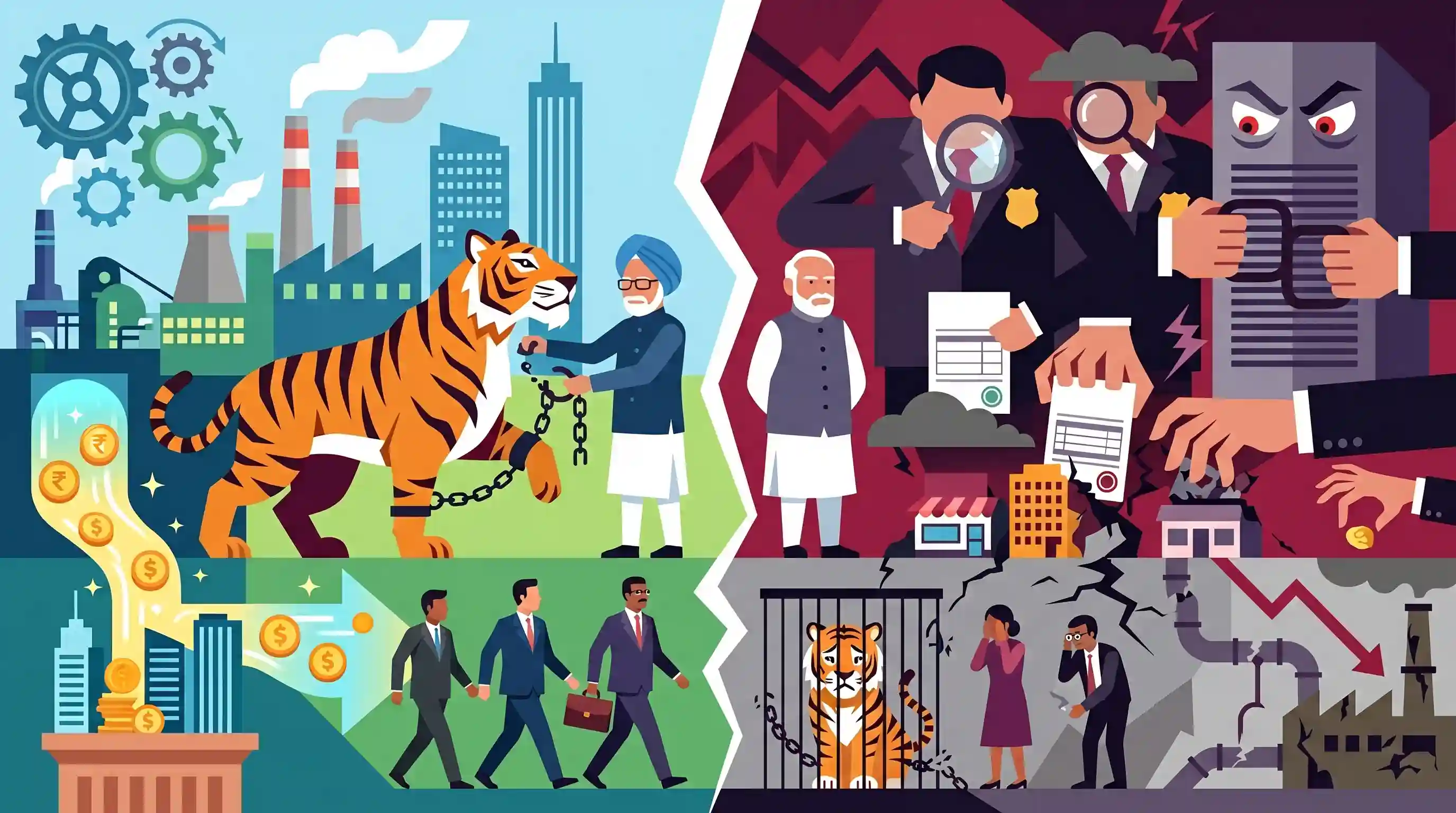
This opinion piece explores the evolving relationship between the Indian state and the corporate sector (India Inc) by contrasting the approaches of two prime ministers. It credits former Prime Minister Manmohan Singh for the 1991 economic reforms that provided businesses with the operational freedom and confidence necessary to drive private capital formation and economic growth. In contrast, it critiques the current administration under Narendra Modi for fostering an environment of fear. The author argues that aggressive oversight by enforcement agencies—such as the ED, CBI, and Income Tax Department—along with regulatory overreach and 'tax terrorism', have suppressed the 'animal spirits' of entrepreneurs, thereby dampening private investment and stunting industrial progress.
Key Points
- The 1991 economic liberalization spearheaded by Manmohan Singh dismantled the License Raj, shifting the state's role from controller to facilitator and boosting corporate confidence.
- During the UPA era, entrepreneurial freedom and the unleashing of 'animal spirits' led to significant private capital formation and industrial growth.
- The article asserts that the current regime is marked by a trust deficit, where aggressive actions by central enforcement agencies (ED, CBI, IT) have created an atmosphere of fear.
- 'Tax terrorism' and regulatory overreach are highlighted as major deterrents to private investment and ease of doing business in contemporary India.
- Institutional quality, a predictable regulatory environment, and a cooperative relationship between the state and business are essential to revive sustained economic growth.
Important Terms
1991 Economic Reforms

The transition to Liberalization, Privatization, and Globalization (LPG) policies that ended the 'License Raj' and opened India’s economy to global competition.
UPSC context
GS3: Evolution of industrial policy, liberalization's impact on growth, and the shift from state-led to market-led development.
Enforcement Directorate (ED)
A specialized financial investigation agency under the Ministry of Finance that enforces the Prevention of Money Laundering Act (PMLA) and Foreign Exchange Management Act (FEMA).
UPSC context
GS2/GS3: Tests understanding of statutory/regulatory bodies, money laundering, and the balance between enforcement and operational freedom.
Central Bureau of Investigation (CBI)
India's premier investigating agency, deriving powers from the DSPE Act, 1946. It probes corruption, complex economic crimes, and cases of national importance.
UPSC context
GS2: Governance and institutional autonomy; tests federalism issues like 'state consent' and the 'caged parrot' debate.
India Inc
A common term for India's formal corporate sector, encompassing the collective private and public enterprises that drive the nation's industrial investment.
UPSC context
GS3: Role of private investment models, capital formation, and industrial growth in the Indian economy.
Income Tax Department
The administrative body under the Ministry of Finance responsible for direct tax collection and enforcing the Income Tax Act, 1961.
UPSC context
GS3: Mobilization of resources, tax reforms, and the debate over 'tax terrorism' versus compliance.
United Progressive Alliance (UPA)
A center-left political coalition led by the Indian National Congress (INC) that governed India from 2004 to 2014 under Prime Minister Manmohan Singh.
UPSC context
GS2: Coalition politics, historical policy frameworks, and the transition from rights-based governance to current models.
National Democratic Alliance (NDA)
A center-right political coalition led by the Bharatiya Janata Party (BJP), which governed from 1998–2004 and again from 2014–present.
UPSC context
GS2: Current governance structures, coalition dynamics, and shifts in economic/political philosophy in modern India.
Prelims Trap
"'Animal spirits' refers to aggressive monetary tightening by the RBI or volatile foreign portfolio outflows."
It is a classic Keynesian macroeconomic concept describing the psychological factors, confidence, and optimism that drive entrepreneurs to take financial risks.
Static Concepts Connected
What does the Keynesian macroeconomic term 'Animal Spirits' signify for an economy?
- Origin: Coined by John Maynard Keynes in 1936 to describe the non-rational, emotional factors influencing economic decision-making.
- Core Meaning: Refers to the confidence, gut instincts, and optimism that drive entrepreneurs to take risks and invest despite uncertainty.
- Economic Impact: It is considered vital for boosting private Gross Fixed Capital Formation (GFCF) and reviving sluggish industrial growth.
What are the core legislative mandates enforced by the Enforcement Directorate (ED)?
- PMLA 2002: Investigates money laundering offenses, with powers to trace and attach properties derived from the proceeds of crime.
- FEMA 1999: Investigates suspected civil violations related to foreign exchange management laws and cross-border financial transactions.
- FEOA 2018: Facilitates the attachment and confiscation of properties of fugitive economic offenders who flee to evade Indian courts.
Cross-Topic Patterns
Governance dictating GS3 Macroeconomic outcomes
Highlights how GS2 topics (enforcement agency overreach, regulatory predictability) directly act as non-economic variables throttling GS3 outcomes (private capital formation and ease of doing business).
Echoes of Retrospective Taxation policies
The modern fear of 'tax terrorism' conceptually aligns with the 2012 Vodafone retrospective tax debacle, reinforcing that sovereign trust is a strict prerequisite for private investment.

Expect a GS3 Mains question evaluating how 'regulatory cholesterol' and tax enforcement uncertainties suppress private capital formation.
Linked PYQs · 5
Linked PYQs · 5
- 2017MainsGS3
Industrial growth rate has lagged-behind in the overall growth of Gross-Domestic-Product (GDP) in the post-reform period." Give reasons. How far the recent changes in Industrial-Policy are capable of increasing the industrial growth rate?
- 2020MainsGS3
Explain the meaning of investment in an economy in terms of capital formation. Discuss the factors to be considered while designing a concession agreement between a public entity and a private entity.
- 2020MainsGS2
Institutional quality is a crucial driver of economic performance". In this context suggest reforms in Civil Service for strengthening democracy.
- 2021MainsGS2
“Pressure groups play a vital role in influencing public policy making in India.” Explain how the business associations contribute to public policies.
- 2021MainsGS2
The jurisdiction of the Central Bureau of Investigation (CBI) regarding lodging an FIR and conducting probe within a particular State is being questioned by various States. However, the power of the States to withhold consent to the CBI is not absolute. Explain with special reference to the federal character of India.
