प्रधानमंत्री के रूप में मनमोहन सिंह का ध्यान आर्थिक विकास पर केंद्रित रहा: मोंटेक
स्रोत:द हिंदू ↗
क्यों मायने रखता है
Provides historical context for India's post-1991 economic trajectory, highlighting the enduring governance tension between market-driven economic growth and rights-based welfare policies, particularly within the structural constraints of coalition politics.
सारांश
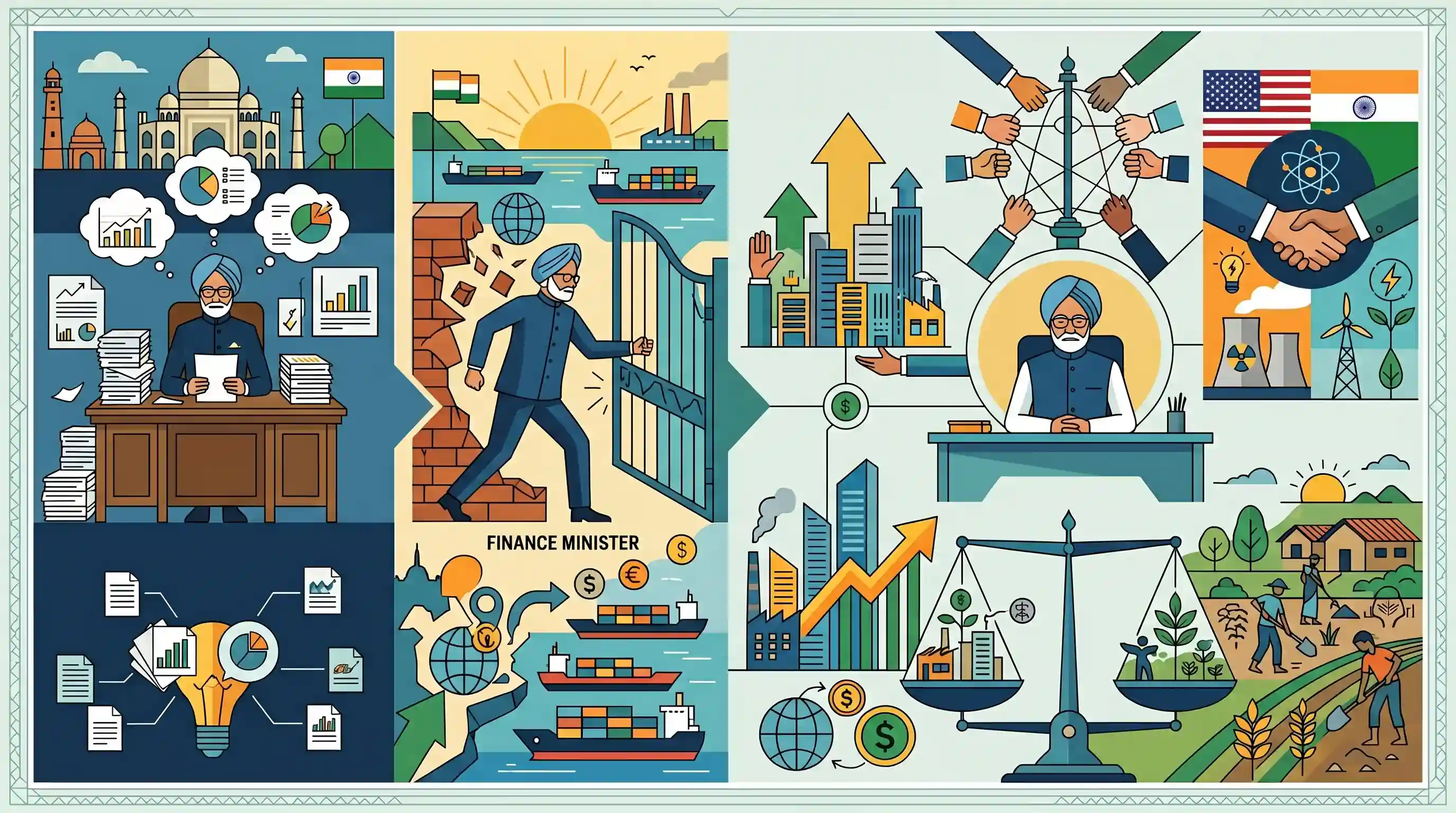
Former Planning Commission Deputy Chairman Montek Singh Ahluwalia praised Dr. Manmohan Singh for his steadfast focus on economic growth during his decade-long tenure as Prime Minister, despite navigating a complex coalition government and ideological divisions regarding welfare versus growth. Ahluwalia highlighted Singh's pivotal role across three phases of his career—as an economist-bureaucrat, a transformative Finance Minister who anchored the 1991 economic reforms, and as a Prime Minister who oversaw an era of 8-9% growth, introduced MGNREGA, and operationalized the Indo-U.S. Civil Nuclear Deal.
मुख्य बिंदु
- Former Planning Commission Deputy Chairman Montek Singh Ahluwalia delivered a lecture highlighting Dr. Manmohan Singh's unwavering focus on economic growth during his 2004-2014 prime ministerial tenure.
- Singh navigated significant structural constraints, including a 'khichdi-type' coalition government and ideological friction between the Prime Minister's Office and the party leadership over the growth versus rights-based welfare debate.
- As Finance Minister (1991-1996), Singh's transformative leadership was vital in launching economic liberalization, ensuring subsequent governments did not roll back these reforms.
- Key achievements during his tenure as PM included maintaining an 8-9% economic growth rate (2004-2010), launching the MGNREGA scheme, and securing the Indo-U.S. Civil Nuclear Deal.
महत्वपूर्ण शब्द
MGNREGA

A 2005 social security law guaranteeing at least 100 days of unskilled manual work per financial year to every rural household whose adult members volunteer. It is a demand-driven scheme.
UPSC context
GS Paper II (Social Justice/Welfare) and GS Paper III (Indian Economy). Tests knowledge of rural development and employment-led poverty alleviation.
Indo-U.S. Civil Nuclear Deal
A landmark 2008 pact (123 Agreement) that ended India's nuclear isolation, allowing it to engage in civilian nuclear trade with the world despite being a non-signatory to the NPT.
UPSC context
GS Paper II (International Relations). Crucial for understanding India-U.S. strategic ties and global non-proliferation regimes.
Planning Commission
A former non-constitutional body established in 1950 that formulated India’s Five-Year Plans. It followed a centralized top-down approach before being replaced by NITI Aayog in 2015.
UPSC context
GS Paper III (Indian Economy/Planning). Tests the history of economic planning and the transition to cooperative federalism (NITI Aayog).
1991 Economic Reforms
Policy shift in 1991 towards Liberalization, Privatization, and Globalization (LPG) to dismantle the 'License Raj,' sparked by a severe Balance of Payments crisis.
UPSC context
GS Paper III (Indian Economy). Fundamental topic regarding the structural transformation of the Indian economy and its global integration.
समावेशी विकास
Growth that is broad-based across sectors, creates productive employment, and ensures the benefits of development are distributed fairly among all segments of society, including marginalized groups.
UPSC context
GS Paper III (Indian Economy). A core developmental objective frequently tested in the context of poverty and inequality.
प्रारंभिक ट्रैप
The Indo-US Civil Nuclear Deal required India to become a signatory to the Non-Proliferation Treaty (NPT).
False. The 2008 deal was historic because India secured a clean waiver from the Nuclear Suppliers Group (NSG) without ever signing the NPT.
संबंधित अवधारणाएँ
What were the core structural pillars of India's 1991 LPG economic reforms?
- Liberalization: Dismantling the License Raj, deregulating industries, ending monopolies, and lowering tariffs to free private enterprise.
- Privatization: Initiating disinvestment in public sector enterprises and opening reserved state sectors to private capital.
- Globalization: Transitioning to market-determined exchange rates, opening up to Foreign Direct Investment (FDI), and integrating globally.
What defines the 'Rights-based approach' to welfare seen in schemes like MGNREGA?
- Justiciable Entitlements: कल्याण को राज्य के परोपकार से कानूनी अधिकारों में स्थानांतरित करता है, जिससे नागरिक वैधानिक कार्य या भोजन की मांग कर सकते हैं।
- Built-in Accountability: Mandates grievance redressal, unemployment allowances for failed delivery, and transparency through mandatory Gram Sabha social audits.
अंतर-विषय पैटर्न
Coalition constraints on structural economic reforms
The tension between alliance Common Minimum Programmes and fiscal consolidation is a recurring GS2/GS3 theme, contrasting coalition consensus-building against single-party majority reform capacity.
Nuclear deal to Net-Zero energy transition
The 2008 NSG waiver ended India's nuclear isolation, directly enabling its current push for Small Modular Reactors (SMRs) to meet the 500 GW non-fossil capacity target by 2030.

Expect a GS3 Mains question contrasting the 2004-2010 'rights-based welfare' model with the current 'DBT and capex-led' growth model.
संबद्ध PYQ · 5
संबद्ध PYQ · 5
- 2019MainsGS3
The public expenditure management is a challenge to the Government of India in the context of budget making during the post-liberalization period. Clarify it.
- 2017MainsGS3
Industrial growth rate has lagged-behind in the overall growth of Gross-Domestic-Product (GDP) in the post-reform period." Give reasons. How far the recent changes in Industrial-Policy are capable of increasing the industrial growth rate?
- 2024MainsGS2
“The growth of cabinet system has practically resulted in the marginalisation of the parliamentary supremacy.” Elucidate.
- 2022MainsGS3
Is inclusive growth possible under market economy ? State the significance of financial inclusion in achieving economic growth in India.
- 2020MainsGS3
Explain intra-generational and inter-generational issues of equity from the perspective of inclusive growth and sustainable development.
