BJP Retains Manjalpur Assembly Seat in Bypoll
Source:The Hindu ↗
Why It Matters
Understanding by-elections and the filling of casual vacancies in State Legislative Assemblies is a core aspect of Indian polity and electoral processes under the Representation of the People Act, frequently tested in Prelims.
Summary
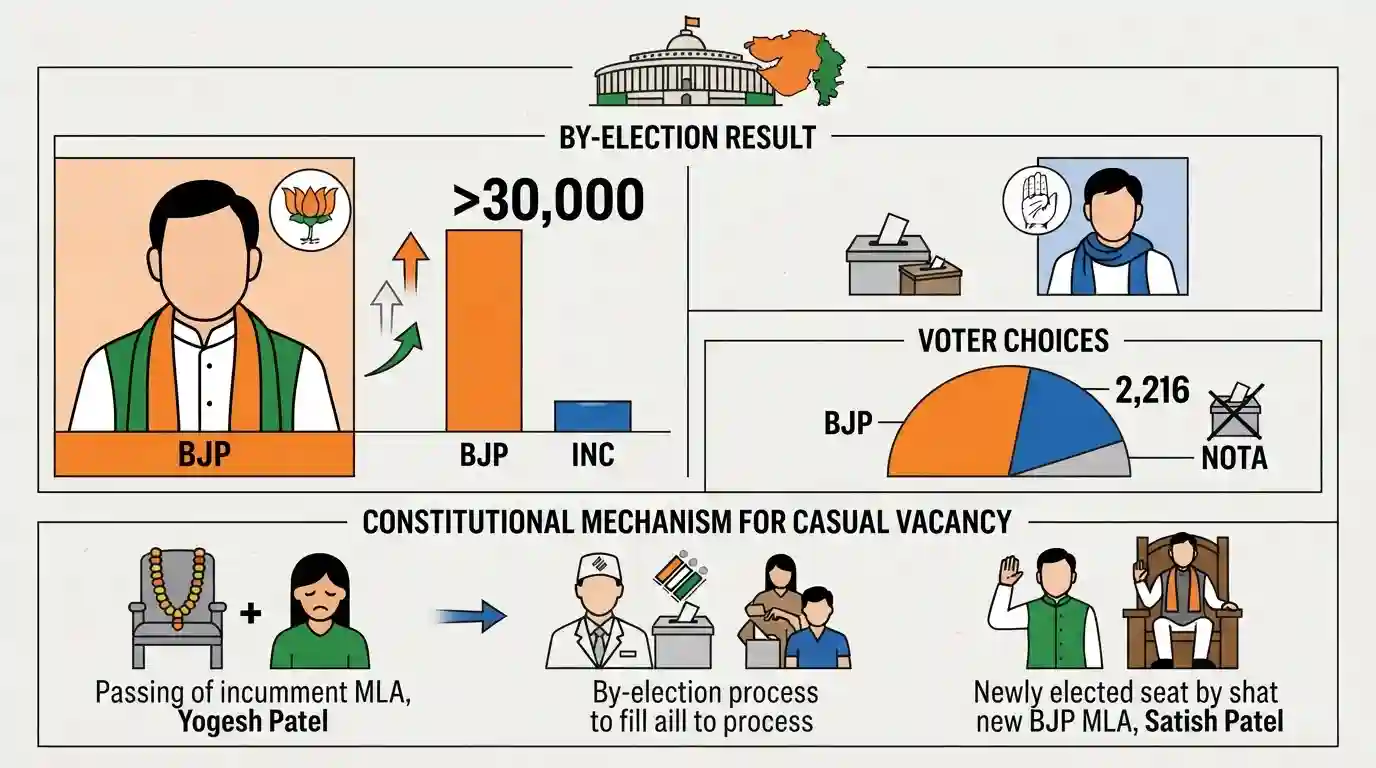
The Bharatiya Janata Party (BJP) retained the Manjalpur Assembly seat in Gujarat following a bypoll necessitated by the passing of the incumbent MLA, Yogesh Patel. BJP candidate Satish Patel defeated Indian National Congress candidate Hariprasad Joshi by a significant margin of more than 30,000 votes. The election also saw 2,216 voters opting for 'None of the Above' (NOTA). This by-election highlights the constitutional mechanisms in place for filling casual vacancies in State Legislatures.
Key Points
- BJP candidate Satish Patel retained the Manjalpur Assembly seat in Gujarat by a margin of over 30,000 votes against his Congress rival.
- The by-election was necessitated by the death of veteran BJP MLA Yogesh Patel.
- The 'None of the Above' (NOTA) option received 2,216 votes in the election.
- By-elections to State Legislative Assemblies are conducted under the purview of the Election Commission of India.
Important Terms
Casual Vacancy

A mid-term vacancy in a legislative body (like Parliament or a State Legislature) caused by the death, resignation, or disqualification of an elected member.
UPSC context
Relevant to Polity (GS Paper 2). Under the Representation of the People Act, 1951, the ECI must hold by-elections within six months to fill these.
Representation of the People Act (RPA)
A 1951 legislation providing the framework for the conduct of elections, qualifications/disqualifications of candidates, and dispute resolution for Parliament and State Legislatures.
UPSC context
GS Paper 2 staple. Tests understanding of electoral mechanics, by-elections (Section 151A), and candidate disqualifications.
Election Commission of India (ECI)
A constitutional body established under Article 324 of the Constitution, responsible for administering and overseeing all elections to Parliament, State Legislatures, and the offices of the President and Vice-President.
UPSC context
Critical GS Paper 2 topic. Tests constitutional bodies, electoral reforms, and the mandate to ensure free and fair elections.
None of the Above (NOTA)
A ballot option allowing voters to formally reject all contesting candidates. It was introduced in 2013 following a Supreme Court directive to protect voter secrecy and encourage better candidates.
UPSC context
Important for GS Paper 2 (Electoral Reforms). Tests awareness of voter rights, Supreme Court judgments (PUCL case), and democratic accountability.
Prelims Trap
"If NOTA secures the highest number of votes in a constituency, a fresh election is mandatorily conducted."
NOTA has no statutory effect on the election result. The human candidate securing the highest number of valid votes wins, even if NOTA votes outnumber them.
Static Concepts Connected
What are the statutory rules governing by-elections in India?
- Six-month rule: Section 151A of the RPA 1951 mandates filling a casual vacancy in Parliament or a State Legislature within six months of its occurrence.
- Tenure exception: A by-election is skipped if the remainder of the vacant seat's term is less than one year.
- Administrative exception: It is also skipped if the ECI and the Central Government jointly certify that holding the poll within the timeframe is difficult.
What is the origin and legal impact of NOTA in Indian elections?
- Judicial origin: Introduced on EVMs following the Supreme Court's 2013 judgment in the People's Union for Civil Liberties (PUCL) v. Union of India case.
- Legal impact: NOTA is purely symbolic. It has no statutory mechanism to reject candidates or enforce re-elections if it gets the majority vote.
- Winner determination: The candidate with the highest number of valid votes is declared elected, regardless of the total NOTA votes cast in the constituency.
Cross-Topic Patterns
Judicial intervention in electoral reforms
NOTA's introduction via the 2013 PUCL judgment connects conceptually with other SC-mandated electoral reforms, such as the Lily Thomas case (disqualification) and the ADR case (criminal antecedents disclosure).
Statutory vs. Constitutional election rules
Aspirants must distinguish between Article 324 (ECI's constitutional mandate) and the RPA 1951 (statutory rules like the six-month deadline for by-elections under Section 151A).

Multi-statement Polity questions in 2026 may blend RPA Section 151A exceptions (by-election timelines) with NOTA's lack of legal teeth.
Linked PYQs · 3
Linked PYQs · 3
- 2024GPSC_PRELIMSGS1
Consider the following statements. 1. The Election Commission of India is an autonomous constitutional authority responsible for administering elections to the Lok Sabha, Rajya Sabha and State Legislative Assemblies in India, and the offices of the President and Vice-President in the country. 2. The Union Cabinet decides the election schedule for the conduct of both general elections and by-elections. 3. Election Commission resolves the disputes relating to splits/mergers of recognized political parties. Which of the above statement/statements is/are correct?
- 2024GPSC_PRELIMSGS1
Consider the following statements regarding Election Commission of India (ECI). 1. The election commissioners can be removed before the expiry of their term. 2. The Chief Election Commissioner can be removed from office only through a process of removal similar to that of a Supreme Court judge. 3. The Constitution has debarred the retiring election commissioner from any further appointment by the government. Which of the above statement/statements is/are correct?
- 2022GPSC_PRELIMSGS1
Consider the following statements regarding Election Commission of India. 1. The Constitution has not specified the term of the members of the Election Commission. 2. The Constitution has debarred the retiring election commissioners from any further appointment by the Government. 3. In case of difference of opinion amongst the Chief Election Commissioner and/or two other election commissioners, the matter is decided by the Chief Election Commissioner. Which of the above statements is/are correct?
