Sub-Caste Enumeration Needs in Upcoming Decennial Census
Source:Indian Express ↗
Why It Matters
The intersection of the decadal Census with caste enumeration is a highly relevant contemporary issue for UPSC. The recent Supreme Court ruling on the sub-classification of SCs/STs for reservations adds a crucial constitutional and governance dimension, directly linking data collection (Census) to the effective implementation of social justice policies (GS2) and the evolving nature of the caste system (GS1).
Summary
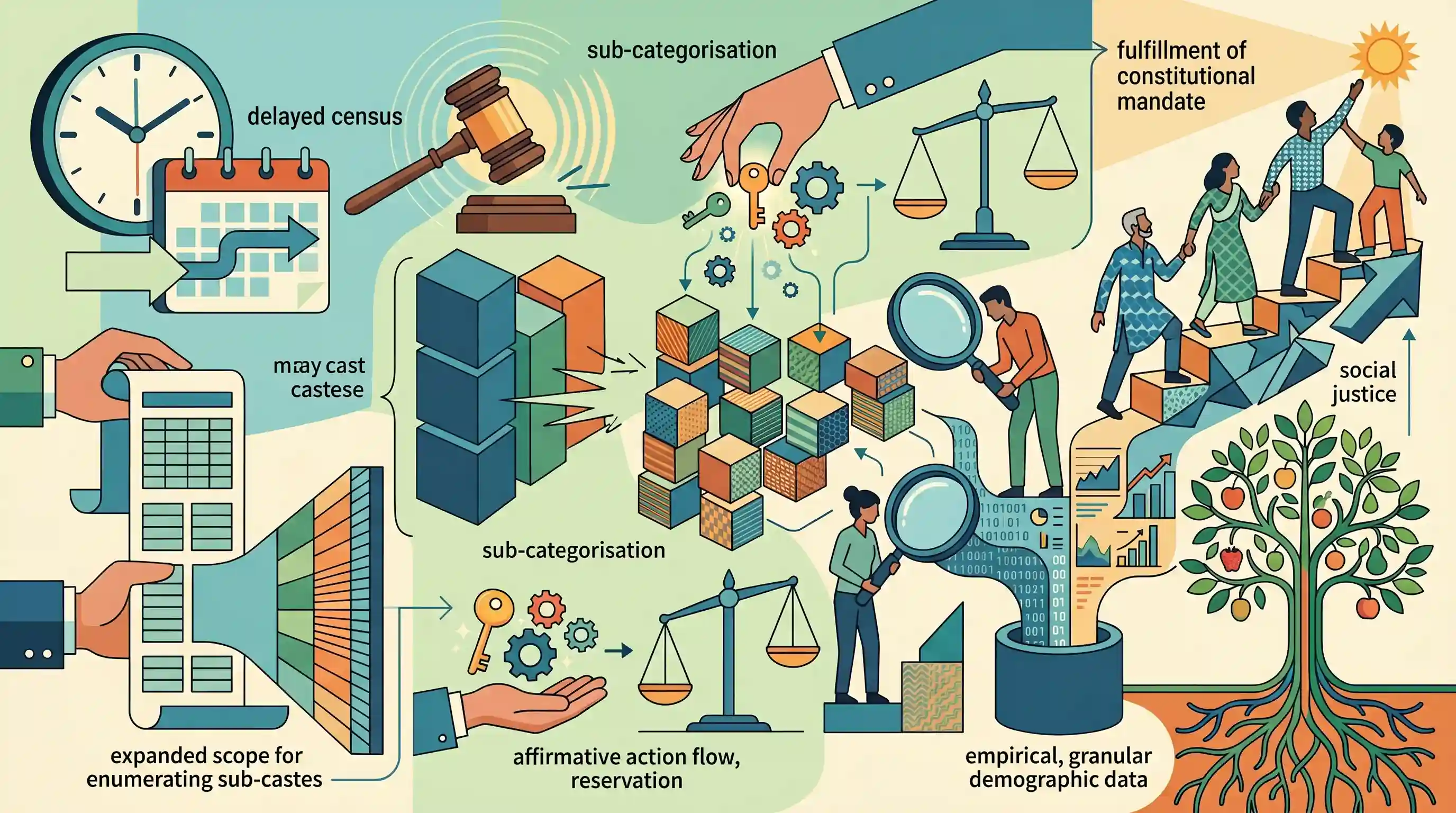
The article by Manish Tewari argues that the upcoming delayed Census, likely to be conducted in 2027, must expand its scope to enumerate sub-castes across all demographic categories. Driven by the recent Supreme Court verdict that allows states to sub-classify Scheduled Castes (SCs) and Scheduled Tribes (STs) for targeted quotas, the author highlights the critical need for empirical, granular demographic data. Without precise socio-economic and population data at the sub-caste level, policies aimed at equitable distribution of affirmative action remain legally vulnerable and practically difficult to execute. The piece concludes that a comprehensive sub-caste census is indispensable for addressing intra-group inequalities and fulfilling the constitutional mandate of social justice.
Key Points
- The delayed decadal Census, anticipated around 2027, must be expanded to officially enumerate sub-castes across SC, ST, OBC, and General categories.
- A recent landmark Supreme Court verdict permits the sub-classification of Scheduled Castes (SCs) and Scheduled Tribes (STs) to provide targeted reservations to the most marginalized among them.
- Implementing sub-classification effectively and legally requires robust empirical data on the socio-economic and demographic realities of specific sub-castes.
- Historically, post-independence censuses have only enumerated the broader SC and ST populations without sub-caste granularity, and have not counted OBCs at all.
- Collecting granular sub-caste data is critical for rationalizing affirmative action, ensuring equitable distribution of resources, and addressing deep-seated intra-group inequalities.
Important Terms
Census Act, 1948

The legal framework governing the decadal population census in India, empowering the Central Government to conduct surveys and mandating public cooperation while ensuring data confidentiality.
UPSC context
GS Paper II (Governance). Tests understanding of the statutory basis for demographic data collection and privacy protections.
Sub-classification of SCs/STs
The division of Scheduled Castes or Tribes into sub-groups to ensure reservation benefits reach the most marginalized, recently validated by a 7-judge Supreme Court bench.
UPSC context
GS Paper II (Social Justice). Key for questions on equitable distribution of affirmative action and internal community inequalities.
State of Punjab vs Davinder Singh (2024)
A landmark 2024 verdict allowing states to sub-classify SC/STs for targeted quotas, provided they use empirical data to prove internal backwardness, overruling the 2004 E.V. Chinnaiah case.
UPSC context
GS Paper II (Judiciary). Essential for understanding current shifts in reservation jurisprudence and federal powers.
Article 341
The constitutional provision empowering the President to specify the list of Scheduled Castes for States/UTs, which only Parliament can subsequently modify.
UPSC context
GS Paper II (Indian Constitution). Fundamental for identifying the legal status of marginalized groups and parliamentary authority over the SC list.
Empirical Data (Affirmative Action)
Quantifiable evidence regarding a community’s socio-economic status and representation in services, mandated by the Supreme Court to justify any sub-classification for reservation.
UPSC context
GS Paper II (Governance). Critical for tests on evidence-based policy and the requirement of judicial review in reservations.
Socio-Economic and Caste Census (SECC)
A specialized census (last in 2011) designed to capture granular caste and economic data to better identify beneficiaries for welfare schemes.
UPSC context
GS Paper II/III (Welfare/Social Justice). Tests knowledge of tools for poverty alleviation and the distinction from the general census.
Prelims Trap
"State legislatures are now empowered to add or remove sub-castes from the SC/ST list to implement targeted reservations."
The Supreme Court ruled states can sub-classify to provide targeted quotas within the list, but altering the Presidential list itself remains Parliament's exclusive domain under Article 341(2).
Static Concepts Connected
How is a caste notified as a Scheduled Caste under the Indian Constitution?
- Presidential Notification: Under Article 341(1), the President, after consulting the Governor, publicly notifies the list of SCs for a specific State or Union Territory.
- Parliamentary Authority: Under Article 341(2), only the Parliament can enact laws to include or exclude groups from this Presidential list. State legislatures cannot alter it.
- Sub-classification Power: The 2024 SC ruling allows states to create preferences or sub-classifications for quotas among the groups already present on the list, without altering the list itself.
What is the history of caste enumeration in the Indian Census?
- Pre-Independence: The 1931 Census was the last comprehensive exercise by the British to collect and publish detailed data on all caste groups across India.
- Post-Independence Practice: Since 1951, the decadal census strictly enumerates only Scheduled Castes and Scheduled Tribes, completely omitting OBCs and General castes from the headcount.
- SECC 2011: Independent India's first attempt to collect caste data alongside economic indicators. The raw caste data was never published by the Union government due to alleged methodological errors.
Cross-Topic Patterns
Sub-classification and Federal Friction
While states are eager to sub-classify SC/STs for regional quotas, the lack of Union-level census data forces states to conduct their own surveys (e.g., Bihar), triggering legal and federal disputes.
SECC 2011 and Welfare Targeting
While the caste enumeration of SECC 2011 was shelved, its deprivation indicators revolutionized welfare delivery, forming the empirical baseline for major schemes like Ayushman Bharat and PM Awas Yojana.

Expect a multi-statement question testing the boundaries of Article 341(2) vs the 2024 SC ruling on state powers for sub-classification.
Linked PYQs · 3
Linked PYQs · 3
- 2018MainsGS1
Caste system is assuming new identities and associational forms. Hence, caste system cannot be eradicated in India." Comment.
- 2022MainsGS2
Discuss the role of the National Commission for Backward Classes in the wake of its transformation from a statutory body to a constitutional body.
- 2018MainsGS2
Whether National Commission for Scheduled Castes (NCSC) can enforce the implementation of constitutional reservation for the Scheduled Castes in the religious minority institutions? Examine.
