Normalcy returns to Manipur Churachandpur district after protests
Source:The Hindu ↗
Why It Matters
The persistence of ethnic conflict and demands for separate administration in Manipur are critical components of North-East insurgency and internal security challenges. It also touches on constitutional aspects regarding the revocation of President's Rule and government formation in strife-torn states.
Summary
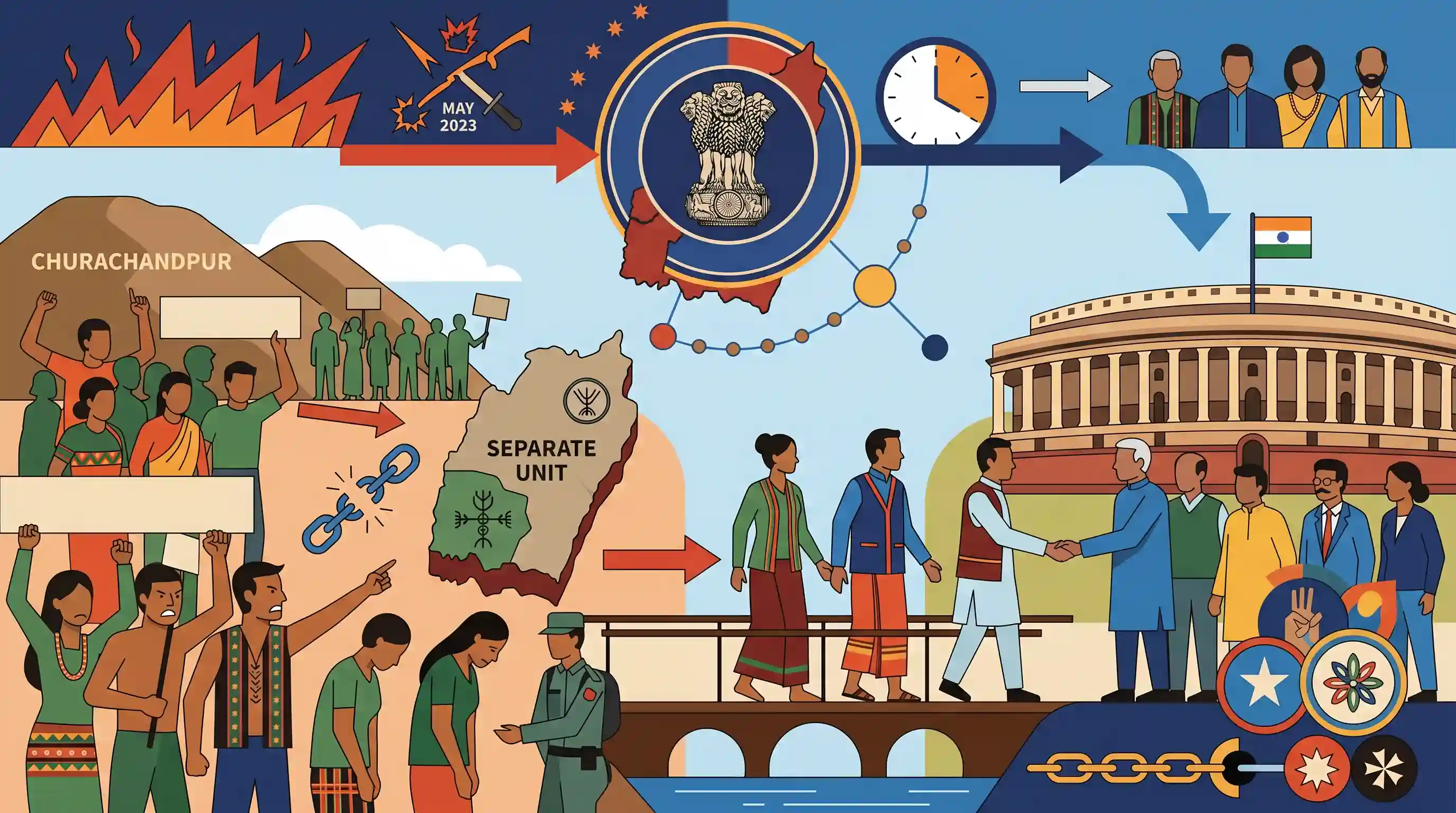
Normalcy is gradually returning to Manipur's Churachandpur district after protests erupted over three Kuki-Zo-Hmar legislators joining a newly formed state government. Tribal groups, including the Zomi Council, accuse the MLAs of betraying their ongoing demand for a separate administrative unit, which gained momentum after the deadly May 2023 ethnic clashes. The formation of the new government follows a year of President's Rule in the violence-hit state.
Key Points
- Protests erupted in Churachandpur after three Kuki-Zo and Hmar legislators joined a Meitei-led government in Manipur.
- Manipur recently formed a popular government led by Y. Khemchand Singh following a year of President's Rule.
- Kuki-Zo tribal bodies and the Zomi Council view the legislators' actions as a betrayal of their ongoing demand for a separate administrative unit.
- The region has been deeply divided since the May 2023 ethnic clashes, which caused significant casualties and displacement.
Important Terms
Indigenous Tribal Leaders Forum (ITLF)

An umbrella body of Kuki-Zo tribal leaders formed in 2022 to represent community interests in Manipur. It spearheads demands for political self-rule and a separate administrative unit.
UPSC context
GS Paper II & III: Governance and Internal Security. Key stakeholder in Northeast ethnic conflict management and tribal rights advocacy.
Zomi Council
An apex body of nine Zomi tribes in Manipur (e.g., Paite, Vaiphei) seeking constitutional protections. It advocates for a "Zoland Territorial Council" under the Sixth Schedule.
UPSC context
GS Paper I & II: Ethnic identity and tribal administration. Tests knowledge of distinct tribal identities and regional administrative demands.
Separate Administration
A political demand by Kuki-Zo groups for a Union Territory with a legislature, independent of the Manipur state government, following the 2023 ethnic clashes.
UPSC context
GS Paper II: Federalism and Centre-State relations. Illustrates challenges to territorial integrity versus regional aspirations for self-governance.
President’s Rule (Article 356)
Constitutional provision for the Union to assume control of a state's governance due to the breakdown of constitutional machinery. Imposed in Manipur in early 2025.
UPSC context
GS Paper II: Indian Polity. Crucial for understanding emergency provisions, judicial review (S.R. Bommai case), and federal stability.
Kuki Women Organisation for Human Rights (KWOHR)
A civil society group advocating for the safety and legal rights of Kuki-Zo women. It monitors human rights violations and protests political decisions seen as betrayals.
UPSC context
GS Paper II: Social Justice and NGOs. Exemplifies the role of civil society and women’s groups in conflict-ridden zones.
Sixth Schedule
Provisions under Articles 244(2) and 275(1) for the administration of tribal areas in Assam, Meghalaya, Tripura, and Mizoram via Autonomous District Councils (ADCs).
UPSC context
GS Paper II: Tribal Administration. Relevant for discussing the expansion of autonomous powers to tribal-majority regions outside the current four states.
Prelims Trap
"The tribal hill areas of Manipur are administered by Autonomous District Councils under the Sixth Schedule."
Manipur is not covered by the 6th Schedule. Instead, its tribal hill areas are protected via the Hill Areas Committee under Article 371C.
Static Concepts Connected
How does Article 371C govern the administration of Manipur's hill areas?
- Hill Areas Committee: The President can mandate the creation of a committee of the Legislative Assembly consisting of members elected from the Hill Areas.
- Governor's Responsibility: The Governor has a special constitutional responsibility to report annually to the President regarding the administration of these Hill Areas.
- Union Directions: The executive power of the Union extends to giving directions to the State regarding the administration of the Hill Areas.
What safeguards against arbitrary President's Rule (Article 356) emerged from the S.R. Bommai case?
- Judicial Review: The Presidential proclamation imposing Article 356 is not absolute and is subject to judicial review for mala fide intent.
- Floor Test Mandatory: The majority of the incumbent government must be tested on the floor of the House, not by the Governor's subjective assessment.
- Conditional Dissolution: The State Legislative Assembly cannot be dissolved until both houses of Parliament approve the Presidential proclamation.
Cross-Topic Patterns
Article 371C vs. Sixth Schedule
The demand for 'Separate Administration' pushes aspirants to compare Manipur's Hill Areas Committee under Article 371C against the Autonomous District Councils found in the Sixth Schedule.
SoO pacts + Public Order jurisdiction
Tripartite Suspension of Operations (SoO) agreements involve the Centre, State, and insurgent groups. UPSC often tests this intersection of Union security mandates and State 'public order' subjects.

Expect a Prelims question matching Article 371 clauses (A-J) to states, coupled with a trap falsely placing Manipur in the 6th Schedule.
Linked PYQs · 3
Linked PYQs · 3
- 2025MainsGS3
What are the major challenges to internal security and peace process in the North-Eastern States? Map the various peace accords and agreements initiated by the government in the past decade.
- 2019MainsGS3
Cross-border movement of insurgents is only one of the several security challenges facing the policing of the border in North-East India. Examine the various challenges currently emanating across the India-Myanmar border. Also, discuss the steps to counter the challenges.
- 2023MainsGS2
Account for the legal and political factors responsible for the reduced frequency of using Article 356 by the Union Governments since mid 1990s.
