Tribunal Report Identifies State Failures in Manipur Violence
Source:The Hindu ↗
Why It Matters
This issue lies at the intersection of GS3 (Internal Security challenges in the Northeast and the role of social media in fanning conflicts) and GS2 (the role of civil society organizations like PUCL, governance failures, and constitutional provisions regarding ST status). It serves as a prime case study for state breakdown, ethnic fault lines, and conflict resolution mechanisms.
Summary
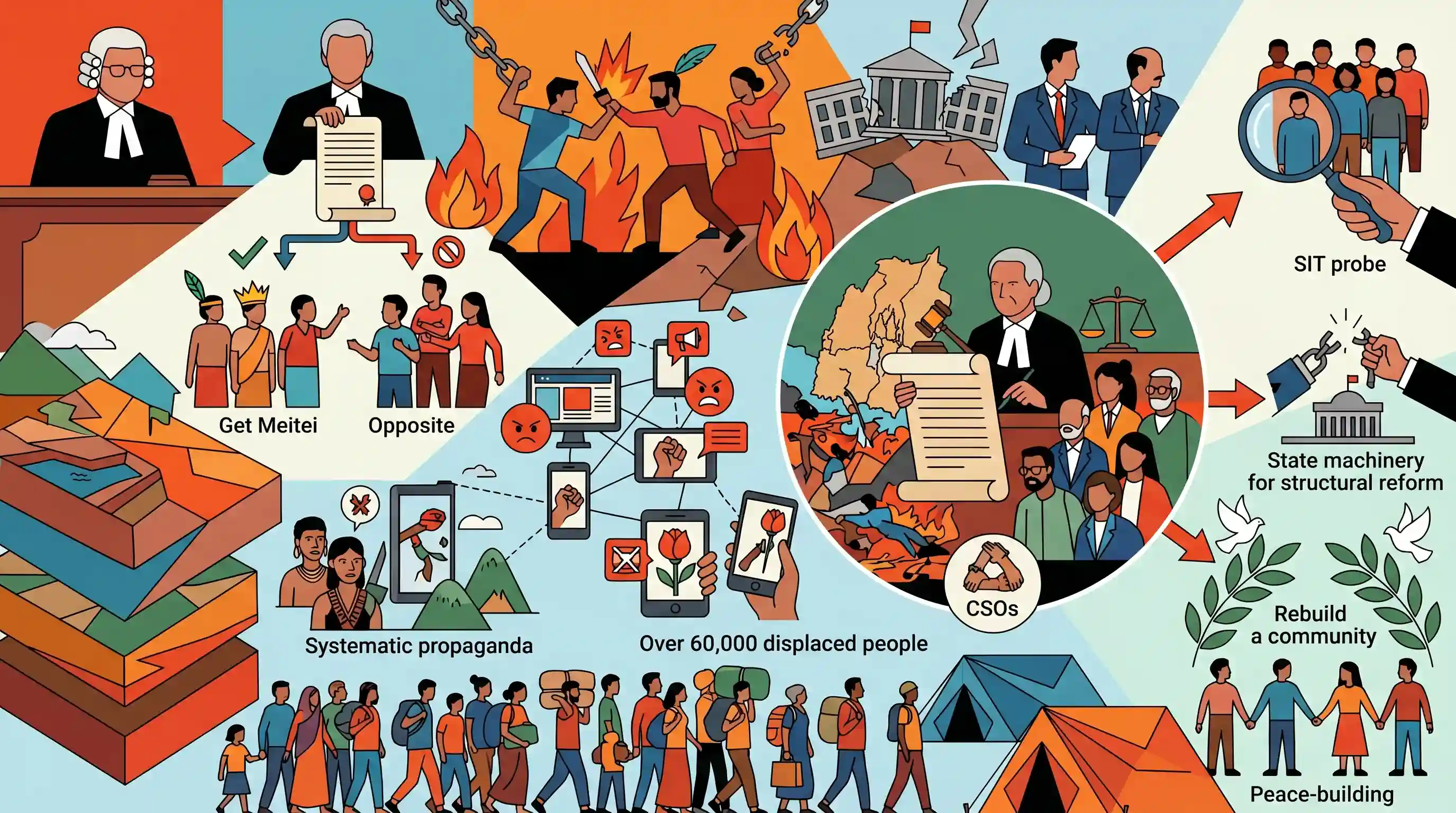
A report by an Independent People's Tribunal, established by the People's Union of Civil Liberties (PUCL) and chaired by former Supreme Court judge Kurian Joseph, states that the ethnic violence in Manipur was a planned and targeted campaign facilitated by the failures of both Central and State governments. The violence, which has displaced over 60,000 people, was triggered by a controversial High Court order recommending Scheduled Tribe (ST) status for the Meitei community. The tribunal highlighted underlying issues such as historical ethnic divisions, land disputes, and systematic propaganda—specifically narratives linking the Kuki community to poppy cultivation—amplified through digital media. It criticized the complete breakdown of state machinery and recommended a court-monitored Special Investigation Team (SIT) probe to ensure accountability and structural reforms for peace-building.
Key Points
- An Independent People's Tribunal constituted by the PUCL and chaired by former SC judge Kurian Joseph concluded that the ongoing Manipur violence was planned, ethnically targeted, and facilitated by state failures.
- The immediate trigger for the violence was a March 2023 Manipur High Court directive recommending Scheduled Tribe (ST) status for the Meitei community, leading to insecurity among Kuki-Zo and Naga groups.
- Underlying causes include deep-rooted ethnic divisions, socio-political marginalization, land ownership disputes, and state-backed narratives around 'war on drugs' and poppy cultivation.
- Misuse of digital media for hate speech and propaganda exacerbated the conflict, causing the internal displacement of over 60,000 individuals into relief camps.
- The report criticized the failure of both Central and State governments to control the violence, advocating for a court-monitored Special Investigation Team (SIT) probe and structural dialogue.
Important Terms
People's Union of Civil Liberties (PUCL)

India's largest human rights organization, founded in 1976 by Jayaprakash Narayan. It defends civil liberties, promotes constitutional rights, and monitors state accountability through legal interventions and fact-finding reports.
UPSC context
GS-II: Important for topics on Civil Society, NGOs, and the protection of Human Rights.
Independent People's Tribunal (IPT)
A non-statutory, civil society-led inquiry body composed of legal experts and eminent citizens. It documents human rights violations and provides a platform for victims when official state mechanisms are perceived to have failed.
UPSC context
GS-II: Relevant to non-state actors in governance and alternative accountability mechanisms.
Scheduled Tribe (ST) Status
Constitutional recognition under Article 342, granting specific communities protections and benefits. Criteria include primitive traits, geographical isolation, and social/economic backwardness; the process requires state recommendation followed by parliamentary legislation.
UPSC context
GS-II: Critical for Social Justice, Welfare Schemes, and Federalism (Article 342).
Special Investigation Team (SIT)
A temporary, specialized unit of experts or officers constituted by the government or judiciary to investigate high-profile, complex, or sensitive criminal cases where regular investigative agencies may face limitations.
UPSC context
GS-II/III: Important for Governance, Judicial Oversight, and Internal Security (Police Reforms).
Manipur High Court
The state's highest judicial body, which issued a controversial March 2023 order (later modified) directing the state to consider Meiteis for ST status, serving as a primary trigger for the ethnic violence.
UPSC context
GS-II: Tests knowledge of Judicial activism, overreach, and the role of High Courts in state-level conflicts.
Prelims Trap
The High Court holds the constitutional authority to mandate the inclusion of a community in the Scheduled Tribes list.
Under Article 342, only Parliament can amend the ST list via legislation, after a Presidential notification. High Courts cannot mandate ST inclusion.
Static Concepts Connected
What is the constitutional process for adding a community to the ST list?
- State Recommendation: The process begins with the State government recommending the community's inclusion.
- Central Approval: The proposal requires clearance from the Office of the Registrar General of India (ORGI) and the NCST.
- Parliamentary Act: The President issues a notification under Article 342, but amending the final list requires an Act of Parliament.
What is the 'Golden Triangle' in the context of drug trafficking?
- Core Location: It refers to the tri-junction intersection of Myanmar, Laos, and Thailand.
- Security Threat: Proximity to India's porous Northeast borders facilitates illicit poppy cultivation, drug cartels, and narco-funding for local insurgent groups.
Cross-Topic Patterns
Drug trade fueling ethnic insurgencies
The political economy of poppy cultivation links India's North-East ethnic divides directly to the transnational organized crime networks of the nearby Golden Triangle.
Digital media as a conflict multiplier
Misinformation and targeted ethnic propaganda on social platforms act as catalysts in internal security breakdowns, transforming local land disputes into state-wide crises.
CSO tribunals filling the accountability void
When state machinery fails, civil society organizations (CSOs) increasingly deploy former judges for 'people's tribunals' to document human rights violations and demand SIT probes.

Expect a GS2/GS3 question linking ST inclusion procedures (Article 342) to internal security fallout and digital propaganda in 2026.
Linked PYQs · 4
Linked PYQs · 4
- 2019MainsGS3
Cross-border movement of insurgents is only one of the several security challenges facing the policing of the border in North-East India. Examine the various challenges currently emanating across the India-Myanmar border. Also, discuss the steps to counter the challenges.
- 2024MainsGS3
Social media and encrypting messaging services pose a serious security challenge. What measures have been adopted at various levels to address the security implications of social media? Also suggest any other remedies to address the problem.
- 2016MainsGS3
Use of Internet and social media by non-state actors for subversive activities is a major security concern. How have these been misused in the recent past? Suggest effective guidelines to curb the above threat.
- 2025MainsGS2
Civil Society Organizations are often perceived as being anti-State actors than non-State actors. Do you agree? Justify.
