Ethnic Conflict Resolution and Reconciliation Challenges in Manipur
Source:Indian Express ↗
Why It Matters
The ongoing crisis in Manipur represents a major internal security and societal challenge. UPSC frequently tests the geopolitical, security, and social dimensions of North-East Indian insurgencies and ethnic conflicts, as well as the ethical frameworks required to govern deeply divided societies.
Summary
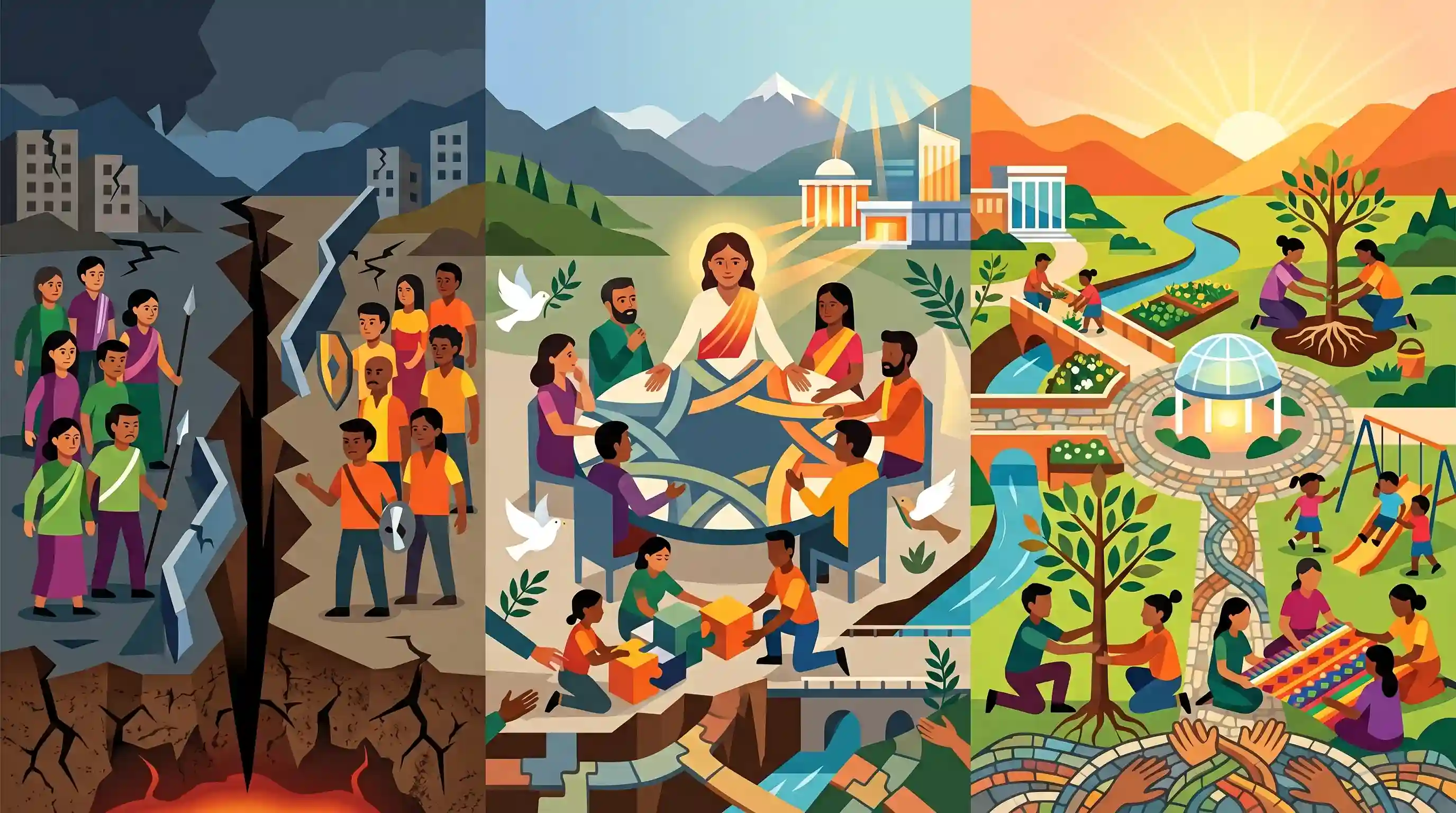
Two years into the Manipur ethnic violence, the article stresses the urgent need for collective healing and establishing a connected future for the state. It underscores the challenges of deep-rooted ethnic divides and protracted conflict, calling for empathetic conflict resolution, sustained peacebuilding efforts, and a renewed focus on inter-community reconciliation rather than relying solely on militarized or law-and-order approaches.
Key Points
- Marks the two-year milestone of the protracted ethnic conflict in Manipur, highlighting the devastating toll on inter-community trust.
- Emphasizes that achieving long-term stability requires transitioning from purely law-and-order measures to profound societal healing and reconciliation.
- Underscores the necessity of dialogue, empathy, and rebuilding trust across deep ethnic fault lines.
- Highlights the broader governance and security challenge in sensitive border states, where identity-based grievances demand systemic, compassionate conflict resolution.
Prelims Trap
"Manipur's Hill Districts are administered by Autonomous District Councils under the Sixth Schedule of the Indian Constitution."
Manipur is NOT a Sixth Schedule state (which applies to Assam, Meghalaya, Tripura, Mizoram). Instead, its hill areas are governed by Article 371C through a Hill Areas Committee.
Static Concepts Connected
How does Article 371C protect the hill areas of Manipur?
- Hill Areas Committee: Constituted by the President, it comprises Members of the Legislative Assembly (MLAs) elected specifically from the designated Hill Areas of the state.
- Governor's Responsibility: The Governor must submit an annual report to the President regarding the administration of these designated Hill Areas.
- Union Executive Power: The Union government is empowered to give executive directions to the state government concerning the proper administration of the Hill Areas.
Which security structures manage the Indo-Myanmar border and internal security in Manipur?
- Assam Rifles: The primary border guarding force for the Indo-Myanmar border, which is also heavily involved in counter-insurgency operations within the North-East.
- Dual Control Mechanism: The Assam Rifles operates under the administrative control of the MHA, while its operational control rests with the Indian Army (MoD).
- Free Movement Regime: An arrangement that historically allowed border tribes to travel 16 km across the Indo-Myanmar border without a visa; recently suspended by the Centre.
Cross-Topic Patterns
Border instability stalling Act East Policy
Protracted violence in Manipur disrupts connectivity projects like the IMT Trilateral Highway, directly undermining India's Act East strategy and economic integration with Southeast Asia.
Administrative neutrality vs ethnic loyalty
The fragmentation of local administration along Meitei-Kuki lines forms a classic GS-4 case study on maintaining civil service impartiality and constitutional morality during intense community conflict.

Expect a multi-statement Prelims question comparing Article 371C (Manipur) with 6th Schedule areas, alongside Assam Rifles' dual-control.
Linked PYQs · 5
Linked PYQs · 5
- 2025MainsGS3
What are the major challenges to internal security and peace process in the North-Eastern States? Map the various peace accords and agreements initiated by the government in the past decade.
- 2019MainsGS3
Cross-border movement of insurgents is only one of the several security challenges facing the policing of the border in North-East India. Examine the various challenges currently emanating across the India-Myanmar border. Also, discuss the steps to counter the challenges.
- 2022MainsGS1
Given the diversities among tribal communities in India, in which specific contexts should they be considered as a single category ?
- 2022MainsGS4
It is believed that adherence to ethics in human actions would ensure in smooth functioning of an organization/system. If so, what does ethics seek to promote in human life? How do ethical values assist in the resolution of conflicts faced by him in his day-to-day functioning?
- 2022MainsGS4
Apart from intellectual competency and moral qualities, empathy and compassion are some of the other vital attributes that facilitate the civil servants to be more competent in tackling the crucial issues or taking critical decisions. Explain with suitable illustrations.
