Ethnic Violence and Internal Security Challenges in Manipur
Source:Indian Express ↗
Why It Matters
The persistent ethnic violence in Manipur highlights structural vulnerabilities in India's internal security framework, the complexities of tribal identity politics, and the limitations of conventional conflict-resolution mechanisms (peace missions) in the face of deep-seated trust deficits.
Summary
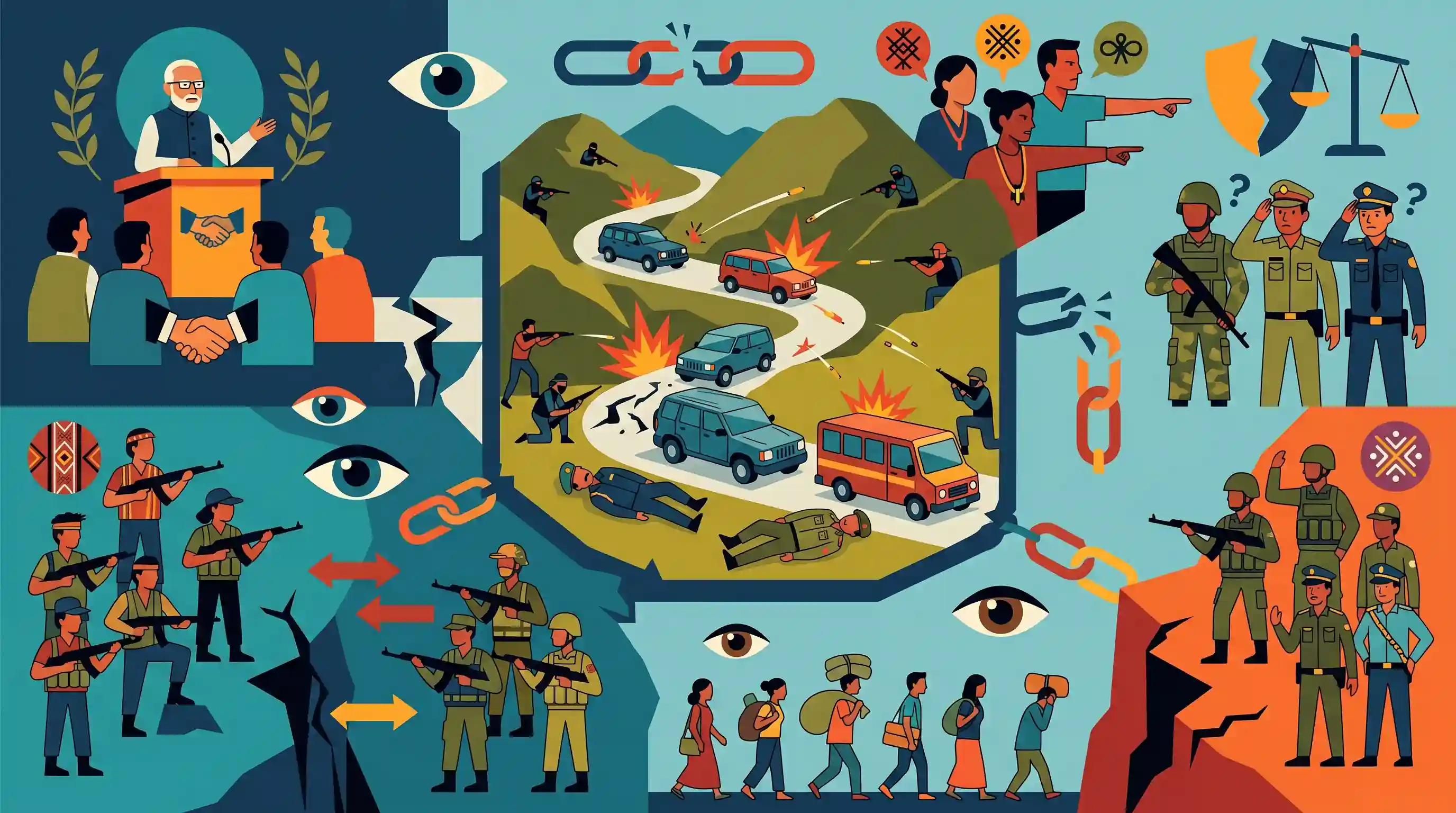
Suspected militants ambushed civilian vehicles on the Imphal-Ukhrul road in Manipur, killing two individuals, including a retired armyman from the Tangkhul Naga tribe. The attack occurred shortly after a "peace mission" by Manipur Chief Minister Y Khemchand Singh aimed at bridging divides between the Tangkhul Naga and Kuki-Zo communities. Tension and violence, including clashes between armed "volunteer groups" of both communities, have gripped the region since February, leading to displacements and a severe trust deficit. Tribal bodies have traded blame while questioning the efficacy and neutrality of state security forces.
Key Points
- Two civilians, including a Tangkhul Naga ex-armyman, were killed in a suspected militant ambush in Manipur's Ukhrul district.
- The violence occurred immediately following a peace outreach visit by Chief Minister Y Khemchand Singh to foster dialogue between the Tangkhul Naga and Kuki-Zo communities.
- Ethnic hostilities have persisted since February in the Litan area, featuring heavy gunfights between armed "volunteer groups" from the warring tribes.
- The Tangkhul Naga Long accused state security forces of incompetence and alleged complicity with Kuki militants, illustrating a severe trust deficit.
- The incident underscores the complexities of navigating tribal faultlines, internal displacement, and armed non-state actors in Northeast India's internal security matrix.
Important Terms
Tangkhul Naga Long

The apex civil body and traditional governing council of the Tangkhul Naga tribe in Manipur, playing a critical role in community mediation and tribal land rights.
UPSC context
GS-I (Indian Society: Tribal Governance) and GS-III (Internal Security). Tests knowledge of Civil Society Organizations (CSOs) in conflict resolution.
Kuki-Zo Council
An umbrella organization formed in October 2024 to unify representation for the Kuki-Zo tribes in Manipur, advocating for political autonomy and a "separate administration."
UPSC context
GS-II (Governance) and GS-III (Internal Security). Relevant for understanding asymmetric federalism and ethnic political movements.
Suspension of Operations (SoO) Agreement
A tripartite ceasefire agreement between the Centre, State, and Kuki-Zo militant groups to stop hostilities and initiate political dialogue while cadres remain in monitored camps.
UPSC context
GS-III (Internal Security: North-East Insurgency). Tests mechanisms for peace-building and state-insurgent engagement.
Armed Forces (Special Powers) Act (AFSPA)
A law granting extraordinary powers (like arrest without warrant) and legal immunity to security forces in regions declared "disturbed areas" by the government.
UPSC context
GS-II (Polity) and GS-III (Internal Security). A core topic regarding federalism, human rights, and internal stability.
Section 163 BNSS
The provision in the Bharatiya Nagarik Suraksha Sanhita (replacing Section 144 CrPC) that empowers magistrates to issue urgent orders to prevent danger or nuisance.
UPSC context
GS-II (Polity: New Criminal Laws). Essential for understanding current legal frameworks for maintaining public order.
Tangkhul Naga
A major Naga ethnic group primarily inhabiting the Ukhrul district of Manipur and known for their significant historical role in the Naga sovereignty movement.
UPSC context
GS-I (Diversity of India) and GS-III (Internal Security). Important for mapping ethnic fault lines in Northeast India.
Prelims Trap
"Manipur's tribal hill districts, such as Ukhrul, are governed under the Sixth Schedule of the Indian Constitution."
Manipur is NOT covered by the Sixth Schedule (which applies only to AMTM states). Instead, its hill areas are protected under Article 371C, which mandates a Hill Areas Committee.
Static Concepts Connected
What is the constitutional protection for Manipur's Hill Areas?
- Article 371C: Provides for the creation of a Hill Areas Committee consisting of MLAs elected from the designated Hill Areas of the state.
- Governor's Report: The Governor of Manipur must submit an annual report to the President of India specifically regarding the administration of the Hill Areas.
- Union Oversight: The executive power of the Union extends to giving directions to the State as to the administration of these hill areas.
What is the Suspension of Operations (SoO) agreement?
- Tripartite Pact: A tripartite ceasefire framework involving the Centre, the State government, and insurgent groups (like Kuki-Zo militias) to halt violence and facilitate political dialogue.
- Ground Rules: Cadres must live in designated camps, store weapons in locked armouries with double keys, and are strictly prohibited from extortion or carrying arms in public.
Cross-Topic Patterns
FMR scrapping and cross-border ethnic ties
Scrapping the Free Movement Regime aims to curb arms influx, but deeply affects the trans-border familial and cultural ties of Kuki-Zo and Naga tribes across the Indo-Myanmar border.
AFSPA phase-out vs armed militias
The proliferation of heavily armed ethnic 'volunteer groups' and civilian ambushes severely complicates the Centre's recent push to incrementally withdraw AFSPA from Northeast Indian states.

Expect a multi-statement question in 2026 merging Article 371C, Sixth Schedule exceptions, and the Suspension of Operations (SoO) pact.
Linked PYQs · 3
Linked PYQs · 3
- 2017MainsGS3
The North-East region of India has been infested with insurgency for a very long time. Analyze the major reasons for the survival of armed insurgency in this region.
- 2022MainsGS1
Given the diversities among tribal communities in India, in which specific contexts should they be considered as a single category ?
- 2021MainsGS3
Analyse the multidimensional challenges posed by external state and non-state actors, to the internal security of India. Also discuss measures required to be taken to combat these threats.
