Manipur ethnic polarization and healthcare access challenges
Source:Indian Express ↗
Why It Matters
This article illustrates the complex ground reality of the Manipur crisis, showing how ethnic divisions affect fundamental rights like access to healthcare. It provides a contemporary example for Mains answers on internal security challenges, the complexities of peacebuilding in North-East India, and the humanitarian consequences of protracted ethnic conflict.
Summary
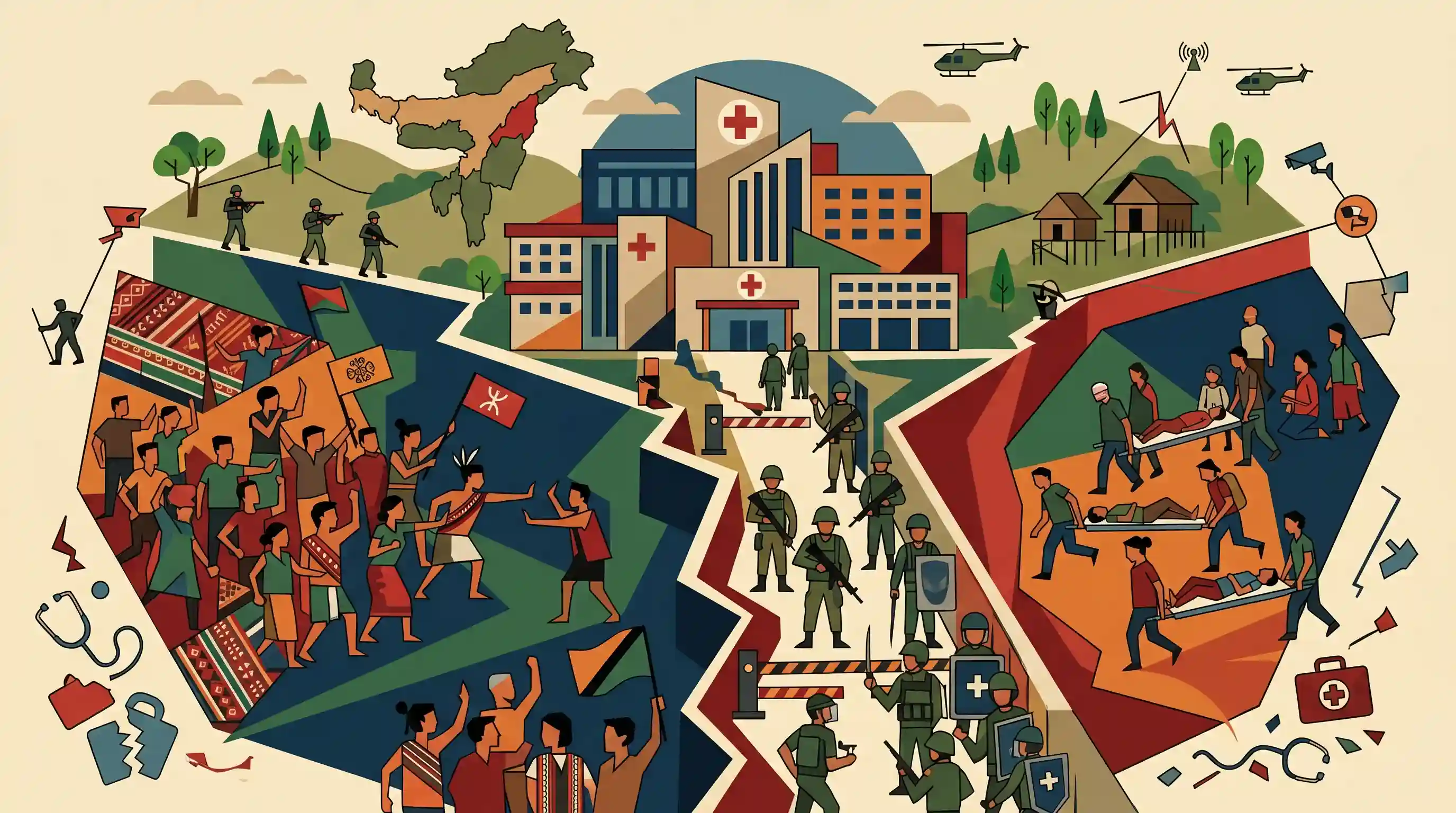
Deepening ethnic fault lines in Manipur were exposed when protests erupted at the Regional Institute of Medical Sciences (RIMS) in Imphal against the admission of three injured Kuki-Zo youths. The youths, injured in a gunfight in Noney district, had to be escorted by the Army and CRPF to the capital due to the strict segregation between communities. Protesters, largely from the Naga and Meitei communities, objected to their treatment. This incident underscores the extreme tribal and ethnic polarization in the state, where basic humanitarian access like emergency healthcare is compromised by inter-community hostility, further complicating the internal security landscape of North-East India.
Key Points
- Three injured Kuki-Zo youths, brought to RIMS hospital in Imphal for medical treatment under security cover, faced intense protests from Naga and Meitei community members.
- The incident highlights the severe ethnic polarization in Manipur, where even access to emergency medical care is obstructed based on community lines.
- The protests, primarily organized by the Rongmei Naga Students Organisation, signal rising tensions between the Naga and Kuki-Zo communities, adding another layer to the ongoing Meitei-Kuki-Zo conflict.
- Since the ethnic violence began in 2023, demographic segregation has deepened, restricting the movement of Kuki-Zos into the Meitei-dominated Imphal Valley and vice-versa, necessitating heavy security escorts for basic mobility.
Important Terms
Regional Institute of Medical Sciences (RIMS)

A premier tertiary healthcare and medical education institution in Imphal under the Ministry of Health & Family Welfare, serving the healthcare needs of seven North-Eastern states.
UPSC context
GS Paper II/III: Illustrates the impact of ethnic conflict on essential social infrastructure and the challenges of providing humanitarian services in polarized zones.
Central Reserve Police Force (CRPF)
India's lead internal security force and largest Central Armed Police Force (CAPF), tasked with maintaining law and order and managing 'buffer zones' in conflict-affected regions like Manipur.
UPSC context
GS Paper III: Crucial for understanding the role of CAPFs in internal security, counter-insurgency, and the 'Unified Command' structure during state-wide crises.
Indian Army
India's primary land-based military branch, deployed in Manipur for 'aid to civil authority' and counter-insurgency operations, often operating under the Armed Forces (Special Powers) Act (AFSPA).
UPSC context
GS Paper III: Highlights the military's role in domestic stabilization and the complexities of civil-military relations in 'disturbed areas.'
Rongmei Naga Students Organisation Manipur (RNSOM)
A prominent student-led civil society organization representing the Rongmei Naga tribe, active in safeguarding Naga territorial interests and maintaining community neutrality amidst the Meitei-Kuki conflict.
UPSC context
GS Paper II/III: Represents the role of ethnic-based pressure groups and civil society in North-East identity politics and conflict resolution.
Ethnic Polarization
The deepening of social and political divisions between ethnic groups, leading to extreme mistrust, geographical segregation, and the breakdown of shared institutional trust.
UPSC context
GS Paper I/III: A core concept for analyzing communalism, internal security threats, and the challenges of national integration in multi-ethnic states.
Internal Security Challenges (North-East)
The complex array of threats in India's North-East, including ethnic insurgencies, border porosity, and tribal identity politics that undermine regional stability and development.
UPSC context
GS Paper III: A high-frequency UPSC topic involving state failure, the role of external actors, and the 'security vs. development' paradigm.
Prelims Trap
"The Meitei community is primarily concentrated in the hill districts, while the Kuki-Zo tribes dominate the Imphal Valley."
It is the exact opposite. The Meitei majority is concentrated in the central Imphal Valley, while Kuki-Zo and Naga tribes inhabit the surrounding hill districts.
Static Concepts Connected
How does Manipur's geographic layout dictate its demographic and ethnic divide?
- Valley Dominance: The Imphal Valley forms roughly 10% of the state's area but houses the majority Meitei population and holds key political infrastructure.
- Tribal Hills: Surrounding hill districts cover 90% of the state and are inhabited primarily by recognized Scheduled Tribes, including Nagas and Kuki-Zos.
- Restrictive Land Laws: Historical land tenure laws restrict non-tribals (mostly valley-dwelling Meiteis) from purchasing land in the hill districts, fueling long-standing demographic anxieties.
What is the constitutional mandate for emergency medical care in India?
- Article 21: The Supreme Court interprets the Right to Life to inherently include the fundamental right to health and timely medical assistance.
- Parmanand Katara Case: The 1989 SC ruling established that all doctors have a professional obligation to provide immediate emergency medical aid to preserve life.
Cross-Topic Patterns
Healthcare access as a security crisis
Weaponization of healthcare access highlights how extreme ethnic polarization degrades basic social infrastructure, bridging GS3 (Internal Security) with GS2 (Health and Governance).
Revival of Naga-Kuki historical faultlines
Naga organizations protesting Kuki-Zo treatment signals a dangerous potential spillover, threatening to reignite the violent Naga-Kuki ethnic clashes of the 1990s alongside the Meitei-Kuki conflict.

Expect a multi-statement Prelims question mapping NE communities (Meitei, Kuki, Rongmei Naga) to their specific geographic terrains.
Linked PYQs · 3
Linked PYQs · 3
- 2017MainsGS3
The North-East region of India has been infested with insurgency for a very long time. Analyze the major reasons for the survival of armed insurgency in this region.
- 2025MainsGS3
What are the major challenges to internal security and peace process in the North-Eastern States? Map the various peace accords and agreements initiated by the government in the past decade.
- 2020MainsGS2
In order to enhance the prospects of social development, sound and adequate health care policies are needed particularly in the fields of geriatric and maternal health care. Discuss.
