Manipur Political Crisis and Government Formation Dilemma
Source:Indian Express ↗
Why It Matters
The Manipur crisis represents a critical intersection of GS2 (Constitutional machinery breakdown, anti-defection law, role of the Governor) and GS3 (internal security, border state stability). Understanding the constitutional remedies and security implications is vital for aspirants analyzing state-level political crises and ethnic conflicts.
Summary
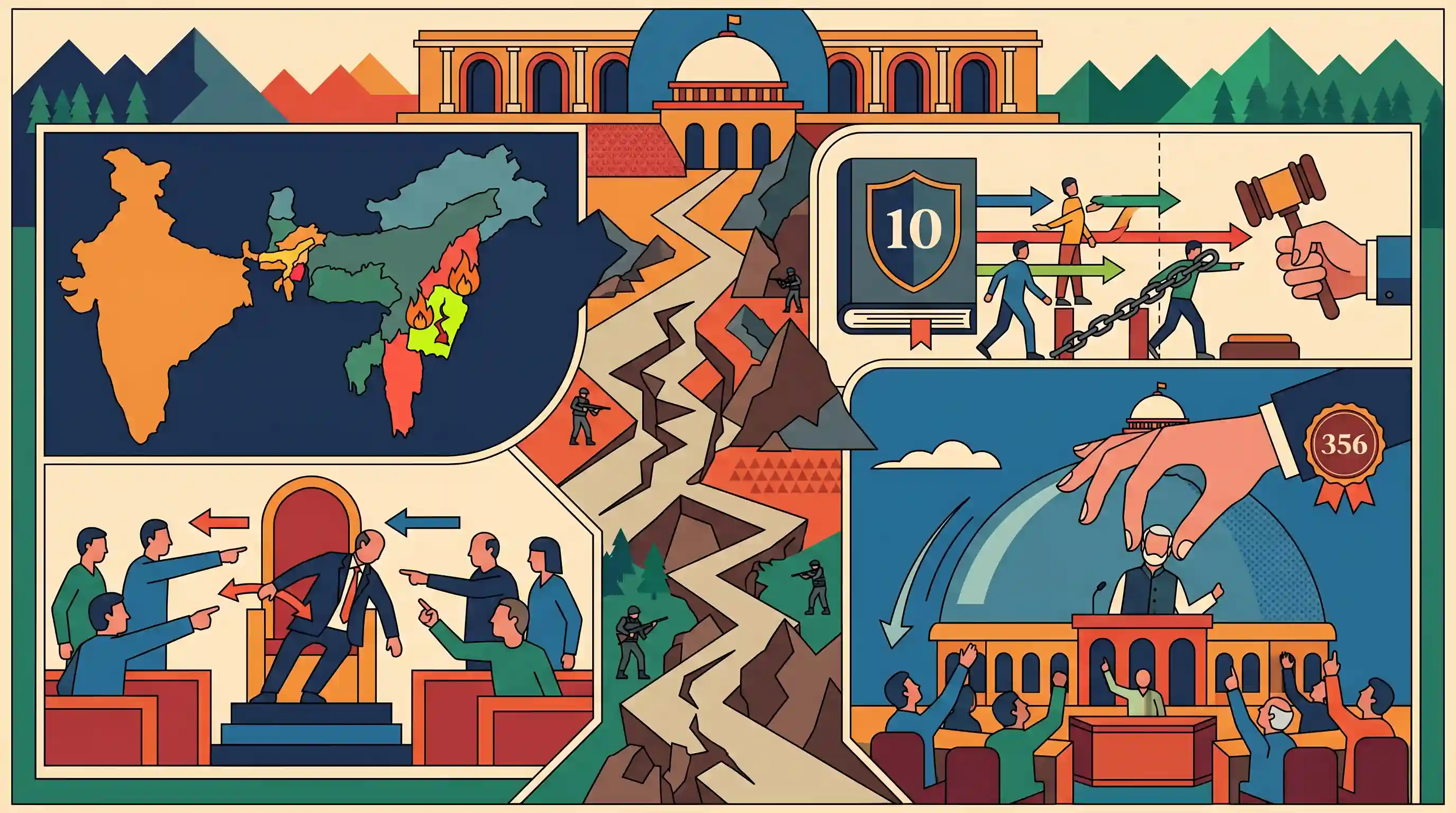
The article examines the multifaceted political crisis in Manipur, where dissident MLAs are reportedly pushing for a leadership change amid devastating ethnic violence. It highlights the constitutional complexities of government formation and the potential application of the anti-defection law (Tenth Schedule). Furthermore, the persistent failure of the state to restore law and order raises critical questions about the invocation of President's Rule (Article 356) and underscores the severe internal security and insurgency challenges plaguing North-East India.
Key Points
- Dissident MLAs in Manipur are reportedly seeking a change in state leadership, exacerbating the political instability alongside the ongoing ethnic violence.
- The political maneuvering brings into focus the provisions of the Tenth Schedule (Anti-Defection Law) and the legal threshold for factional splits within the ruling party.
- Persistent ethnic clashes between the Meitei and Kuki-Zo communities highlight a severe breakdown of law and order and internal security in the border state.
- The failure of the state machinery to curb violence has intensified debates over the Governor's role and the potential imposition of President's Rule under Article 356.
- The crisis reflects the complex interplay between constitutional governance challenges and deep-rooted insurgency issues in North-East India.
Important Terms
Tenth Schedule

Added by the 52nd Amendment Act (1985), it provides for the disqualification of legislators (MPs/MLAs) on grounds of defection to maintain political stability.
UPSC context
GS Paper 2 (Polity); tests understanding of party discipline, political stability, and the Speaker's adjudicatory role.
Article 356
Commonly known as 'President's Rule', it allows the Union to take control of state administration when the constitutional machinery fails.
UPSC context
GS Paper 2 (Federalism); tests knowledge of Centre-State relations and the S.R. Bommai case safeguards.
State Legislative Assembly
The directly elected lower house (Vidhan Sabha) of a state legislature, where the Council of Ministers is collectively responsible for its actions.
UPSC context
GS Paper 2 (Polity); tests the functioning of state-level parliamentary democracy and executive accountability.
Internal Security
The management of domestic threats—such as ethnic violence or insurgency—to maintain the rule of law and territorial integrity, especially in sensitive regions.
UPSC context
GS Paper 3 (Security); tests the ability to analyze ethno-political conflicts and the state's response to unrest.
Article 355
A constitutional provision that mandates the Union to protect states against external aggression and internal disturbance, often a precursor to Article 356.
UPSC context
GS Paper 2 (Federalism); tests the Union's duty towards states during severe internal law and order breakdowns.
Prelims Trap
"A split by one-third of a party's MLAs protects them from disqualification under the Tenth Schedule."
The 91st Constitutional Amendment (2003) deleted the provision that exempted a 'split' from disqualification. Currently, only a 'merger' backed by at least two-thirds of the legislature party protects dissident MLAs.
Static Concepts Connected
What is the constitutional mandate of Article 355?
- Duty of Union: It imposes a duty on the Union to protect states against external aggression and internal disturbance, ensuring governance per constitutional provisions.
- Precursor to 356: It is often utilized as a legal precursor to Article 356 (President's Rule) when a state's law and order machinery completely collapses.
- Non-punitive intervention: Unlike Article 356, it allows the Centre to deploy central forces or issue directives to restore order without dismissing the elected state government.
What did the S.R. Bommai (1994) judgment establish regarding Article 356?
- Floor Test supremacy: The majority enjoyed by the Council of Ministers must be tested on the floor of the House, not by the Governor's subjective assessment.
- Judicial Review: A Presidential proclamation invoking Article 356 is not absolute and remains subject to judicial review to check mala fide political intent.
- Suspended animation: The State Assembly should only be kept in suspended animation until Parliament formally approves the Presidential proclamation to impose President's Rule.
Cross-Topic Patterns
Border insurgency & constitutional machinery
Manipur's crisis overlaps GS-3 internal security (ethnic divides, cross-border infiltration) with GS-2 constitutional failure (invoking Article 355/356), offering a dual-angle framing that UPSC heavily favors in Mains.
Tenth Schedule meets Floor Tests
Similar to the Maharashtra political crisis, dissident MLAs attempting to change leadership triggers overlapping constitutional debates on Tenth Schedule disqualifications and the Governor's power to call a floor test.

Expect a multi-statement Prelims question mixing Article 355's 'internal disturbance' mandate with Tenth Schedule merger exceptions.
Linked PYQs · 5
Linked PYQs · 5
- 2023MainsGS2
Account for the legal and political factors responsible for the reduced frequency of using Article 356 by the Union Governments since mid 1990s.
- 2025PrelimsGS1
Consider the following statements : I. If any question arises as to whether a Member of the House of the People has become subject to disqualification under the 10th Schedule, the President's decision in accordance with the opinion of the Council of Union Ministers shall be final. II. There is no mention of the word 'political party' in the Constitution of India. Which of the statements given above is/are correct?
- 2014PrelimsGS1
Which one of the following Schedules of the Constitution of India contains provisions regarding anti-defection?
- 2025MainsGS3
What are the major challenges to internal security and peace process in the North-Eastern States? Map the various peace accords and agreements initiated by the government in the past decade.
- 2017MainsGS3
The North-East region of India has been infested with insurgency for a very long time. Analyze the major reasons for the survival of armed insurgency in this region.
