Manipur Ethnic Conflict and Tribal Governance Dynamics
Source:Indian Express ↗
Why It Matters
The Manipur ethnic conflict is a critical case study for internal security and state machinery challenges. The prominent role of bodies like the Zomi Council also highlights the practical aspects of tribal governance, identity politics, and civil society influence in the region, relevant to GS2 (governance) and GS3 (security).
Summary
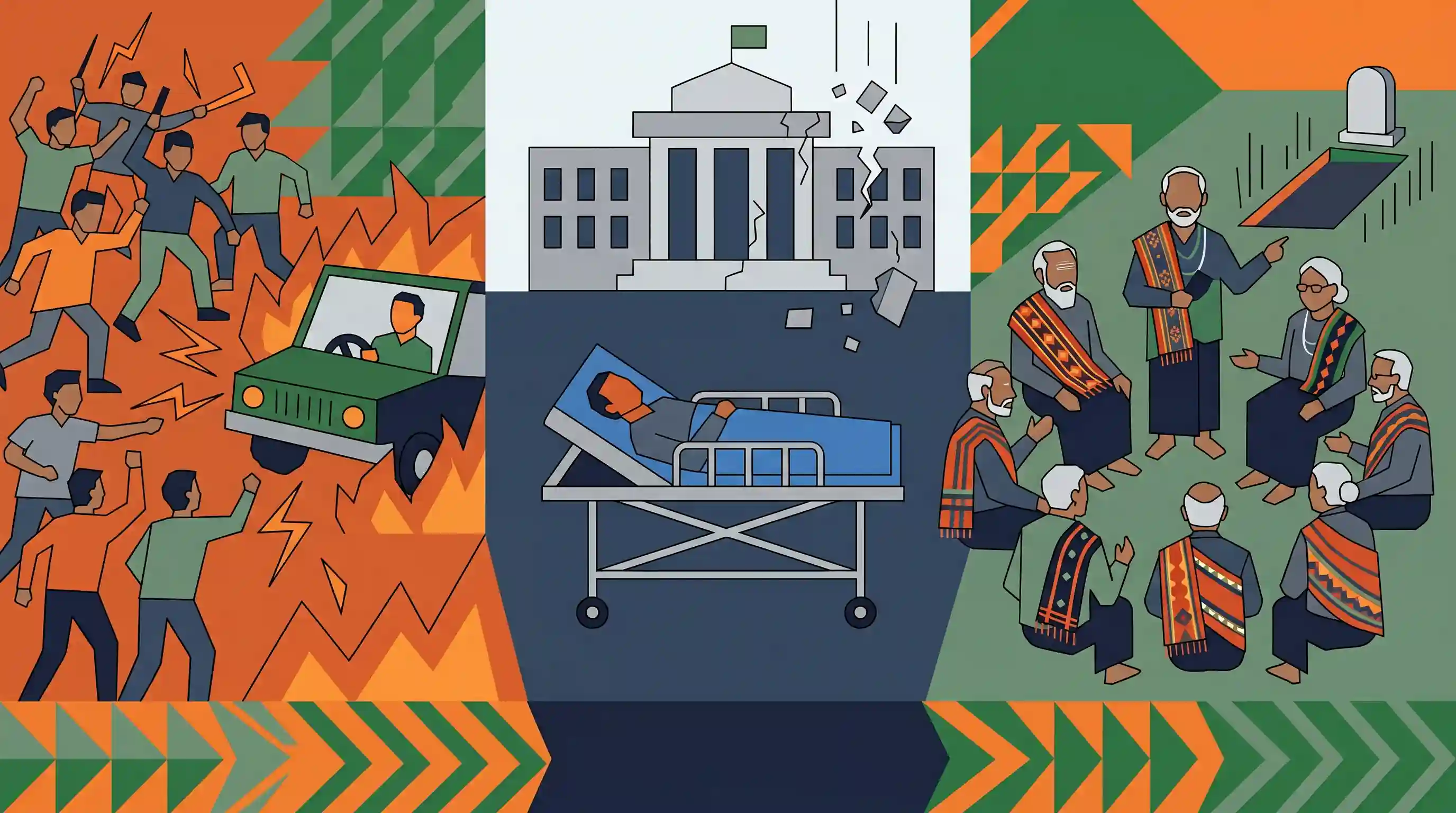
Manipur BJP MLA Vungzagin Valte, who was severely injured by a mob during the onset of the state's ethnic violence in May 2023, has passed away. Following his death, his body was moved to a district morgue, with the Zomi Council—the apex body of the Zomi tribes—stepping in to take the final call on his burial. The tragedy underscores the devastating personal and political toll of the ongoing ethnic conflict in Manipur, as well as the prominent role of tribal councils in community leadership.
Key Points
- BJP MLA Vungzagin Valte, who was severely assaulted during the initial outbreak of ethnic violence in Manipur in May 2023, has passed away.
- His body has been moved to a district morgue, and the Zomi Council, the apex body of Zomi tribes, is taking the final decision regarding his burial arrangements.
- The incident reflects the prolonged internal security crisis, the extent of ethnic polarization, and the breakdown of law and order in the state.
- The authoritative role of the Zomi Council highlights the enduring significance of tribal apex bodies in guiding community decisions and governance in Northeast India.
Important Terms
Zomi Council

The apex socio-political body representing Zomi tribes (like Paite, Zou, and Vaiphei) in Manipur. It manages customary affairs, advocates for community interests, and negotiates for political autonomy.
UPSC context
GS-II & III: Governance and Internal Security; role of non-state tribal actors in conflict management.
Article 371C
A special constitutional provision for Manipur that authorizes the President to create a "Hill Areas Committee" and assigns the Governor special responsibilities for hill administration.
UPSC context
GS-II: Indian Constitution; tests knowledge of asymmetric federalism and state-specific special provisions.
Hill Areas Committee (HAC)
A statutory body of the Manipur Legislative Assembly comprising members elected from hill districts. It monitors legislation and administration affecting tribal areas as mandated under Article 371C.
UPSC context
GS-II: Polity; specialized legislative committees and institutional safeguards for Scheduled Tribes.
Kuki-Zo
An umbrella ethnic category for related Tibeto-Burman tribes (including Kuki, Zomi, and Chin) inhabiting Manipur's hills and neighboring regions, sharing linguistic and cultural ties.
UPSC context
GS-I & III: Geography/Security; understanding ethnic demographics and conflict drivers in Northeast India.
Suspension of Operations (SoO) Agreement
A 2008 tripartite ceasefire agreement between the Centre, Manipur government, and Kuki-Zo militant groups to end hostilities and initiate political dialogue.
UPSC context
GS-III: Internal Security; peace-making processes and insurgent group management in border states.
Separate Administration
The political demand by Manipur’s hill tribes for a distinct administrative unit (like a Union Territory or Sixth Schedule Council) independent of the state government.
UPSC context
GS-II: Federalism; political solutions to deep-seated ethnic conflicts and demands for regional autonomy.
Prelims Trap
"The tribal hill areas of Manipur are protected and administered under the Sixth Schedule of the Constitution."
Manipur is governed under Article 371C (Hill Areas Committee), not the Sixth Schedule, which exclusively covers tribal areas in Assam, Meghalaya, Tripura, and Mizoram (AMTM).
Static Concepts Connected
What are the constitutional provisions of Article 371C for Manipur?
- Hill Areas Committee: Mandates the creation of a committee comprising MLAs elected from Manipur's designated Hill Areas to safeguard tribal legislative interests.
- Governor's Special Responsibility: The Governor holds special responsibility for hill area administration and must submit annual reports directly to the President of India.
- Union Executive Power: The Union government is empowered to give directives to the state government concerning the administration of these hill areas.
How do Chin-Kuki-Zomi demographics affect regional security?
- Transnational kinships: These ethnic groups inhabit contiguous areas across India, Myanmar, and Bangladesh, making hard borders difficult to enforce and deeply complicating the Free Movement Regime (FMR).
- Insurgency & Refugees: Shared ethnicity facilitates cross-border movement, providing safe havens for insurgent groups and driving refugee influxes during civil unrest in neighboring Myanmar.
Cross-Topic Patterns
Internal Security + Free Movement Regime (FMR)
The ethnic ties of the Zomi across the porous Indo-Myanmar border directly link Manipur's localized internal conflict to India's broader security decision to suspend the Free Movement Regime (FMR).
Governance Breakdown + Customary Law
The Zomi Council's authority over burial and community decisions highlights the enduring parallel power of tribal apex bodies, which often act as de facto governance structures when formal state machinery breaks down.

Article 371C (Manipur) vs 371A/G, or the geography of the Chin-Kuki-Zomi ethnic corridor, will likely feature in 2026 Prelims.
Linked PYQs · 3
Linked PYQs · 3
- 2025MainsGS3
What are the major challenges to internal security and peace process in the North-Eastern States? Map the various peace accords and agreements initiated by the government in the past decade.
- 2019MainsGS3
Cross-border movement of insurgents is only one of the several security challenges facing the policing of the border in North-East India. Examine the various challenges currently emanating across the India-Myanmar border. Also, discuss the steps to counter the challenges.
- 2015PrelimsGS1
The provisions in Fifth Schedule and Sixth Schedule in the Constitution of India are made in order to
