Electoral Roll Revision and Aadhaar Linkage Demands in Manipur
Source:Indian Express ↗
Why It Matters
This article connects the dots between GS2 (Electoral Reforms, ECI's role in maintaining the purity of electoral rolls) and GS3 (Internal Security, Border Management). It illustrates how unchecked illegal immigration can directly impact political demographics, leading to severe ethnic violence and prompting demands for stringent electoral verification measures like mandatory Aadhaar linkage.
Summary
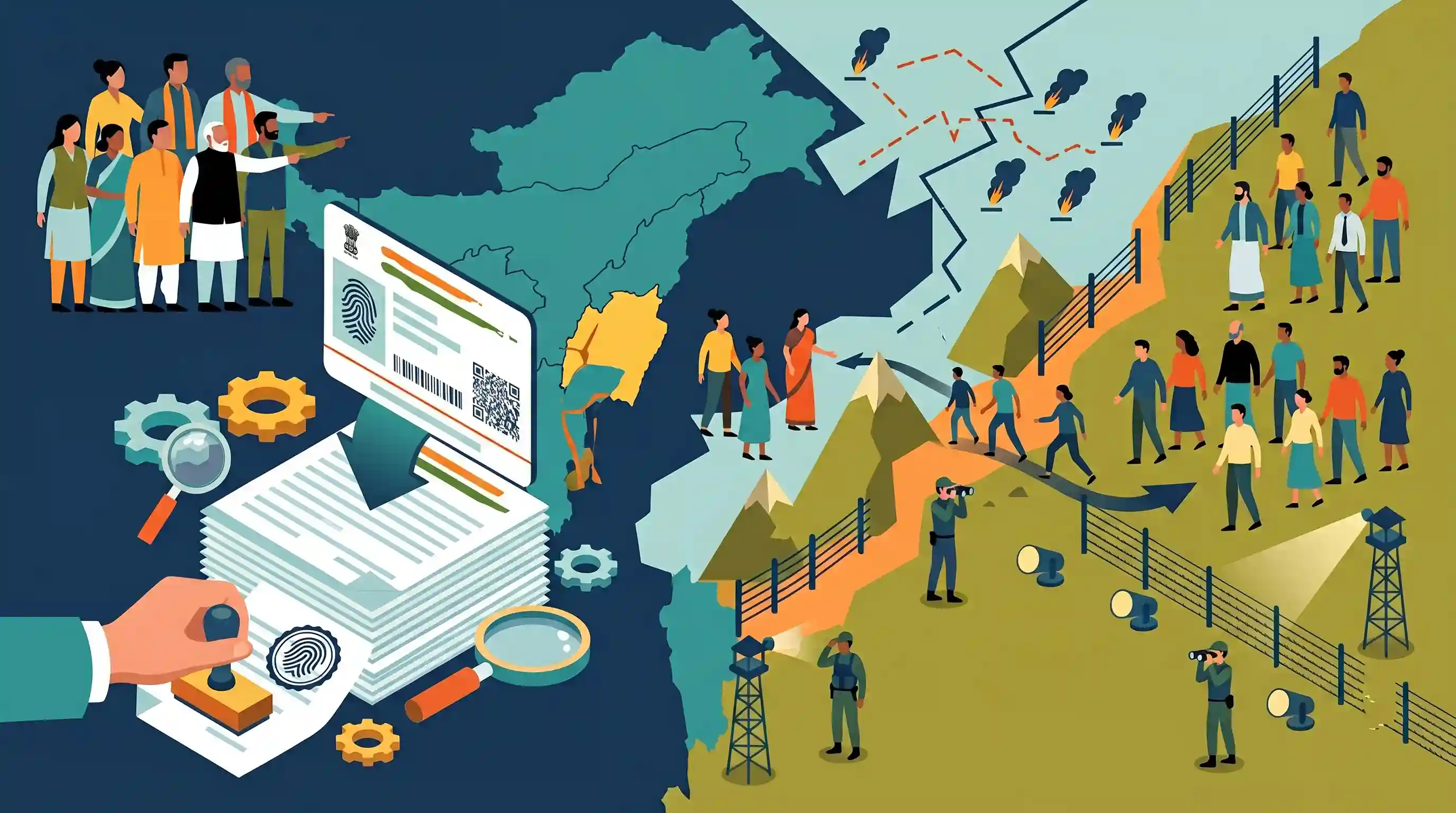
Election authorities in violence-hit Manipur have commenced outreach programs with political parties for the revision of electoral rolls. Against the backdrop of the ongoing ethnic conflict, parties across the political spectrum—including the ruling BJP—are demanding that Aadhaar linkage be made mandatory for voter registration. This unified demand is driven by widespread apprehensions over demographic changes and illegal immigration across the porous India-Myanmar border. The political consensus underscores the critical need for electoral reforms to maintain the purity of the electoral rolls and highlights the profound impact of trans-border migration on internal security and ethnic harmony in the Northeast.
Key Points
- District Election Officers in Manipur have initiated outreach with political parties regarding the revision of electoral rolls amid the state's ongoing ethnic conflict.
- Parties across the political spectrum, including the ruling BJP, have demanded that Aadhaar linkage be made mandatory for voter registration.
- The push for mandatory Aadhaar verification stems from deep-rooted anxieties over illegal immigration from Myanmar and consequent demographic shifts.
- Local political groups argue that stringent identity checks are necessary to prevent the inclusion of non-citizens in the electoral rolls, which they view as a threat to indigenous political rights.
- The scenario highlights the complex intersection of electoral integrity, border management failures, and internal security challenges in India's Northeast.
Important Terms
Special Intensive Revision (SIR)

A comprehensive, house-to-house verification drive conducted by the Election Commission of India to update, verify, and correct electoral rolls, ensuring lists are free from duplicates and ineligible entries.
UPSC context
GS Paper II (Elections). Tests understanding of electoral integrity and the ECI's administrative mechanisms for maintaining accurate voter lists.
Representation of the People Act, 1950
Legislative framework governing the allocation of seats, voter qualifications, and the preparation of electoral rolls; specifically, Section 21(3) empowers the ECI to conduct special revisions.
UPSC context
GS Paper II (Statutory Bodies/Elections). Essential for questions on the legal basis of India's democratic and representative processes.
Election Commission of India (ECI)
An autonomous constitutional body established under Article 324 responsible for the superintendence, direction, and control of all Union and State election processes in India.
UPSC context
GS Paper II (Constitutional Bodies). A core topic for prelims and mains regarding the conduct of free and fair elections.
Aadhaar Act, 2016
Legislation providing statutory backing for Aadhaar, a 12-digit unique identity number for residents, aimed at targeted benefit delivery; legally established as proof of identity, not citizenship.
UPSC context
GS Paper II (Governance) and III (Internal Security). Relevant for debates on privacy, digital identity, and exclusionary risks in voter registration.
Internal Security
The preservation of peace and sovereignty within a nation’s borders; in Manipur, this involves managing ethnic tensions, insurgency, and demographic shifts triggered by cross-border migration.
UPSC context
GS Paper III (Internal Security). Focuses on the challenges of ethnic conflict and its impact on national stability in border states.
Border Management
Strategic oversight and securing of national boundaries to prevent illegal immigration, smuggling, and cross-border insurgency, particularly vital along the porous 1,643 km India-Myanmar border.
UPSC context
GS Paper III (Internal Security). Key for understanding the nexus between trans-border migration and local demographic anxieties in the Northeast.
Electoral Rolls
The official list of citizens eligible to vote in a specific constituency, updated through annual summary revisions or special intensive drives to ensure electoral purity.
UPSC context
GS Paper II (Elections). Critical for analyzing issues of voter exclusion, inclusion, and the impact of migration on democratic representation.
Prelims Trap
Aadhaar linkage with Voter ID is mandatory under the Election Laws (Amendment) Act, 2021 to filter out non-citizens.
Aadhaar linkage is currently voluntary. Furthermore, Aadhaar is strictly proof of residence, not citizenship, making it legally insufficient on its own to identify non-citizens.
Static Concepts Connected
Who qualifies to be registered in the electoral roll under RPA 1950?
- Indian Citizen: Must be a citizen of India; non-citizens and illegal immigrants are strictly disqualified from voting.
- Age criteria: Must be not less than 18 years of age on the qualifying date (e.g., January 1st, April 1st, etc.).
- Ordinary resident: Must be ordinarily resident in that specific constituency as per Section 20 of the RPA, 1950.
How is the India-Myanmar border currently managed?
- Guarding force: The Assam Rifles is the designated Central Armed Police Force (CAPF) guarding the 1,643 km boundary.
- Free Movement Regime: Suspended recently due to internal security threats, this bilateral arrangement allowed border tribes to travel 16 km without a visa.
- Geography: The highly porous, largely unfenced border spans four states: Arunachal Pradesh, Nagaland, Manipur, and Mizoram.
Cross-Topic Patterns
Aadhaar vs Citizenship debate
Demands for Aadhaar to verify voters ironically overlook that Aadhaar establishes residence, not citizenship. This links demographic anxiety in NE to broader CAA/NRC and electoral roll purity debates.
Chin-Kuki-Zo trans-border contiguity
Trans-border ethnic ties between Myanmar's Chin state, Mizoram, and Manipur complicate border management, making physical fencing and FMR suspension socio-politically volatile for internal security.

Election Laws (Amendment) 2021 (voluntary Aadhaar linkage) paired with FMR suspension is highly likely as a 2026 Prelims multi-statement Q.
Linked PYQs · 4
Linked PYQs · 4
- 2019MainsGS3
Cross-border movement of insurgents is only one of the several security challenges facing the policing of the border in North-East India. Examine the various challenges currently emanating across the India-Myanmar border. Also, discuss the steps to counter the challenges.
- 2014MainsGS3
How does illegal transborder migration pose a threat to India's security? Discuss the strategies to curb this, bringing out the factors which give impetus to such migration.
- 2024MainsGS2
Examine the need for electoral reforms as suggested by various committees with particular reference to "one nation one election" principle.
- 2017MainsGS2
To enhance the quality of democracy in India the Election Commission of India has proposed electoral reforms in 2016. What are the suggested reforms and how far are they significant to make democracy successful?
