Manipur Delimitation Stalled Amid Ethnic Tensions and Security
Source:Indian Express ↗
Why It Matters
Delimitation is a core constitutional process for ensuring equal representation ('one vote, one value'). In regions with ethnic fault lines like Manipur, demographic data and electoral boundaries become deeply politicised, directly impacting internal security and governance. This serves as a critical case study for UPSC aspirants on the intersection of polity (Representation of People Act, Delimitation Commission) and internal security (border management, ethnic insurgency).
Summary
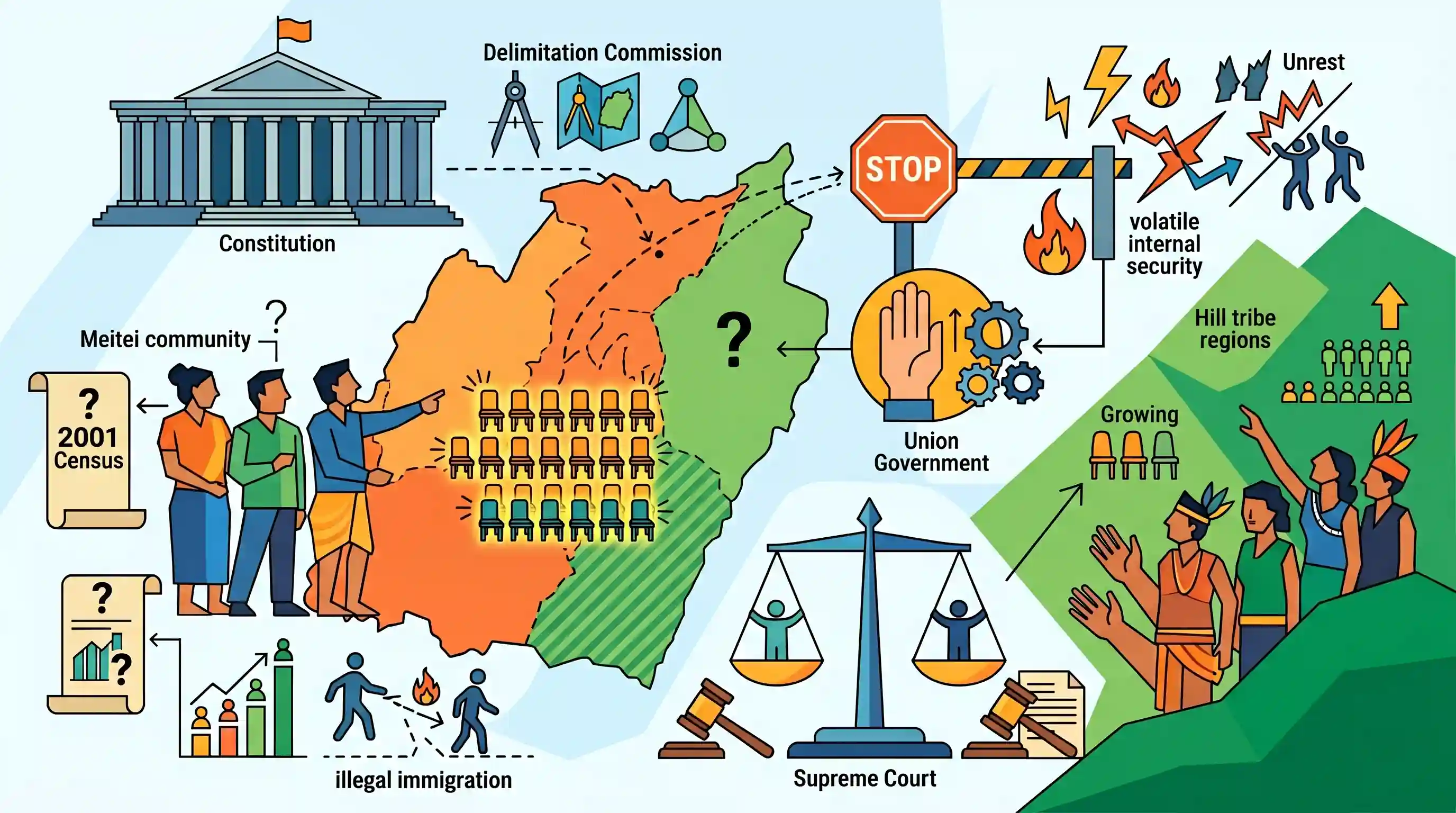
The article highlights the delayed delimitation process in Manipur, which has emerged as a deeply contentious issue intertwined with the state's ethnic conflict. Delimitation aims to redraw electoral constituencies based on population data. However, the Meitei community, which currently holds 40 out of 60 Assembly seats in the geographically smaller valley, opposes the exercise using 2001 Census data. They allege abnormal population growth in the Kuki and Naga-dominated hill districts due to illegal immigration, fearing that delimitation will shift political power away from the valley. The Centre has delayed the exercise citing volatile internal security conditions, while the Supreme Court is currently reviewing the matter. This underscores the complex interplay between demographic anxieties, political representation, and internal security in Northeast India.
Key Points
- The delimitation exercise in Manipur, intended to redraw Assembly and Lok Sabha constituencies, has become a major flashpoint amid the ongoing ethnic conflict.
- Manipur is geographically divided into a central valley (10% area, 40 Assembly seats, Meitei-dominated) and surrounding hills (90% area, 20 seats, Kuki and Naga-dominated).
- Meitei groups strongly oppose redrawing boundaries based on the 2001 Census, alleging that population figures in the hill districts were artificially inflated by illegal immigration.
- Redrawing boundaries based on the contested census data could shift political representation and Assembly seats from the valley to the hills, exacerbating Meitei fears of political marginalisation.
- The Supreme Court is currently examining the delay in the delimitation process, while the Centre has deferred it citing sensitive law and order conditions and internal security risks.
Important Terms
Delimitation Commission of India

An independent, high-powered body appointed by the President to redraw the boundaries of Lok Sabha and Assembly constituencies. Its orders have the force of law and cannot be challenged in court.
UPSC context
GS Paper-II/Constitutional Bodies. Tests understanding of electoral geography, representation, and the mechanism for maintaining 'one vote, one value'.
Article 82 of the Indian Constitution
Constitutional provision mandating the Parliament to enact a Delimitation Act after every decennial Census to readjust the allocation of seats and territorial division of constituencies.
UPSC context
GS Paper-II/Indian Constitution. Crucial for understanding the constitutional basis of electoral reforms and the legal requirement for demographic representation.
Delimitation Act, 2002
The statutory framework for the last nationwide delimitation exercise. In Manipur, its implementation was deferred in 2008 due to security concerns but revived via a 2020 Presidential order.
UPSC context
GS Paper-II/Elections and Governance. Relevant for studying the legal obstacles to redrawing constituencies in conflict-prone regions like Manipur.
Election Commission of India
The permanent constitutional body that collaborates with the Delimitation Commission. Under Section 8A of the RP Act 1950, it can be empowered by the Centre to conduct delimitation in specific Northeast states.
UPSC context
GS Paper-II/Constitutional Bodies. Tests knowledge of ECI’s additional statutory roles beyond conducting elections, particularly in specific regional contexts.
Supreme Court of India
The highest judicial authority currently reviewing petitions regarding the delay in Manipur's delimitation. In 2025, it granted the Centre a timeline to address the stalled exercise in the Northeast.
UPSC context
GS Paper-II/Judiciary. Highlights the court's role in enforcing statutory mandates when political or ethnic deadlocks stall constitutional processes.
Prelims Trap
"The Delimitation Commission is exclusively mandated to conduct the deferred delimitation exercise in Manipur."
Under Section 8A of the Representation of the People Act 1950, the Election Commission of India (ECI), not the Delimitation Commission, conducts delimitation in Manipur once deferment is lifted.
Static Concepts Connected
How does the Constitution mandate delimitation of electoral constituencies?
- Article 82: Parliament enacts a Delimitation Act after every census to readjust the allocation of seats.
- Article 170: Mandates the readjustment of territorial constituencies for State Legislative Assemblies after each census.
- Judicial Immunity: Under Article 329(a), orders issued by the Delimitation Commission have the force of law and cannot be questioned in any court.
What is the executive power to defer the delimitation process?
- Section 10A: The Delimitation Act 2002 empowers the President to defer the exercise in any state if there is a serious threat to peace, public order, or national unity.
- Used in 2008: This provision was invoked in 2008 to freeze the exercise in four states: Assam, Arunachal Pradesh, Manipur, and Nagaland due to volatile internal security conditions.
Cross-Topic Patterns
FMR, Immigration, and Demographic Anxiety
The delimitation dispute directly ties to the recent scrapping of the Free Movement Regime (FMR) with Myanmar, as indigenous groups fear illegal immigration is skewing census data and altering political power.
Article 371C and Hill Governance Asymmetry
Manipur's delimitation crisis highlights the tension between valley political dominance and protected tribal autonomy under Article 371C, which established special Hill Area Committees for the state's tribal regions.

Expect a 2026 Prelims question mixing Article 82, ECI's special role under RPA Sec 8A for NE states, and judicial review of delimitation.
Linked PYQs · 3
Linked PYQs · 3
- 2024PrelimsGS1
How many Delimitation Commissions have been constituted by the Government of India till December 2023?
- 2025MainsGS3
What are the major challenges to internal security and peace process in the North-Eastern States? Map the various peace accords and agreements initiated by the government in the past decade.
- 2019MainsGS3
Cross-border movement of insurgents is only one of the several security challenges facing the policing of the border in North-East India. Examine the various challenges currently emanating across the India-Myanmar border. Also, discuss the steps to counter the challenges.
