Manipur Demographic Deadlock Deepens Over Census and NRC Demands
Source:The Hindu ↗
हे का महत्त्वाचे आहे
The dispute over the Census and NRC in Manipur is a prime example of how demographic anxiety translates into deep internal security and constitutional dilemmas. It provides critical lessons on federal relations in administrative tasks like the Census, the geopolitical challenges of managing the open India-Myanmar border, and the delicate administrative task of balancing indigenous community anxieties with humanitarian considerations.
सारांश
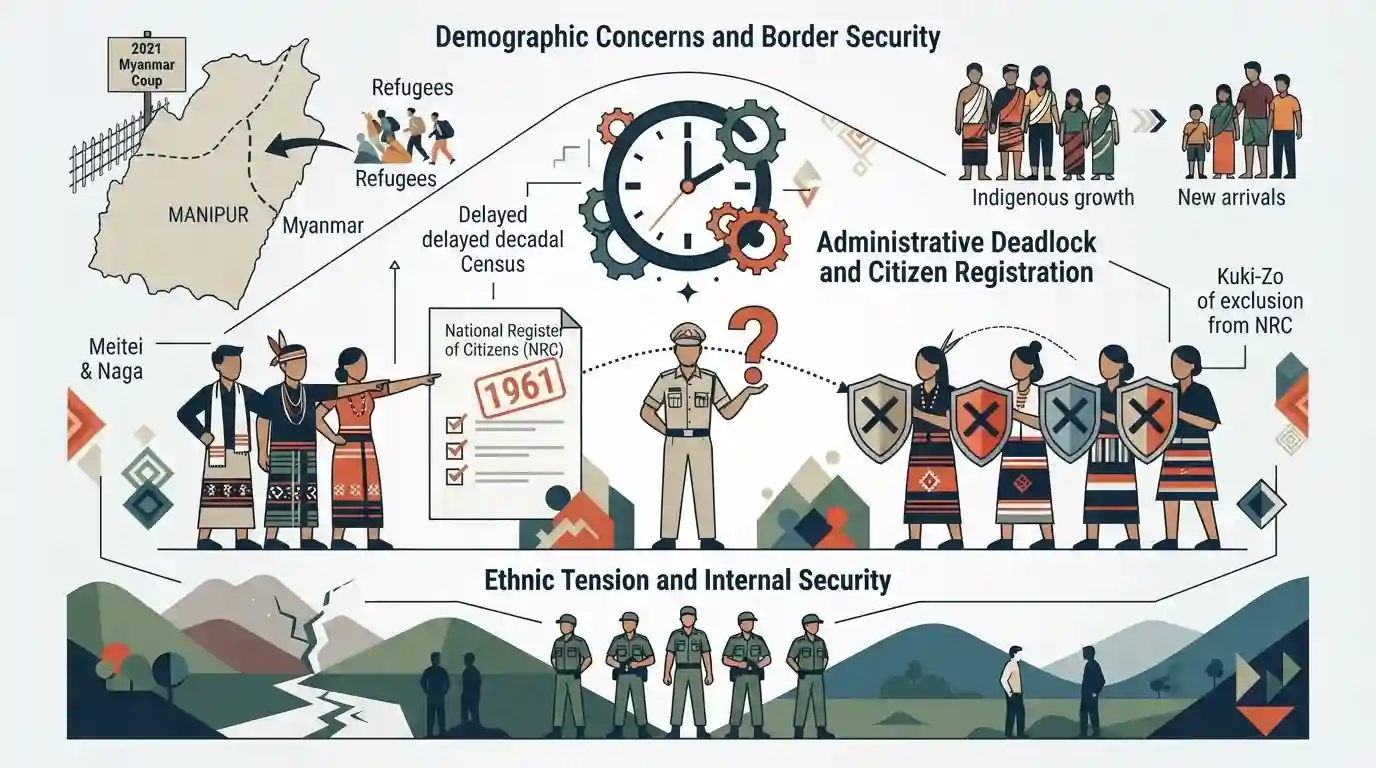
The state of Manipur is experiencing a deep administrative and political deadlock over the delayed decadal Census. Meitei and Naga groups are urging the Central government to implement a National Register of Citizens (NRC) with a 1961 cutoff year before any Census operations begin. They fear the Census will legitimize undocumented immigrants from Myanmar who crossed over following the 2021 military coup. Conversely, Kuki-Zo groups oppose the NRC, fearing it will be used to systematically target and disenfranchise their community. The debate highlights the complex nexus of demography, citizenship, border security, and ethnic tensions in Northeast India.
मुख्य मुद्दे
- Meitei and Naga civil society groups are demanding that the National Register of Citizens (NRC) be updated with 1961 as the base year before the delayed decadal Census is conducted in Manipur.
- Proponents of the NRC first approach argue that conducting a Census prior to identifying illegal immigrants would inadvertently regularize and legitimize the massive influx of undocumented migrants fleeing post-coup Myanmar.
- The Manipur Legislative Assembly has previously passed resolutions urging the Union Government to establish a state-specific NRC to protect the indigenous communities from demographic distortion.
- Kuki-Zo communities strongly oppose these demands, stating that the 1961 base year is an arbitrary mechanism to target and disenfranchise tribal populations who historically lack formal land deeds and documentation.
- The issue highlights broader geopolitical and security realities, including the suspension of the India-Myanmar Free Movement Regime (FMR) and the physical fencing of the border to curb unregulated migration.
महत्त्वाच्या संज्ञा
National Register of Citizens (NRC)

A legal register of Indian citizens. In Manipur, Meitei and Naga groups are demanding an NRC with a 1961 base year to identify and exclude undocumented immigrants, particularly those fleeing Myanmar's 2021 coup.
UPSC context
GS-2 (Citizenship) & GS-3 (Internal Security). Tests the legal framework of citizenship, demographic shifts, and internal security challenges.
Free Movement Regime (FMR)
A recently suspended bilateral arrangement allowing tribes along the Indo-Myanmar border to travel up to 16 km into the other country visa-free. It recognized historical trans-border ethnic and familial ties.
UPSC context
GS-3 (Border Management). Crucial for topics on the Act East policy, porous borders, illegal immigration, and cross-border insurgency.
Census Act 1948
The central legislation governing India's decennial population enumeration. It provides the legal framework for conducting the Census and ensures data confidentiality, though the current delay has sparked political and ethnic deadlocks.
UPSC context
GS-1 (Population) & GS-2 (Governance). Relevant for understanding the statutory basis of data collection, demographic planning, and federal relations.
Citizenship Act 1955
The foundational federal law governing the acquisition, determination, and termination of Indian citizenship. Under Section 14A, it provides the legal and statutory framework for maintaining the National Register of Citizens.
UPSC context
GS-2 (Polity). Essential for evaluating the constitutional rules of citizenship, statutory amendments, and the legal basis of the NRC.
Coordinating Committee on Manipur Integrity (COCOMI)
The Coordinating Committee on Manipur Integrity is a prominent Meitei civil society coalition. It strongly advocates for Manipur's territorial integrity and is a central voice demanding the NRC and opposing Kuki-Zo armed groups.
UPSC context
GS-3 (Internal Security). Highly relevant for analyzing the role of ethnic civil society organizations and non-state actors in Northeast insurgencies.
Kuki-Inpi
The traditional apex administrative and civil society body representing the Kuki tribes in Manipur. It actively opposes the NRC demands and electoral revisions without first safeguarding internally displaced Kuki-Zo people.
UPSC context
GS-3 (Internal Security). Important for grasping tribal governance structures, ethnic fault lines, and the Kuki-Zo perspective in the conflict.
पूर्वपरीक्षा सापळा
State governments in the North-East possess statutory powers to conduct and implement their own state-specific National Register of Citizens.
Only the Union Government can conduct an NRC under the Citizenship Act, 1955. States like Manipur can only pass Assembly resolutions requesting the Centre to initiate the process.
संबंधित स्थिर संकल्पना
How does a Census legally differ from the National Register of Citizens (NRC)?
- Statutory Backing: The Census is conducted under the Census Act, 1948, while the NRC is updated under the Citizenship Act, 1955.
- Core Objective: The Census captures macro demographic data but does not confer citizenship. The NRC specifically aims to identify legal Indian citizens and weed out undocumented immigrants.
- Confidentiality: Census data is legally confidential and cannot be used for individual identification or prosecution. The NRC explicitly creates an identifiable, public register of individuals.
What was the Free Movement Regime (FMR) on the Indo-Myanmar border?
- Origins: Formalised in 2018 as part of the Act East policy to facilitate traditional cultural and trade ties among trans-border ethnic tribes.
- Provisions: It allowed tribes living along the border to travel up to 16 km inside the other country without a visa, using a border pass valid for a year.
- Current Status: Suspended by the Centre in 2024 due to severe internal security concerns, including illegal migration, insurgency, and arms smuggling exacerbated by the Myanmar coup.
आंतर-विषय नमुने
Insurgency, Migration, and the Golden Triangle
The scrapping of FMR and border fencing are not just demographic measures; they directly link to curbing narcotics smuggling from the adjacent Golden Triangle (Myanmar, Laos, Thailand), which funds local insurgencies.
Forest Rights vs. Citizenship Proof
The Kuki-Zo community's lack of historical land deeds mirrors the broader national challenge in implementing the Forest Rights Act, where indigenous tribal populations struggle to provide documentary proof of historical residency.

Expect a multi-statement question combining the statutory basis of the Census, the Citizenship Act (NRC), and the scrapping of the FMR.
संबंधित PYQ · 2
संबंधित PYQ · 2
- 2019MainsGS3
Cross-border movement of insurgents is only one of the several security challenges facing the policing of the border in North-East India. Examine the various challenges currently emanating across the India-Myanmar border. Also, discuss the steps to counter the challenges.
- 2017MainsGS3
The North-East region of India has been infested with insurgency for a very long time. Analyze the major reasons for the survival of armed insurgency in this region.
