Karaikal fishing village faces severe infrastructure and water crises
Source:The Hindu ↗
Why It Matters
This case study exemplifies the on-ground challenges in ensuring basic civic amenities—such as safe drinking water, sanitation, and rural connectivity—highlighting the critical role of local governance and the effective implementation of schemes like WASH and Jal Jeevan Mission for vulnerable communities.
Summary
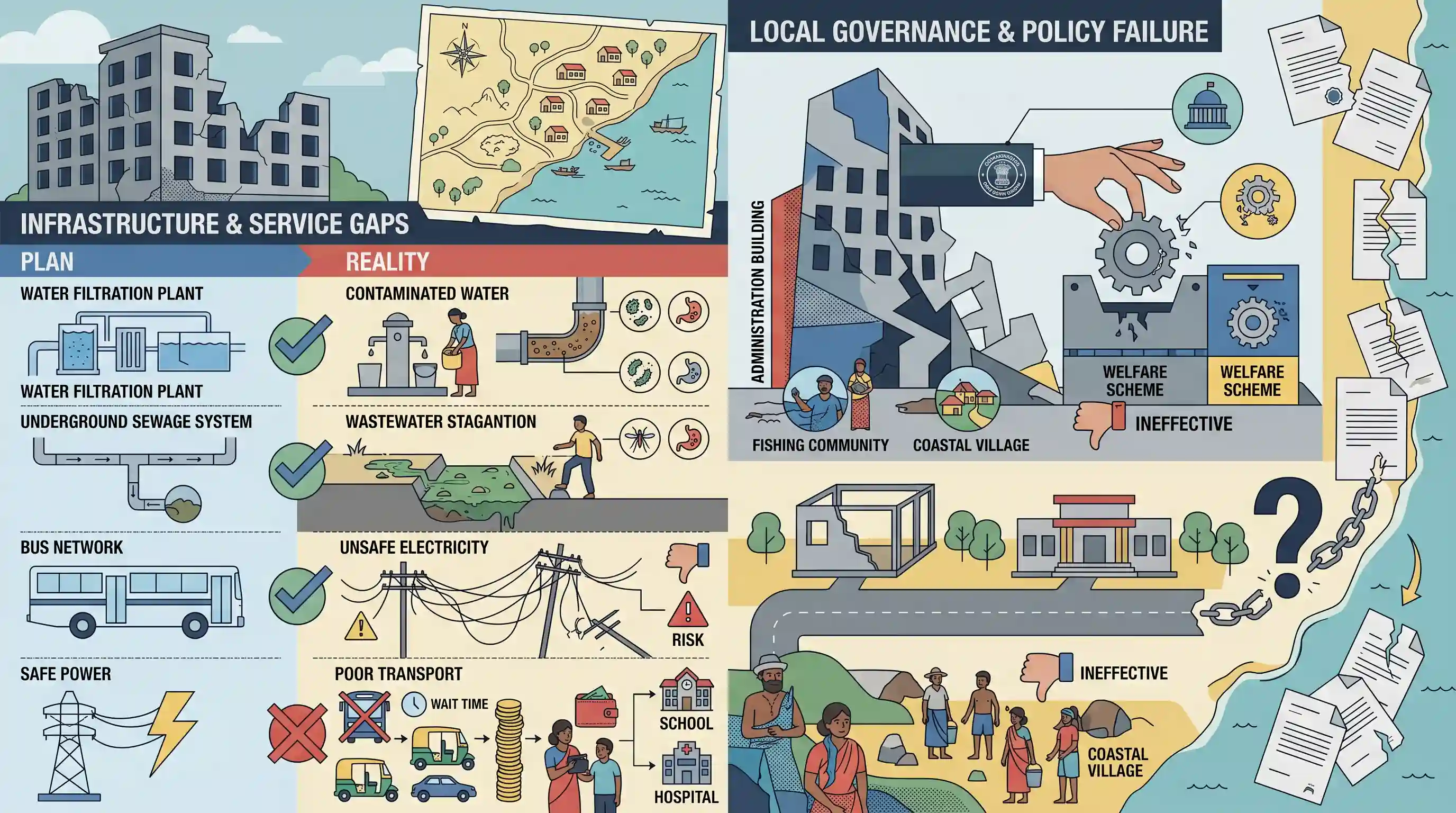
The article underscores the dire infrastructural deficits plaguing Mandapathur, a fishing village in Karaikal, Puducherry. The local community is grappling with multiple civic challenges, including the supply of contaminated drinking water, lack of a proper sewage system resulting in wastewater stagnation, and unsafe electrical infrastructure. Compounding these issues is poor public transport connectivity, which increases the financial burden on residents. The situation highlights significant gaps in local governance and the ineffective implementation of basic welfare and developmental policies meant for vulnerable coastal communities.
Key Points
- Mandapathur, a fishing village in Karaikal, is severely affected by a lack of basic infrastructure, significantly hampering residents' quality of life.
- The village faces critical shortages of safe drinking water, with public distribution points supplying contaminated water containing visible black particles.
- Inadequate sanitation infrastructure has led to wastewater stagnating in residential areas, causing severe hygiene and health concerns.
- Structurally weak and aging electric poles pose a continuous safety threat, particularly during strong winds and adverse weather.
- Poor public transport and road connectivity exacerbate the community's socio-economic vulnerability by increasing commuting costs.
Important Terms
Jal Jeevan Mission (JJM)

Flagship initiative aiming to provide Functional Household Tap Connections (FHTC) to every rural household, ensuring 55 litres of potable water per capita per day through community-led management.
UPSC context
GS II (Welfare Schemes) and GS III (Infrastructure). Tests implementation of tap-water targets and sustainable water management.
WASH
An integrated framework of Water, Sanitation, and Hygiene services essential for public health, focusing on safe water, waste containment, and hygienic practices to prevent diseases.
UPSC context
GS II (Public Health). Crucial for SDG 6, human rights, and evaluating health-governance linkages.
Pradhan Mantri Matsya Sampada Yojana (PMMSY)
Flagship scheme for the sustainable development of the fisheries sector, targeting infrastructure modernization, productivity enhancement, and the socio-economic welfare of fishing communities.
UPSC context
GS III (Economics/Infrastructure). Tests knowledge of sectoral development, blue economy, and vulnerable community welfare.
Swachh Bharat Mission-Grameen (SBM-G)
A national campaign for rural sanitation; Phase II focuses on sustaining Open Defecation Free (ODF) status and implementing solid and liquid waste management (SLWM).
UPSC context
GS II (Governance). Evaluates the shift from infrastructure construction to behavior change and service delivery.
Coastal Regulation Zone (CRZ)
A regulatory framework managing human activities and development within 500 meters of the high tide line to protect coastal ecosystems and ensure fisherfolk livelihoods.
UPSC context
GS III (Environment). Tests understanding of environmental legislation and balancing conservation with community needs.
ODF Plus
A status awarded to villages that sustain ODF status and implement effective solid and liquid waste management systems to ensure overall environmental cleanliness.
UPSC context
GS II (Social Justice/Health). Relevant for evaluating rural sanitation sustainability and waste management policy implementation.
Prelims Trap
"The Right to clean drinking water is a statutory right derived from the Jal Jeevan Mission."
It is a Fundamental Right implicitly protected under Article 21 (Right to Life) through Supreme Court jurisprudence, predating recent statutory water missions.
Static Concepts Connected
Which key items in the 11th Schedule address coastal village infrastructure deficits?
- Drinking Water: Item 11 empowers Panchayati Raj Institutions to manage the local provision and maintenance of safe drinking water systems.
- Rural Electrification: Item 14 covers electricity distribution, placing the onus on local bodies to monitor and report unsafe electrical infrastructure.
- Health & Sanitation: Item 23 includes rural sanitation and public health, directly addressing issues like wastewater stagnation and sewage management.
What does ODF Plus under Swachh Bharat Mission (Gramin) Phase-II mandate?
- Greywater Management: Requires 100% treatment and reuse of greywater through community infrastructure like soak pits and waste stabilization ponds.
- Visual Cleanliness: Villages must maintain sustained visual cleanliness, ensuring minimal litter and absolutely no stagnant wastewater in public or residential areas.
- Institutional Capacity: Empowers Gram Panchayats and Village Water and Sanitation Committees (VWSCs) to manage long-term operation and maintenance.
Cross-Topic Patterns
PMMSY & Coastal Village Infrastructure
The Pradhan Mantri Matsya Sampada Yojana extends beyond fish production to fund modern, climate-resilient coastal villages, addressing the exact physical infrastructural gaps seen in Karaikal.
Quantitative vs. Qualitative Delivery
Jal Jeevan Mission highlights a frequent governance pattern where physical infrastructure targets (tap connections) are met, but qualitative delivery and operational maintenance (water purity) fail locally.

Expect a Mains question examining the paradox of 'Har Ghar Jal' quantitative coverage versus qualitative local O&M failures and contamination.
Linked PYQs · 3
Linked PYQs · 3
- 2024MainsGS2
Analyse the role of local bodies in providing good governance at local level and bring out the pros and cons merging the rural local bodies with the urban local bodies.
- 2017MainsGS2
To ensure effective implementation of policies addressing water, sanitation and hygiene needs the identification of the beneficiary segments is to be synchronized with the anticipated outcomes." Examine the statement in the context of the WASH scheme.
- 2019MainsGS2
Performance of welfare schemes that are implemented for vulnerable sections is not so effective due to absence of their awareness and active involvement at all stages of policy process. Discuss.
