UN Backed Report Declares Famine Crisis in Gaza
Source:The Hindu ↗
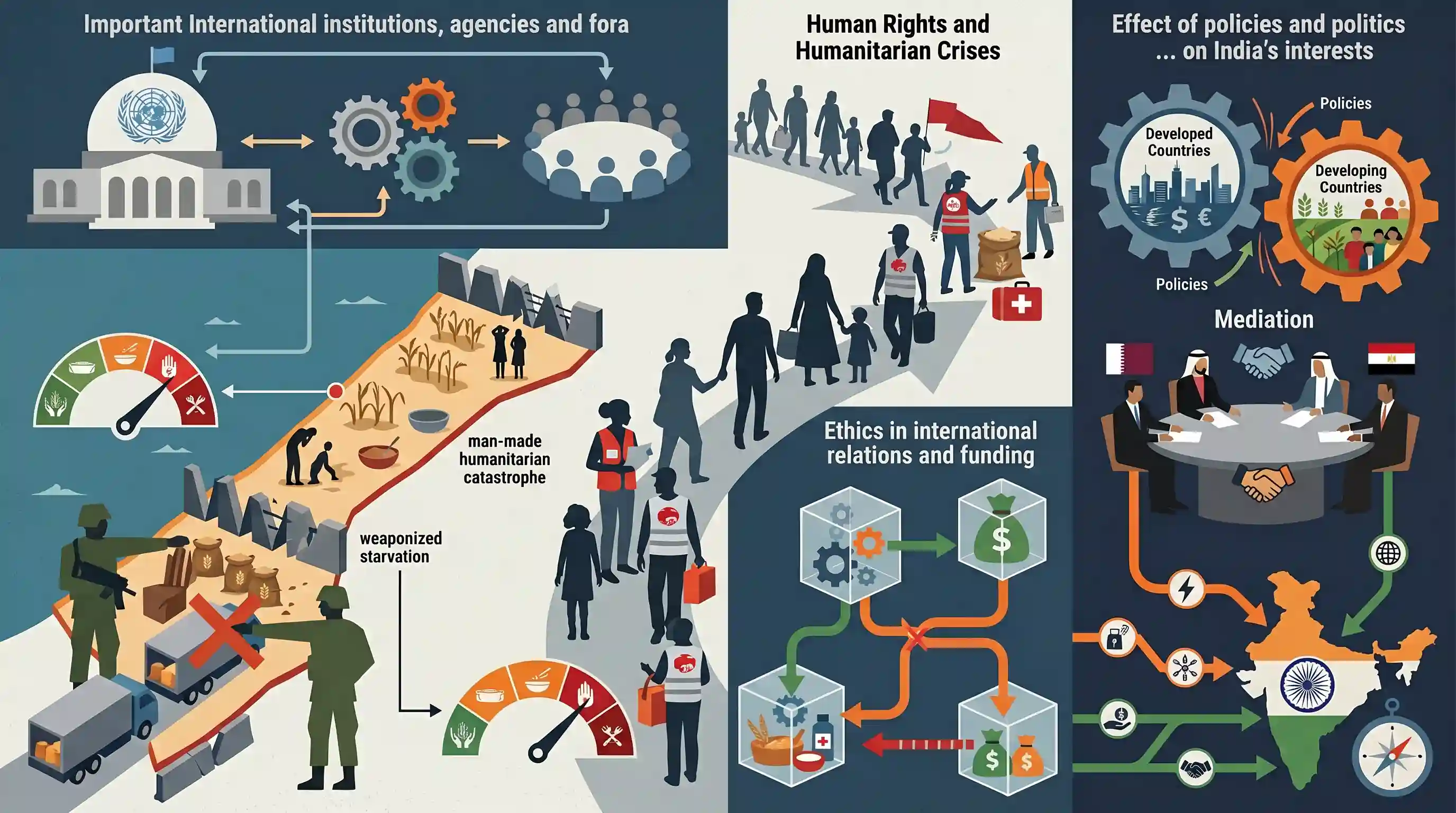
Why It Matters
The crisis in Gaza is a critical case study for UPSC aspirants on international relations, the efficacy of the UN, and ethics in warfare. It highlights the weaponization of essential resources (starvation) in conflicts, testing the boundaries of international humanitarian law and the role of global powers in mediating or exacerbating geopolitical crises in West Asia.
Summary
The UN-backed Integrated Food Security Phase Classification (IPC) has declared a famine in Gaza, highlighting a deliberate, man-made humanitarian catastrophe orchestrated by Israel. Despite international pressure and available mediation from Qatar and Egypt, Israel's severe blockade and military operations continue to weaponize starvation. This strategy has marginalized traditional UN aid mechanisms, caused massive civilian casualties, and constitutes a profound crisis for international law and humanitarian ethics.
Key Points
- The UN-backed Integrated Food Security Phase Classification (IPC) has officially declared a famine in Gaza, marking the first such emergency in West Asia, with acute child malnutrition and rampant household starvation.
- Israel has exacerbated the crisis by intensifying a blockade that originated in 2007, culminating in a devastating total blockade imposed earlier in the year.
- UN-led food distribution operations have been systematically dismantled and replaced by the U.S. and Israeli-backed Gaza Humanitarian Foundation (GHF), which has seen rampant civilian casualties at its food centres.
- The crisis underscores the severe weaponization of starvation in warfare, demonstrating a calculated intent by Israeli authorities to destroy Palestinian life despite available ceasefire options mediated by Egypt and Qatar.
Important Terms
Integrated Food Security Phase Classification (IPC)

A global multi-partner initiative providing a standardized five-phase scale to classify food insecurity severity. Phase 5 (Catastrophe/Famine) indicates extreme food lack, destitution, and critical mortality levels.
UPSC context
GS Paper 2 & 3: Important international agencies; issues relating to hunger/food security; objective metrics for humanitarian intervention.
International Humanitarian Law (IHL)
A set of rules (e.g., Geneva Conventions) that limits the effects of armed conflict. It specifically prohibits the use of starvation of civilians as a method of warfare.
UPSC context
GS Paper 2 & 4: International relations ethics; mandate of global institutions; legal frameworks for human rights during conflict.
Gaza Humanitarian Foundation (GHF)
A controversial, private US-Israeli-backed mechanism (2025) designed to distribute aid in Gaza while bypassing UN channels. Criticized for politicizing aid and failing to uphold neutral humanitarian principles.
UPSC context
GS Paper 2: Effects of policies of developed countries; ethics in international funding and aid distribution.
Hamas
A Palestinian Islamist political and militant organization that has been the de facto governing authority of the Gaza Strip since 2007, following an electoral victory and subsequent conflict with Fatah.
UPSC context
GS Paper 2: West Asia geopolitics; impact of non-state actors on international security and India's interests.
Gaza Strip
A densely populated Palestinian territory on the Mediterranean coast, bordering Israel and Egypt. It has been under a blockade since 2007 and is currently the center of a severe humanitarian crisis.
UPSC context
GS Paper 1 & 2: World Geography (Places in News); International Relations (Middle East conflict).
Prelims Trap
Famine is officially declared through a political resolution by the United Nations Security Council.
Famine is a technical classification (IPC Phase 5) determined by agencies like FAO/WFP using strict quantitative metrics (malnutrition/mortality rates), not a political UNSC declaration.
Static Concepts Connected
What are the criteria for declaring a Famine (IPC Phase 5)?
- Extreme Shortages: At least 20% of households face an extreme lack of food and destitution.
- Acute Malnutrition: Acute malnutrition rates among children exceed 30% of the population.
- Mortality Rate: Death rates exceed 2 persons (or 4 children) per 10,000 people per day due to starvation or disease.
How does International Law address the weaponization of starvation?
- Rome Statute: Article 8 explicitly classifies the intentional starvation of civilians and depriving them of indispensable survival objects as a war crime.
- UNSC Res 2417: Expressly condemns the starving of civilians and the unlawful denial of humanitarian access as a method of warfare.
- Geneva Conventions: Mandate the free passage of essential foodstuffs and medical supplies for civilian populations during armed conflicts.
Cross-Topic Patterns
India's De-hyphenation in West Asia
India balances strategic defense and technology ties with Israel alongside its historical backing of a Palestinian two-state solution and UNRWA funding, illustrating a mature de-hyphenated foreign policy.
Decline of neutral multilateral aid
Dismantling neutral UN operations for politically conditional aid initiatives links directly to GS4 (Ethics in IR), highlighting the erosion of non-discriminatory humanitarian assistance in modern warfare.

Expect a 2026 prelims question on IPC Phase 5 metrics or the Rome Statute, and a mains question on the weaponization of humanitarian aid.
Linked PYQs · 3
Linked PYQs · 3
- 2018MainsGS2
“India’s relations with Israel have, of late, acquired a depth and diversity, which cannot be rolled back.” Discuss.
- 2025MainsGS2
"The reform process in the United Nations remains unresolved, because of the delicate imbalance of East and West and entanglement of the USA vs. Russo-Chinese alliance.” Examine and critically evaluate the East-West policy confrontations in this regard.
- 2023MainsGS4
International aid' is an accepted form of helping 'resource-challenged' nations. Comment on 'ethics in contemporary international aid'. Support your answer with suitable examples.
