West Bengal Political Rallies and INDIA Bloc National Unity
Source:the-shillong-times ↗
Why It Matters
Demonstrates the complex dynamics of regional vs. national alliances (INDIA bloc) and highlights key historical events in West Bengal politics (1993 Writers' Building march). It also touches on defamation, which is relevant to reasonable restrictions on free speech.
Summary
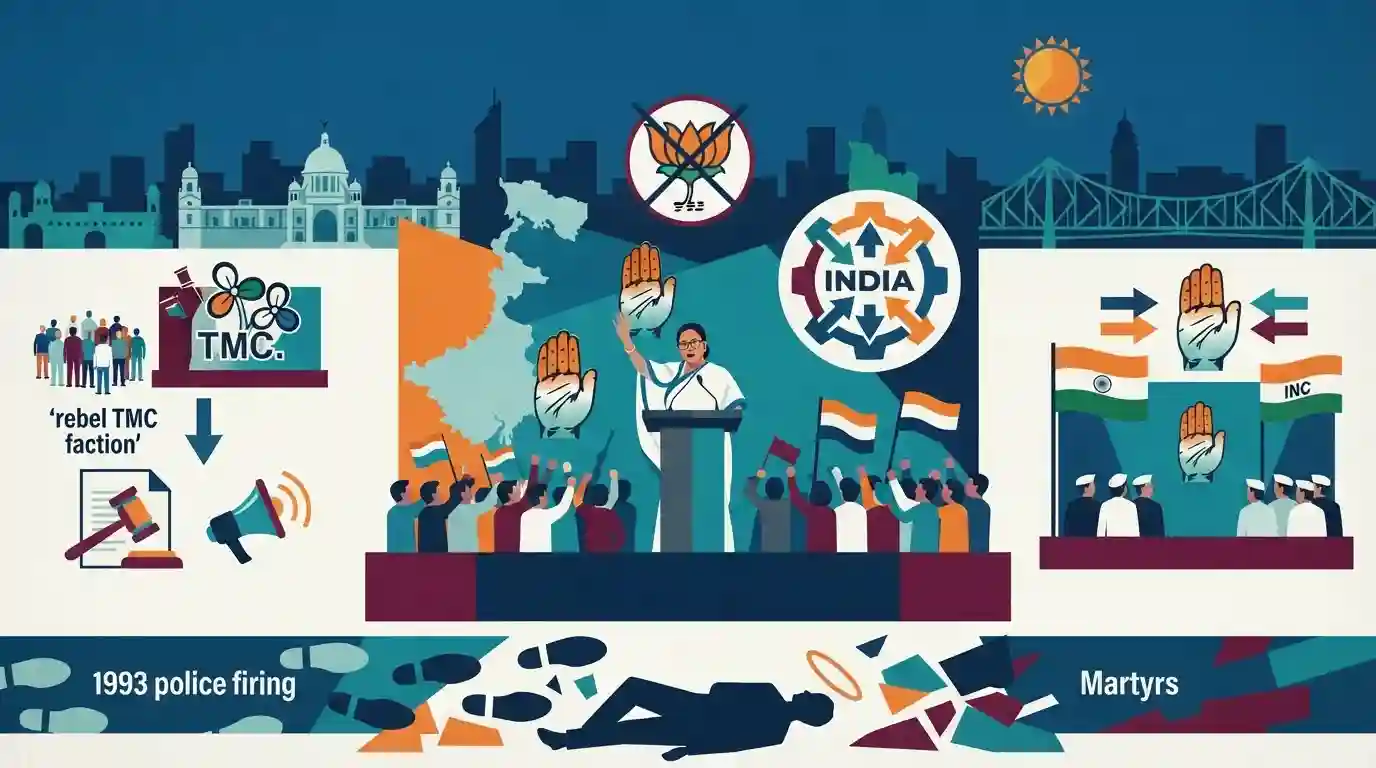
On West Bengal's 'Martyrs' Day', marking the 1993 police firing on Youth Congress workers, parallel rallies were organized by Chief Minister Mamata Banerjee, a rebel TMC faction, and the Congress. Banerjee used the occasion to call for the national unity of the INDIA bloc to defeat the BJP in upcoming elections. The parallel events, along with a defamation notice sent by Abhishek Banerjee to Madan Mitra, highlighted deepening internal rifts within the state's ruling Trinamool Congress.
Key Points
- West Bengal CM Mamata Banerjee appealed for unity within the INDIA bloc (TMC, Congress, CPI-M) at the national level to unseat the BJP in the 2029 general elections.
- 'Martyrs' Day' is observed annually on July 21 to commemorate the deaths of 13 Youth Congress workers in a 1993 police firing during the Left Front government's tenure.
- Internal rifts in the TMC were highlighted by a parallel rally held by a rebel faction, indicating a political party split.
- TMC leader Abhishek Banerjee sent a legal defamation notice to rival leader Madan Mitra, bringing focus to political discourse and defamation laws.
Important Terms
INDIA bloc

A multi-party alliance of Indian opposition parties formed in 2023 to coordinate electorally and present a united front against the ruling Bharatiya Janata Party (BJP).
UPSC context
GS Paper II (Polity & Governance). Relevant for understanding coalition politics, federalism, and the dynamics of multi-party systems in India.
Trinamool Congress (TMC)
A major Indian political party founded in 1998 by Mamata Banerjee, primarily active in West Bengal, where it has served as the ruling party since 2011.
UPSC context
GS Paper II (Polity & Governance). Tests knowledge of regional/state parties, anti-incumbency, and federal relations.
Left Front
A coalition of left-leaning and communist political parties in West Bengal, led by the CPI(M), which governed the state continuously for 34 years from 1977 to 2011.
UPSC context
GS Paper II (Polity & Governance). Illustrates the history of coalition governance, land reforms, and ideological political alignments in states.
CPI(M)
A national political party in India that split from the CPI in 1964, championing socialist principles and leading the historic Left Front government in West Bengal.
UPSC context
GS Paper II (Polity & Governance). Crucial for questions on national party status, ideology-based politics, and decentralized local governance.
Congress
One of India's oldest and major national political parties, dominant throughout post-independence history, and currently a key anchor of the national opposition alliance.
UPSC context
GS Paper II (Polity & Governance). Examines the party system evolution, national opposition dynamics, and historic party dominance in India.
BJP
A major national political party in India, founded in 1980, characterized by nationalist ideology, and currently leading the central coalition government.
UPSC context
GS Paper II (Polity & Governance). Analyzes national party structures, electoral mandates, and majoritarian or coalition governance at the Centre.
Youth Congress
The youth wing of the Indian National Congress (INC), historically active in grassroot mobilizations, protests, and training young political leaders in India.
UPSC context
GS Paper II (Polity & Governance). Tests understanding of the role of political party wings, pressure groups, and youth mobilization in democratic processes.
Prelims Trap
A legislative faction representing one-third of a political party is exempt from disqualification under the Tenth Schedule during a split.
The 91st Constitutional Amendment (2003) completely abolished the split exemption. Currently, only a merger involving at least two-thirds of party members is protected.
Static Concepts Connected
How does the Election Commission resolve political party splits under Paragraph 15 of the Symbols Order?
- ECI Jurisdiction: Under Paragraph 15 of the Symbols Order, 1968, the ECI is the sole authority to decide disputes when a recognized party splits.
- Test of Majority: The ECI evaluates support in both the legislative wing (MPs and MLAs) and the organizational wing to determine the legitimate faction.
- Unrecognized Parties Limit: This adjudicatory power is limited to recognized parties; split disputes in unrecognized registered parties are directed to civil courts.
What is the constitutional standing of Defamation in India?
- Article 19(2) Limit: Article 19(2) lists defamation as a reasonable restriction on the fundamental right to freedom of speech and expression.
- Article 21 Integration: The Supreme Court in Subramanian Swamy (2016) declared the right to reputation as an integral component of the Right to Life.
- Dual Remedies: Defamation remains both a civil tort for damages and a criminal offense under the Bharatiya Nyaya Sanhita (BNS).
Cross-Topic Patterns
Coalition politics vs state-level rifts
Explores how local political rivalries and split dynamics within regional parties undermine cohesive national coalition building (like the INDIA bloc) ahead of general elections.
ECI symbols order vs Anti-Defection Law
Analyzes the jurisdictional interplay between the Election Commission's power to allocate symbols under Paragraph 15 and the Speaker's power to disqualify under the Tenth Schedule.

Analysis of ECI’s exclusive jurisdiction over party symbols (Paragraph 15) vs Speaker's Tenth Schedule powers will likely feature in 2026.
Linked PYQs · 2
Linked PYQs · 2
- 2019WBCS_PRELIMSGS1
Which Article of the Constitution of India guarantees to all citizens the freedom of speech and expression?
- 2023WBCS_PRELIMSGS1
After the Surat Split in 1907, the second split in the Congress took place in 1918 on the issue of
