West Bengal Welfare Schemes and State Fiscal Deficit Challenges
Source:Indian Express ↗
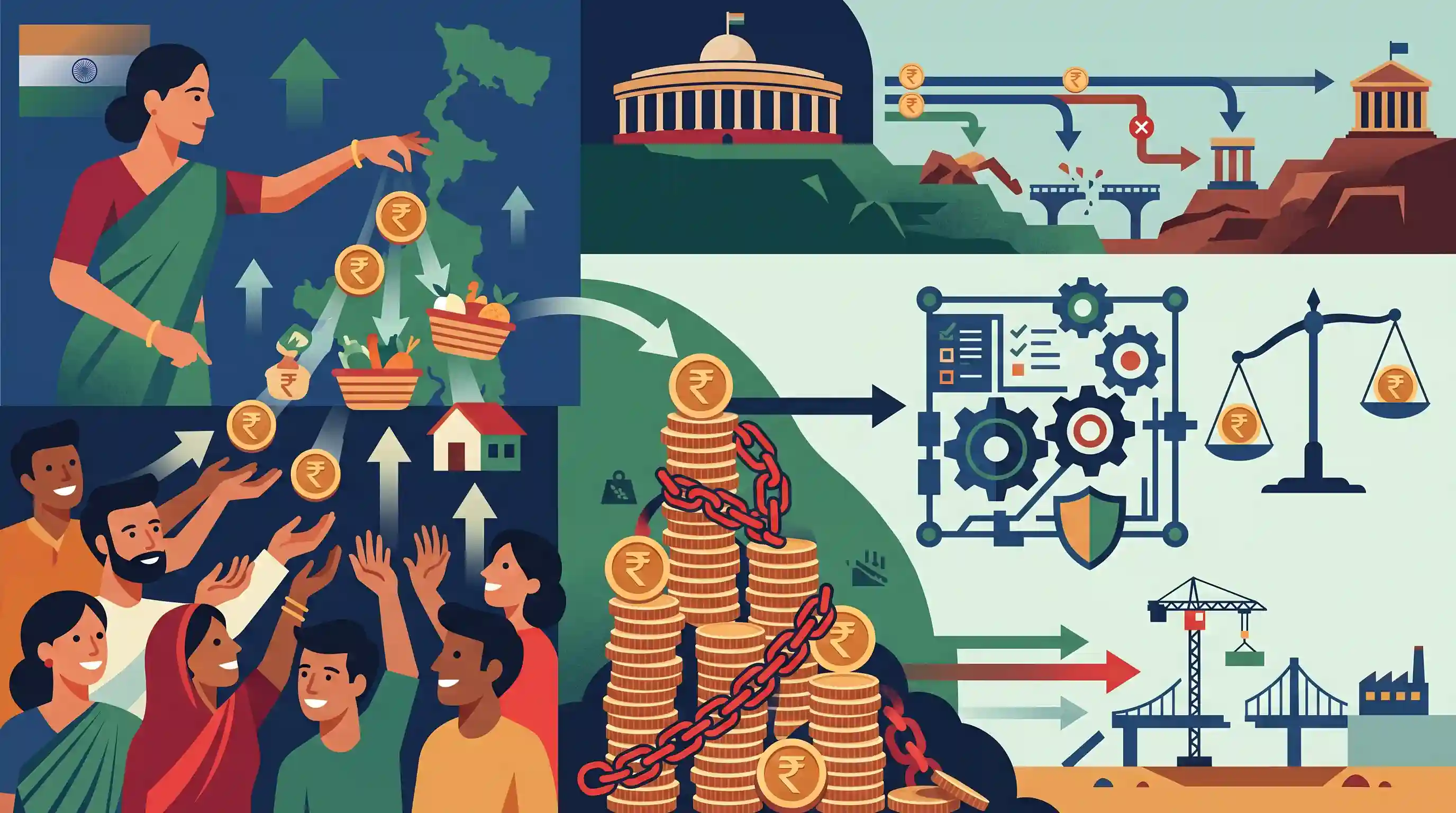
Why It Matters
The proliferation of welfare schemes and 'freebies' is a major issue in Indian political economy, raising questions about state debt sustainability, the crowding out of capital expenditure, and the health of fiscal federalism. It provides a real-world case study for topics on government budgeting, resource mobilization, and macroeconomic policy.
Summary
West Bengal Chief Minister Mamata Banerjee and the Trinamool Congress (TMC) are doubling down on welfarism despite significant fiscal constraints. The heavy reliance on direct benefit transfers and welfare promises poses challenges to the state's fiscal health, leading to mounting debt and a squeeze on capital expenditure. This scenario underscores the broader national debate on balancing populist welfare measures with fiscal prudence under the FRBM framework, while also highlighting the complexities of fiscal federalism and Centre-State resource sharing.
Key Points
- West Bengal Chief Minister Mamata Banerjee continues to expand and emphasize welfare schemes despite growing concerns over the state's fiscal health.
- The state's finances face significant strain due to a high debt burden, rising revenue expenditure on subsidies and direct cash transfers, and limited capital expenditure.
- The situation highlights the persistent policy debate between competitive welfarism (often termed 'freebies' or populism) and macroeconomic stability and fiscal prudence.
- West Bengal's fiscal challenges are further complicated by ongoing political friction with the Union Government over the alleged withholding of central scheme funds and resource allocation issues.
Important Terms
Fiscal Responsibility and Budget Management (FRBM) Act

A 2003 law (with state equivalents like WBFRBM 2010) mandating fiscal discipline by setting targets to reduce fiscal deficits, revenue deficits, and public debt to sustainable levels.
UPSC context
GS Paper III (Economy); essential for questions on fiscal policy, deficit management, and rule-based budgeting.
Fiscal Federalism
The financial relationship between different levels of government, focusing on revenue sharing, taxation powers, and grants to balance state autonomy with national economic stability.
UPSC context
GS Paper II (Federalism); tests knowledge of Centre-State relations and the role of the Finance Commission.
Fiscal Deficit
The difference between a government's total expenditure and its total non-borrowed receipts; a key indicator of the fiscal health and borrowing requirements of a state.
UPSC context
GS Paper III (Budgeting); critical for evaluating state finances and macroeconomic stability.
Capital Expenditure (CapEx)
Government spending on the creation of physical assets like infrastructure, which generates long-term economic returns, often 'squeezed' by rising revenue expenditure on welfare.
UPSC context
GS Paper III (Economic Development); tests the debate between short-term welfare and long-term growth.
Government of West Bengal
The administrative body of the state, currently led by the TMC, facing high debt-to-GSDP ratios due to extensive social welfare outlays like Lakshmir Bhandar.
UPSC context
GS Paper II (State Executive); relevant for case studies on state-level welfarism and fiscal strain.
All India Trinamool Congress (TMC)
A major regional political party in West Bengal, currently the fourth-largest in India’s Parliament, known for its focus on populist welfare and secularism under Mamata Banerjee.
UPSC context
GS Paper II (Polity); significant for topics on regional parties and their role in national politics.
Direct Benefit Transfer (DBT)
A mechanism to transfer subsidies and benefits directly into the bank accounts of beneficiaries, intended to reduce leakages and improve targeting in welfare schemes.
UPSC context
GS Paper II/III (Governance/Economy); central to discussions on inclusive growth and social sector initiatives.
Prelims Trap
"Direct Benefit Transfers (DBT) and welfare subsidies are classified as Capital Expenditure because they build human capital."
Subsidies and DBTs are strictly classified as Revenue Expenditure because they do not create physical or financial assets for the government, regardless of their social utility.
Static Concepts Connected
What are the constitutional provisions governing borrowing by Indian States?
- Article 293: States can borrow money within the territory of India upon the security of the Consolidated Fund of the State, subject to limits set by the state legislature.
- Central Consent: A state cannot raise any loan without the Centre's consent if there is still an outstanding part of a previous loan made or guaranteed by the Centre.
- Conditional Borrowing: The Union Government can impose conditions while giving consent for state borrowing, a power routinely used to enforce FRBM fiscal deficit targets.
How does the FRBM framework regulate the fiscal limits of State Governments?
- State FRBM Acts: Following the Centre's FRBM Act (2003), states enacted their own fiscal responsibility laws, which was incentivized by the 12th Finance Commission.
- Fiscal Deficit Target: States are generally mandated to contain their fiscal deficit at 3% of their Gross State Domestic Product (GSDP).
- Debt-to-GSDP Ratio: As recommended by the NK Singh Committee, states should aim for a long-term prudential debt-to-GSDP ratio of 20%.
Cross-Topic Patterns
Supreme Court debate on freebies
Connects state fiscal strain to the ongoing Supreme Court and ECI debates on distinguishing constitutionally mandated welfarism from unsustainable political freebies funded by borrowing.
CSS funding and cooperative federalism
Links state debt crises to the withholding of Centrally Sponsored Scheme (CSS) funds, highlighting the constitutional tensions in cooperative federalism and vertical fiscal imbalances.

Expect a 2026 Mains question on balancing competitive welfarism with FRBM limits, or a Prelims statement on Article 293 state borrowing.
Linked PYQs · 5
Linked PYQs · 5
- 2025MainsGS3
Explain how the Fiscal Health Index (FHI) can be used as a tool for assessing the fiscal performance of states in India. In what way would it encourage the states to adopt prudent and sustainable fiscal policies?
- 2013MainsGS3
What were the reasons for the introduction of Fiscal Responsibility and Budget Management (FRBM) Act, 2003 ? Discuss critically its salient features and their effectiveness.
- 2022MainsGS2
Besides the welfare schemes, India needs deft management of inflation and unemployment to serve the poor and the underprivileged sections of the society. Discuss.
- 2023MainsGS2
“Development and welfare schemes for the vulnerable, by its nature, are discriminatory in approach.” Do you agree? Give reasons for your answer.
- 2025MainsGS2
Examine the evolving pattern of Centre-State financial relations in the context of planned development in India. How far have the recent reforms impacted the fiscal federalism in India?
