Central Enforcement Agencies Impact Regional Political Structures
Source:Indian Express ↗
Why It Matters
It provides a real-world case study for GS-2 and GS-3 topics, specifically illustrating the criminal-political nexus in border smuggling, the intervention of central agencies like the CBI and ED in state politics, and the consequent shifts in political party structures to manage tainted leaders.
Summary
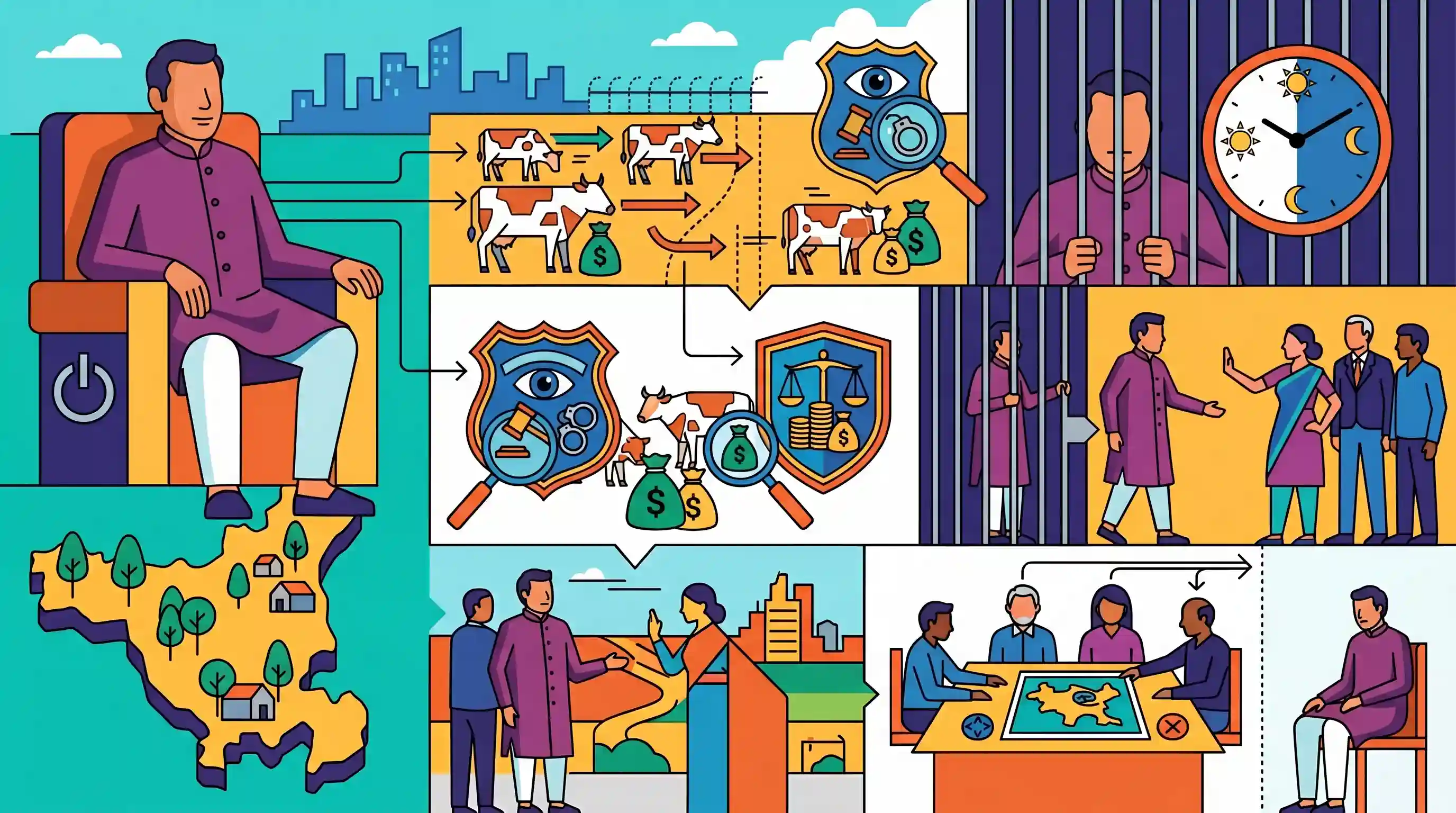
The article examines the political sidelining of Trinamool Congress (TMC) strongman Anubrata Mondal in West Bengal following his release from a two-year imprisonment. Mondal was investigated by the CBI and ED in connection with a massive cross-border cattle smuggling case. Upon his return, the party leadership chose not to restore his former absolute control over the Birbhum district, instead empowering a core committee. This development underscores the implications of political corruption, the nexus between politicians and transborder crimes, and the impact of central enforcement agency actions on regional party dynamics.
Key Points
- Senior TMC leader Anubrata Mondal has seen his influence significantly curtailed by the party leadership after spending over two years in Tihar jail.
- Mondal was arrested and investigated by the CBI and ED for his alleged role in a major cross-border cattle smuggling racket.
- Instead of reinstating his absolute authority over the Birbhum district, the TMC has entrusted control to a core committee, diluting his power.
- The case highlights the involvement of prominent political figures in transborder crimes and the active role of central investigative agencies in pursuing such cases, which often leads to political realignments.
Important Terms
Prevention of Money Laundering Act (PMLA)

A 2002 Act aimed at preventing money laundering and enabling the confiscation of property derived from criminal proceeds, often linked to scheduled offenses.
UPSC context
GS III (Money Laundering) and GS II (Statutory Laws). Tests the legal framework for financial security and executive power.
Enforcement Directorate (ED)
A specialized agency under the Ministry of Finance that investigates financial crimes, specifically enforcing PMLA, FEMA, and the Fugitive Economic Offenders Act.
UPSC context
GS II (Statutory/Regulatory bodies) and GS III. Tests understanding of central agencies and their impact on federalism.
Central Bureau of Investigation (CBI)
India’s premier investigating agency, functioning under the DSPE Act 1946, handling anti-corruption, economic offenses, and serious special crimes of national importance.
UPSC context
GS II (Constitutional/Non-Constitutional bodies). Tests federal challenges regarding state consent and investigative autonomy.
Criminalisation of Politics
The infiltration of individuals with criminal backgrounds or pending criminal charges into the electoral process and legislative bodies.
UPSC context
GS II (Polity/Elections). Tests knowledge of electoral reforms, Vohra Committee findings, and threats to democratic integrity.
Representation of the People Act (RPA), 1951
The key 1951 legislation governing the conduct of elections, including the qualifications and disqualification (Section 8) of people's representatives.
UPSC context
GS II (Salient features of RPA). Essential for understanding the legal criteria for holding and losing public office.
Transborder Crimes
Illegal activities, such as smuggling or trafficking, that occur across international borders, challenging national security and formal border management.
UPSC context
GS III (Internal Security). Tests knowledge of border management challenges and the nexus between crime and regional instability.
Prelims Trap
A politician faces automatic disqualification under the RPA if kept in undertrial detention for more than two years.
Disqualification under Section 8(3) of the RPA requires an actual conviction with a sentence of 2+ years. Prolonged undertrial detention does not trigger this.
Static Concepts Connected
How does the CBI exercise jurisdiction in states, and what is "general consent"?
- Statutory Basis: The CBI derives its powers from the Delhi Special Police Establishment (DSPE) Act, 1946, not a dedicated CBI Act.
- State Consent: Under Section 6 of the DSPE Act, the CBI requires explicit consent (general or case-specific) from the state government to investigate within its territory.
- Judicial Exception: The Supreme Court and High Courts can direct the CBI to investigate a crime anywhere in the country without requiring the state's consent.
What makes the India-Bangladesh border prone to smuggling, and what is CIBMS?
- Geographic Vulnerability: India's longest border (4,096.7 km) features highly porous riverine belts, char lands, and dense settlements right up to the zero line, making physical fencing difficult.
- CIBMS Deployment: The Comprehensive Integrated Border Management System (CIBMS) deploys tech solutions like thermal imagers, underground sensors, and sonar to secure unfenced riverine gaps.
Cross-Topic Patterns
PMLA bail vs. Right to Speedy Trial
The strict 'twin conditions' for bail under Section 45 of PMLA often clash with Article 21, creating a recurring constitutional debate regarding prolonged undertrial detention functioning as a de facto punishment.
Border smuggling + Political economy
Transborder crimes like cattle smuggling generate massive illicit cash networks that often fund regional political machinery, necessitating multi-agency probes (CBI for crime, ED for money laundering).

Expect a mixed prelims question testing RPA disqualification clauses against PMLA's stringent bail conditions and undertrial detention.
Linked PYQs · 4
Linked PYQs · 4
- 2020MainsGS2
There is a need for simplification of procedure for disqualification of persons found guilty of corrupt practices under the Representation of Peoples Act". Comment.
- 2021MainsGS2
The jurisdiction of the Central Bureau of Investigation (CBI) regarding lodging an FIR and conducting probe within a particular State is being questioned by various States. However, the power of the States to withhold consent to the CBI is not absolute. Explain with special reference to the federal character of India.
- 2021MainsGS3
Discuss how emerging technologies and globalisation contribute to money laundering. Elaborate measures to tackle the problem of money laundering both at national and international levels.
- 2020MainsGS3
Analyze internal security threats and transborder crimes along Myanmar, Bangladesh and Pakistan borders including Line of Control (LoC). Also discuss the role played by various security forces in this regard.
