Constitutional Mandate of Election Commission in Voter List Updates
Source:Indian Express ↗
Why It Matters
The issue underscores the critical balance between the Election Commission's mandate to maintain accurate electoral rolls and the fundamental constitutional right to vote (Article 326). It also highlights the growing friction between constitutional bodies and state governments, bringing federalism and electoral transparency into focus for UPSC aspirants.
Summary
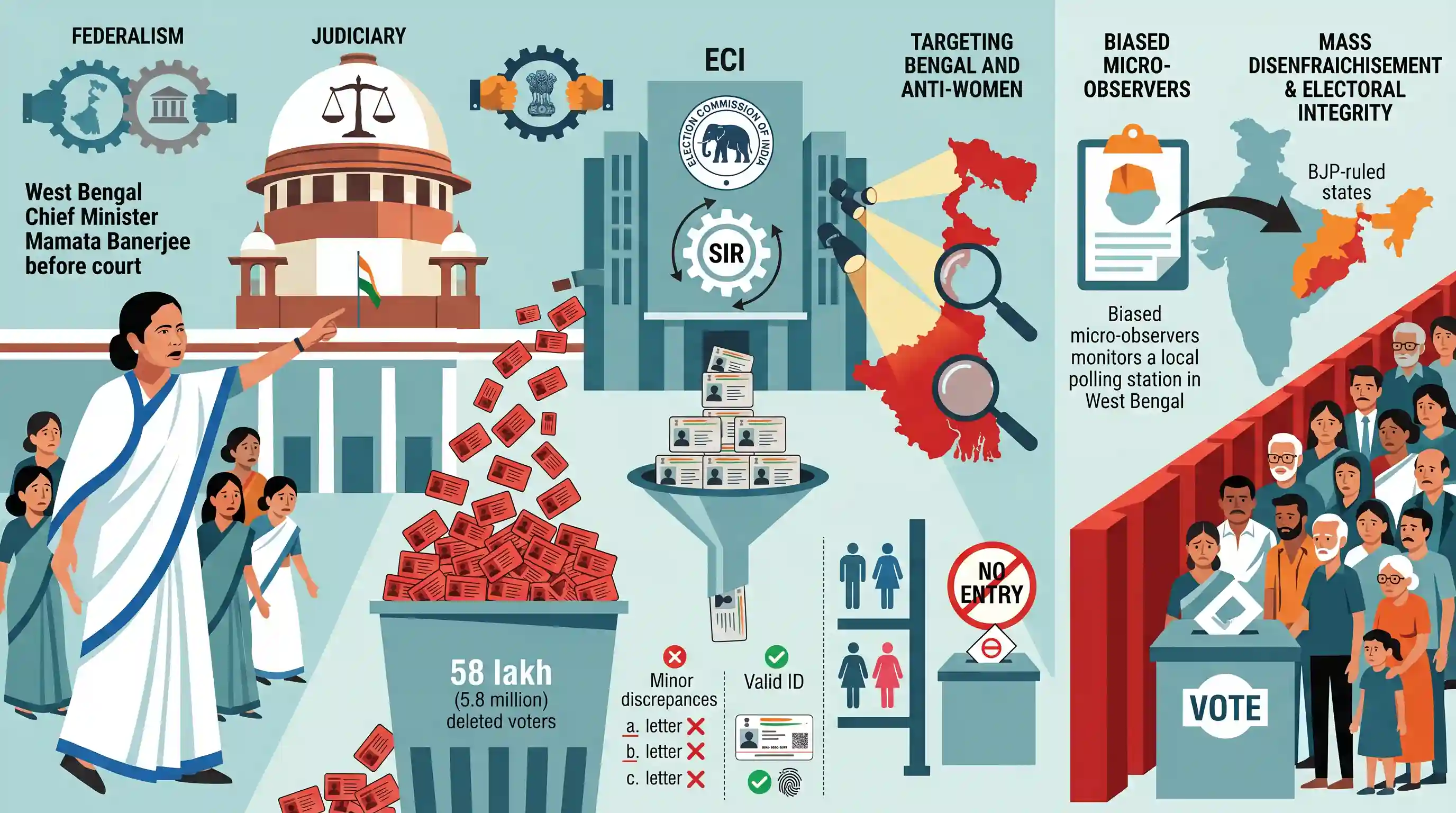
West Bengal Chief Minister Mamata Banerjee personally appeared before the Supreme Court to challenge the Election Commission of India's Special Intensive Revision (SIR) of electoral rolls. She alleged the process arbitrarily deleted 58 lakh voters without providing any scope for appeal, citing minor discrepancies like spelling mismatches while ignoring valid IDs like Aadhaar. Furthermore, the CM argued the process targets Bengal specifically, is "anti-women," and employs biased micro-observers from BJP-ruled states, thereby risking mass disenfranchisement and undermining electoral integrity.
Key Points
- West Bengal CM Mamata Banerjee personally approached the Supreme Court to challenge the Election Commission's Special Intensive Revision (SIR) of electoral rolls in the state.
- The CM alleged that the SIR process has arbitrarily deleted 58 lakh voters without providing an avenue for appeal.
- Deletions were reportedly based on minor typographical discrepancies (Bengali to English translation errors) while valid documents like Aadhaar and domicile certificates were disregarded.
- The state government accused the ECI of bias, citing the deployment of micro-observers from BJP-ruled states and arguing that the process disproportionately affects women and targets Bengal.
- The case highlights significant concerns regarding potential mass disenfranchisement and the tension between electoral roll sanitization and the constitutional right to vote.
Important Terms
Election Commission of India (ECI)

An autonomous constitutional body established in 1950 to administer election processes in India at the Union and State levels, including for Parliament and State Legislatures.
UPSC context
GS-II: Appointment to various Constitutional posts, powers, functions and responsibilities of various Constitutional Bodies.
Special Intensive Revision (SIR)
A comprehensive, door-to-door physical verification and update of electoral rolls conducted by the ECI to ensure error-free voter lists and remove duplicate or deceased entries.
UPSC context
GS-II: Important aspects of governance, transparency and accountability; Electoral reforms and the integrity of the voting process.
Representation of the People Act, 1950
The primary legislation providing for the allocation of seats, delimitation of constituencies, and the detailed procedures for the preparation and revision of electoral rolls.
UPSC context
GS-II: Salient features of the Representation of People’s Act; statutory framework for the registration of electors.
Article 324
A constitutional provision vesting the superintendence, direction, and control of the preparation of electoral rolls and the conduct of elections in the Election Commission.
UPSC context
GS-II: Powers and functions of the Election Commission and its independence in ensuring free and fair elections.
Article 326
Mandates that elections to the Lok Sabha and State Legislative Assemblies shall be on the basis of adult suffrage, granting every citizen over 18 the right to vote.
UPSC context
GS-II: Universal Adult Suffrage and the constitutional right to vote as a cornerstone of Indian democracy.
Article 32
The Right to Constitutional Remedies, which empowers the Supreme Court to issue writs for the enforcement of fundamental rights, including protection against arbitrary disenfranchisement.
UPSC context
GS-II: Judiciary, fundamental rights, and the role of the Supreme Court as the guarantor of the Constitution.
Prelims Trap
Disputes between a State Government and the Election Commission fall under the Supreme Court's original jurisdiction under Article 131.
Article 131 strictly applies to federal disputes (Union vs. State, or State vs. State), not disputes between a State and an independent constitutional body like the ECI.
Static Concepts Connected
What is the difference between RPA 1950 and RPA 1951?
- RPA 1950: Governs the allocation of seats, delimitation of constituencies, voter qualifications, and preparation/revision of electoral rolls.
- RPA 1951: Regulates the actual conduct of elections, candidate qualifications/disqualifications, corrupt practices, and resolution of election disputes.
Is the Right to Vote a Fundamental or Constitutional Right?
- Constitutional Right: It is a constitutional right guaranteed under Article 326, which mandates universal adult suffrage for Lok Sabha and Assembly elections.
- Statutory backing: Its enforcement and the specific mechanics of voter registration and disqualification are governed statutorily by the RPA 1950.
Cross-Topic Patterns
Federalism vs. Independent Bodies
State-ECI friction over electoral rolls mirrors ongoing federal tensions involving central agencies like the CBI and ED, highlighting concerns over institutional neutrality.
Aadhaar and Voter Disenfranchisement
Disregarding Aadhaar in roll revisions connects to the Election Laws (Amendment) Act 2021 debate, balancing voter deduplication against the risk of exclusion errors.

Expect a multi-statement Prelims question testing Article 131 limits alongside the exact statutory separation of RPA 1950 and RPA 1951.
Linked PYQs · 4
Linked PYQs · 4
- 2022MainsGS2
Discuss the procedures to decide the disputes arising out of the election of a Member of the Parliament or State Legislature under The Representation of the People Act, 1951. What are the grounds on which the election of any returned candidate may be declared void ? What remedy is available to the aggrieved party against the decision ? Refer to the case laws.
- 2017PrelimsGS1
Right to vote and to be elected in India is a
- 2022MainsGS2
Discuss the role of the Election Commission of India in the light of the evolution of the Model Code of Conduct.
- 2014PrelimsGS1
The power of the Supreme Court of India to decide disputes between the Centre and the States falls under its
