Judicial Review of Election Commission Electoral Roll Revision
Source:The Hindu ↗
Why It Matters
This issue highlights the critical tension between the Election Commission's constitutional mandate to maintain accurate electoral rolls (Article 324) and the risk of mass disenfranchisement. It is highly relevant for GS2 questions on the functioning of constitutional bodies, electoral reforms, limits of judicial review in election matters, and federal dynamics when central forces are deployed for state-level electoral administration.
Summary
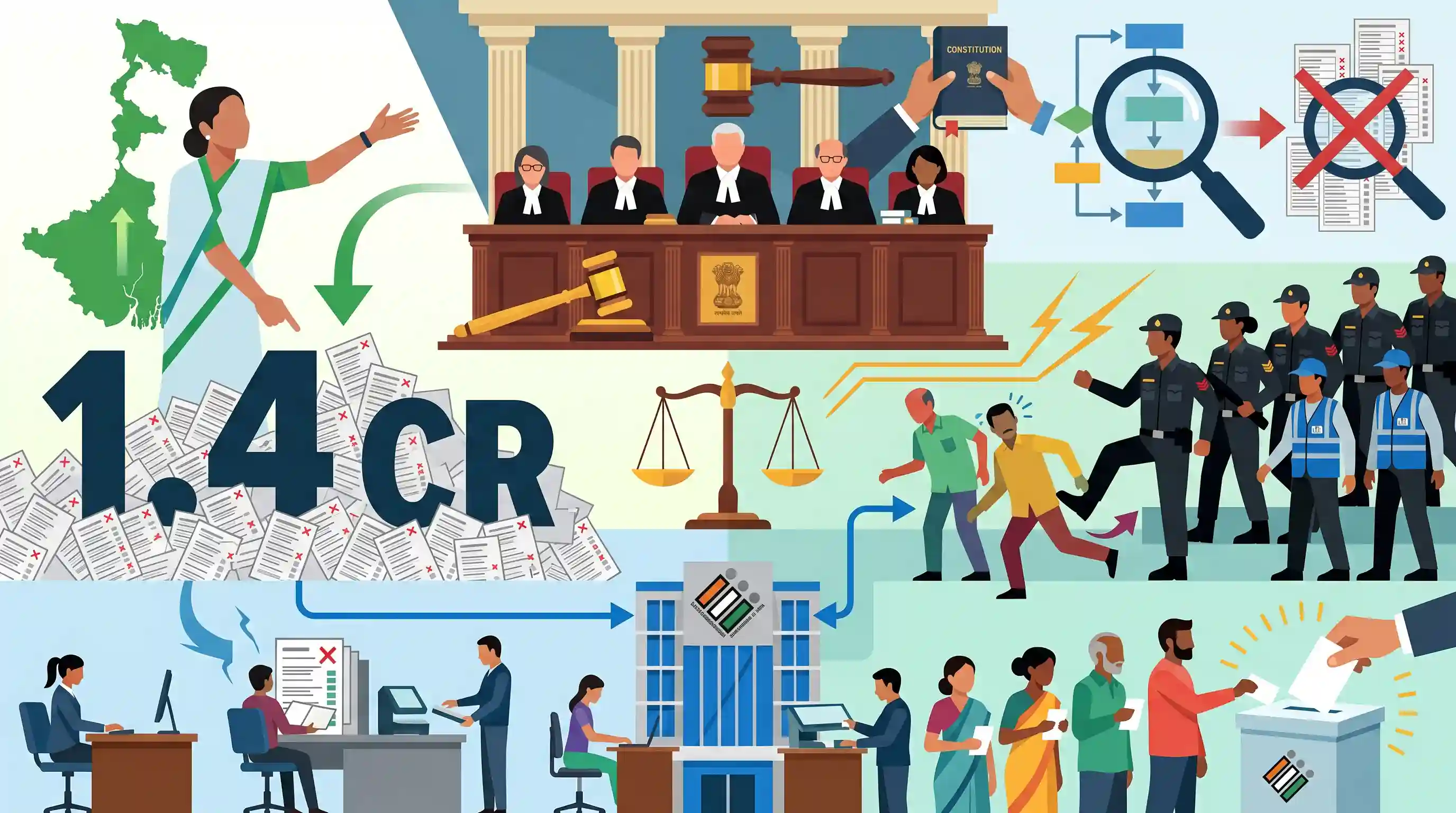
West Bengal Chief Minister Mamata Banerjee made a direct appeal to the Supreme Court during a hearing concerning the Election Commission of India's (ECI) Special Intensive Revision (SIR) of electoral rolls in the state. She accused the ECI of arbitrarily deleting 1.4 crore genuine voters over minor typographical errors and contested the deployment of central micro-observers and CAPF personnel, arguing it sidelined the state's administrative machinery. The CJI-led bench emphasized its role in reviewing the ECI's procedural fairness and constitutional mandate, rather than engaging in a fact-finding exercise on individual voter exclusions.
Key Points
- The West Bengal government challenged the ECI's Special Intensive Revision (SIR) of electoral rolls in the Supreme Court, alleging the arbitrary deletion of approximately 1.4 crore voters.
- Chief Minister Mamata Banerjee directly addressed CJI Surya Kant, arguing that genuine voters were being disenfranchised due to minor spelling mistakes or Aadhar mismatches.
- The State also contested the ECI's deployment of micro-observers and Central Armed Police Forces (CAPF) for the electoral roll revision, arguing it bypasses the state's administrative machinery.
- The Supreme Court clarified that its jurisdiction in this matter is limited to assessing the procedural fairness and legality of the ECI's actions, rather than conducting a fact-finding mission on individual voter deletions.
- The dispute underscores federal friction between state governments and the Election Commission regarding administrative control, electoral procedures, and cooperative federalism.
Important Terms
Special Intensive Revision (SIR)

A comprehensive, house-to-house verification drive by the Election Commission to update electoral rolls, remove ineligible entries, and include new voters under Article 324 and RPA 1950.
UPSC context
GS Paper II: Electoral Processes. Tests knowledge of voter roll integrity and ECI's statutory powers.
Election Commission of India (ECI)
An autonomous constitutional body established under Article 324 to administer and supervise elections to the Parliament, State Legislatures, and the offices of the President and Vice-President.
UPSC context
GS Paper II: Constitutional Bodies. Essential for understanding the mandate and independence of India's election machinery.
Central Micro-observers
Central government or PSU employees deployed by the ECI in sensitive areas to monitor polling or roll-revision tasks, reporting directly to observers for enhanced transparency.
UPSC context
GS Paper II: Election Management. Relevant for measures ensuring free and fair polling in contested regions.
Central Armed Police Forces (CAPF)
Seven internal security forces (e.g., CRPF, BSF) under the Ministry of Home Affairs, often deployed during elections to maintain order and safeguard the polling process.
UPSC context
GS Paper II/III: Internal Security and Governance. Tests understanding of federal relations and election security.
Judicial Review
The power of the judiciary to examine the legality and procedural fairness of actions taken by the executive and constitutional bodies, ensuring they align with the Constitution.
UPSC context
GS Paper II: Constitutional Provisions. Key for understanding the balance of power and judicial oversight.
Prelims Trap
The preparation, revision, and deletion of entries in electoral rolls are governed by the Representation of the People Act, 1951.
Electoral rolls, constituencies, and voter qualifications are governed by the RPA 1950. The RPA 1951 deals solely with the actual conduct of elections, offenses, and dispute resolution.
Static Concepts Connected
How does the ECI secure and control administrative staff for election duties?
- Article 324(6): The President or Governor is constitutionally bound to make necessary staff available to the Election Commission when requested.
- Deemed Deputation: Staff deployed for election duties are deemed to be on deputation to the ECI, falling entirely under its disciplinary control.
- Micro-Observers: Drawn exclusively from Central Government and PSUs to monitor sensitive areas, bypassing local state administration to ensure neutrality.
What limits exist on judicial intervention in the Indian electoral process?
- Article 329(b): Imposes a strict constitutional bar on courts interfering in electoral matters once the election process has been officially notified.
- Election Petitions: Elections can only be challenged post-completion through an election petition filed before the High Court.
- Pre-notification Review: The Supreme Court can review ECI actions, like electoral roll preparation, for procedural fairness before the election cycle formally begins.
Cross-Topic Patterns
ECI mandate vs. State administrative autonomy
The deployment of CAPF and central micro-observers for local rolls revision highlights the tension between ECI's Article 324 powers and the state's traditional administrative control over its machinery.
Aadhaar linkage and voter disenfranchisement
Voter deletions due to 'Aadhaar mismatches' revive debates around the Election Laws (Amendment) Act 2021, questioning if 'voluntary' Aadhaar seeding operates as a de facto exclusionary tool.

Expect a 2026 Prelims statement distinguishing RPA 1950 (rolls) vs RPA 1951 (conduct), coupled with Article 324(6) on staff deputation.
Linked PYQs · 5
Linked PYQs · 5
- 2022MainsGS2
Discuss the role of the Election Commission of India in the light of the evolution of the Model Code of Conduct.
- 2017MainsGS2
To enhance the quality of democracy in India the Election Commission of India has proposed electoral reforms in 2016. What are the suggested reforms and how far are they significant to make democracy successful?
- 2017PrelimsGS1
For election to the Lok Sabha, a nomination paper can be filed by
- 2022MainsGS2
Discuss the procedures to decide the disputes arising out of the election of a Member of the Parliament or State Legislature under The Representation of the People Act, 1951. What are the grounds on which the election of any returned candidate may be declared void ? What remedy is available to the aggrieved party against the decision ? Refer to the case laws.
- 2017PrelimsGS1
Right to vote and to be elected in India is a
