Federal friction and constitutional bodies autonomy in Indian polity
Source:Indian Express ↗
Why It Matters
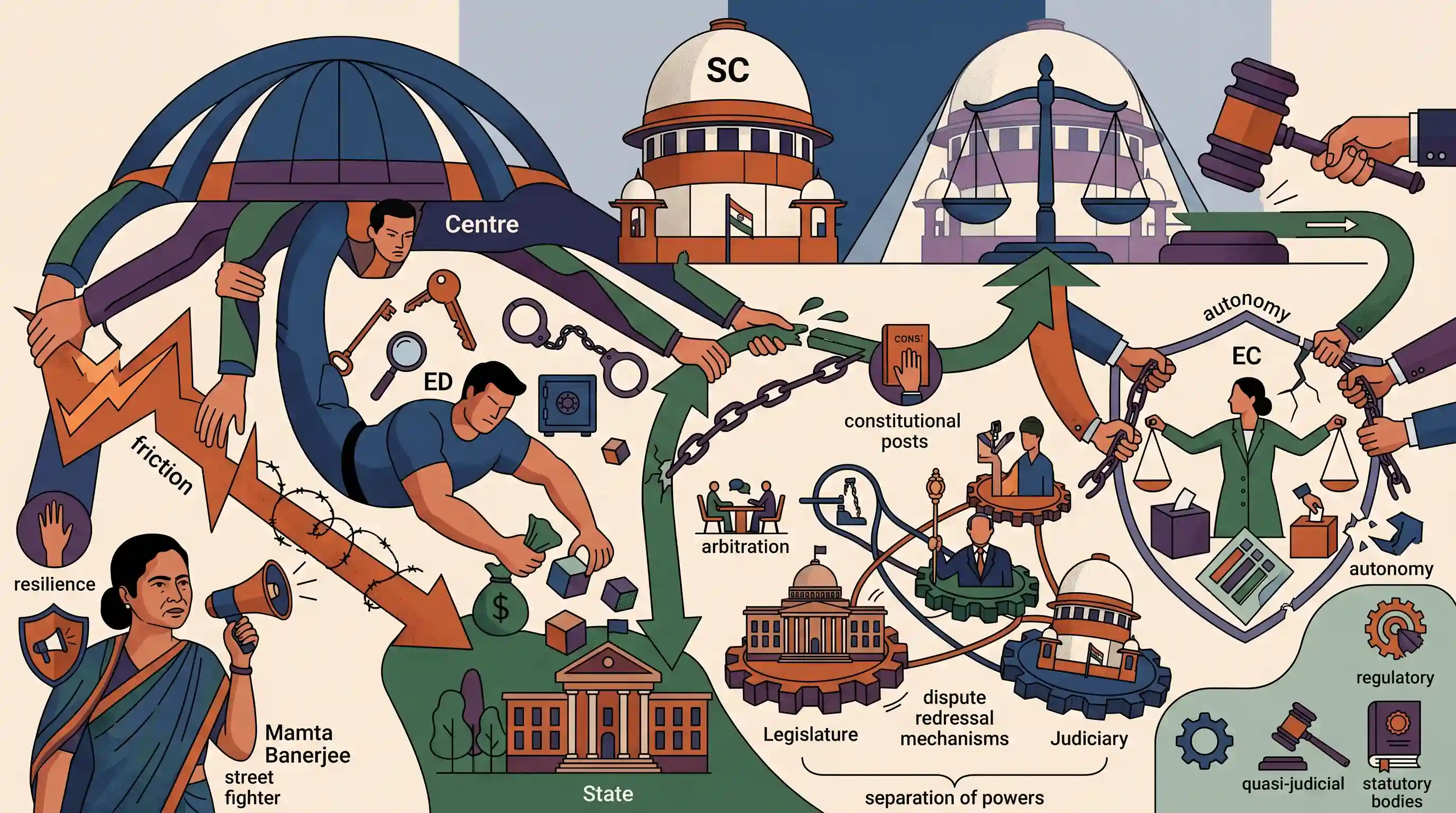
The frequent clashes between state governments and central agencies highlight growing fault lines in India's federal structure. Understanding the balance of power, the necessity for institutional independence (such as the EC and ED), and the judiciary's role in conflict resolution is vital for grasping contemporary governance challenges.
Summary
The article analyzes the political and legal battles of West Bengal Chief Minister Mamata Banerjee, focusing on her confrontations with the Enforcement Directorate (ED) and the Election Commission (EC), which have increasingly reached the Supreme Court. It highlights her resilience as a political "street fighter" managing to navigate pressure from central authorities. Broadly, the piece serves as a lens to examine critical issues in Indian polity, including the friction in Centre-State relations, the alleged weaponization of central investigative agencies against opposition leaders, the autonomy of constitutional bodies like the Election Commission, and the pivotal role of the higher judiciary in adjudicating federal and institutional disputes.
Key Points
- Analyzes the ongoing conflict between the West Bengal government and central agencies like the Enforcement Directorate (ED), highlighting allegations of the politicization of investigative bodies.
- Discusses the role and interventions of the Election Commission (EC) in the state's political arena, raising questions about institutional autonomy.
- Examines the critical role of the Supreme Court as the constitutional arbiter in mediating federal disputes between opposition-ruled states and the Centre.
- Portrays Mamata Banerjee's political resilience while underscoring the broader implications for Centre-State relations and cooperative federalism in India.
Important Terms
Supreme Court of India

The highest judicial authority in India, serving as the final court of appeal and the guardian of the Constitution. It holds exclusive original jurisdiction to adjudicate disputes between the Centre and States.
UPSC context
GS Paper II (Judiciary/Federalism): Tests judicial review powers and the Court's role in resolving Centre-State disputes through Article 131.
Enforcement Directorate (ED)
A specialized financial investigation agency under the Ministry of Finance that enforces the Prevention of Money Laundering Act (PMLA) and foreign exchange laws. It is central to debates on federalism and institutional autonomy.
UPSC context
GS Paper II (Statutory Bodies): Focuses on the agency's powers, judicial scrutiny of its actions, and its impact on Centre-State administrative relations.
Election Commission of India (ECI)
An autonomous constitutional body established under Article 324 to conduct and supervise elections to Parliament and State Legislatures. It ensures free, fair, and transparent electoral processes across India.
UPSC context
GS Paper II (Constitutional Bodies): Examines its independence, regulatory role during elections, and the enforcement of the Model Code of Conduct.
Prelims Trap
"Like the CBI, the Enforcement Directorate requires prior consent of the State Government to assume jurisdiction within a state."
The ED operates under PMLA and FEMA, which grant it pan-India jurisdiction. Only the CBI requires state consent under Section 6 of the DSPE Act.
Static Concepts Connected
What is the scope of the Supreme Court's Original Jurisdiction under Article 131?
- Parties involved: Applies strictly to disputes between Centre and States, or between two or more States.
- Legal rights: The dispute must involve a question of law or fact on which the existence or extent of a legal right depends.
- Exclusions: Excludes purely political disputes, private citizen petitions, and disputes arising from pre-Constitution treaties or agreements.
Under what authority does the Election Commission enforce the Model Code of Conduct?
- Article 324: Vests the ECI with plenary powers of superintendence, direction, and control of elections, acting as a residuary power.
- Non-statutory nature: The MCC is a consensus document among political parties, lacking direct statutory backing but enforced via Article 324 to ensure a level playing field.
Cross-Topic Patterns
PMLA jurisdiction vs Cooperative Federalism
The ED's overriding investigative powers under PMLA are frequently tested in Mains against the 'Police' and 'Public Order' entries in the State List, sparking debates on coercive federalism.
Article 131 + Suit maintainability
States increasingly invoking Article 131 against Central actions (e.g., ED cases, CAA, BSF jurisdiction) makes the Supreme Court's strict original jurisdiction parameters a critical Prelims focus.

Expect a 2026 Prelims question comparing the ED's PMLA jurisdiction vs CBI's DSPE Act constraints, framed as a federalism issue.
Linked PYQs · 3
Linked PYQs · 3
- 2024MainsGS2
What changes has the Union Government recently introduced in the domain of Centre-State relations ? Suggest measures to be adopted to build the trust between the Centre and the States and for strengthening federalism.
- 2021MainsGS2
The jurisdiction of the Central Bureau of Investigation (CBI) regarding lodging an FIR and conducting probe within a particular State is being questioned by various States. However, the power of the States to withhold consent to the CBI is not absolute. Explain with special reference to the federal character of India.
- 2022MainsGS2
Discuss the role of the Election Commission of India in the light of the evolution of the Model Code of Conduct.
