Supreme Court Plea on Electoral Roll Revision in West Bengal
Source:Indian Express ↗
Why It Matters
The preparation of electoral rolls is foundational to democratic elections. Disputes between a State Chief Minister and the ECI reaching the Supreme Court highlight crucial issues of federal friction, the autonomy of Constitutional bodies (Article 324), and the scope of judicial intervention in electoral matters.
Summary
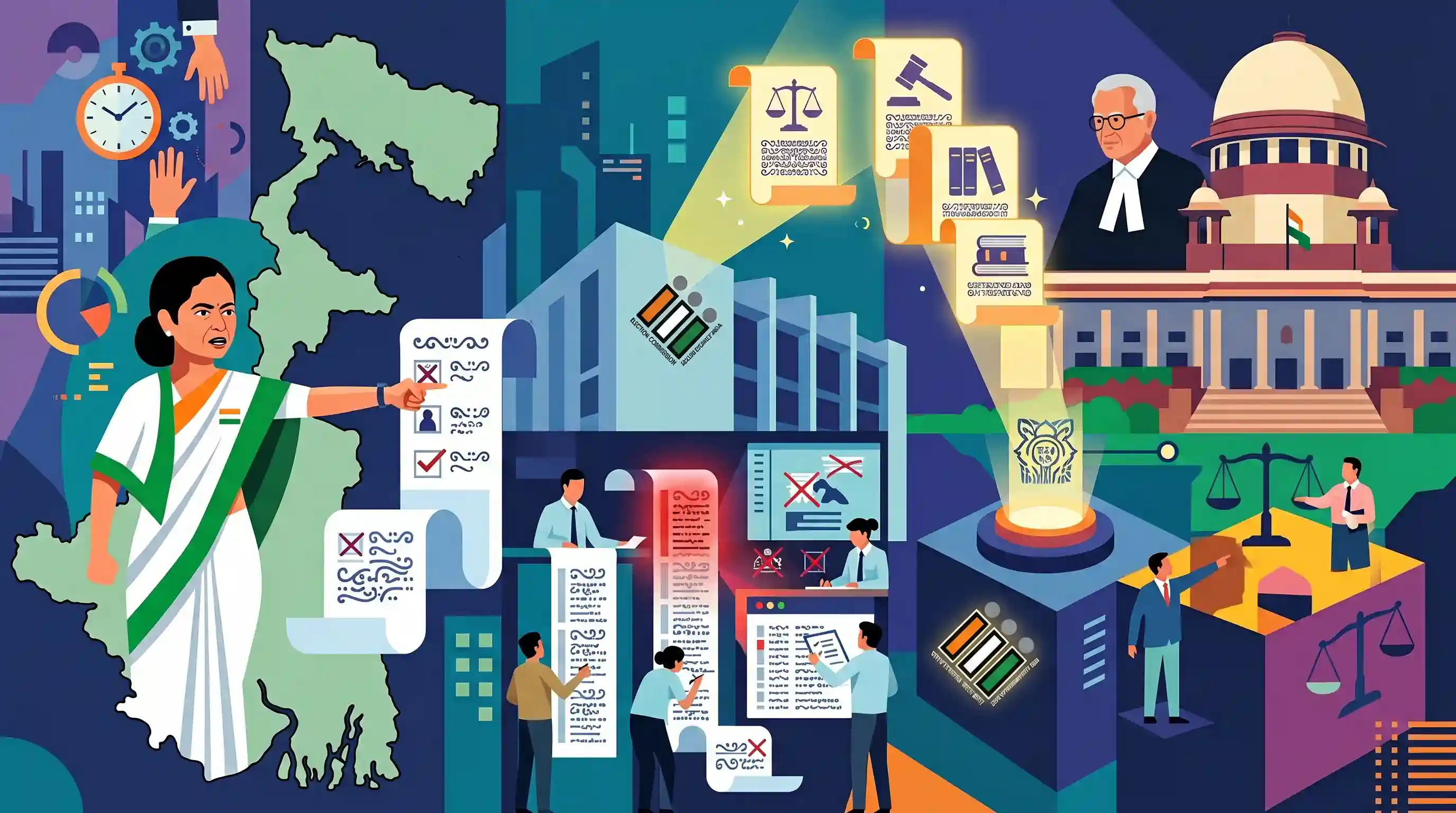
West Bengal Chief Minister Mamata Banerjee has moved the Supreme Court to challenge the voter list revision process (referred to as the 'SIR' process) in the state. The legal challenge brings to the forefront the administrative tensions between the state government and the Election Commission of India (ECI) concerning electoral roll preparation. Constitutionally, the ECI draws its power to superintend and control the preparation of electoral rolls from Article 324, governed statutorily by the Representation of the People Act, 1950. The Supreme Court's hearing of this plea will likely touch upon the boundaries of judicial review in electoral procedures and the functional independence of the ECI against allegations of procedural irregularities by a state government.
Key Points
- West Bengal Chief Minister Mamata Banerjee has approached the Supreme Court to challenge the 'SIR' voter list process in the state.
- The plea likely questions the procedural fairness, legality, or specific modalities adopted during the preparation or revision of the electoral rolls in West Bengal.
- The case underscores ongoing political and administrative friction between the state executive and the Election Commission of India (ECI) over electoral management.
- It raises constitutional questions regarding the extent of judicial intervention in the ECI's mandate under Article 324 to supervise, direct, and control the preparation of voter lists.
Important Terms
Election Commission of India (ECI)

An independent constitutional body established under Article 324 to oversee free and fair elections, including the preparation of electoral rolls and the conduct of legislative polls.
UPSC context
GS-II: Constitutional Bodies. Essential for questions on electoral integrity, independence of institutions, and the separation of powers.
Article 324 of the Constitution
A constitutional provision vesting the 'superintendence, direction, and control' of elections for Parliament and State Legislatures in the Election Commission of India.
UPSC context
GS-II: Important aspects of governance, transparency and accountability. Tested on the scope of the ECI’s plenary powers and autonomy.
Representation of the People Act, 1950
A 1950 parliamentary act providing for the allocation of legislative seats, delimitation of constituencies, and the detailed procedures for preparing and revising electoral rolls.
UPSC context
GS-II: Salient features of the RPA. Critical for distinguishing from the 1951 Act (which covers election conduct and disputes).
Special Intensive Revision (SIR)
A comprehensive verification exercise by the ECI involving house-to-house enumeration to update voter lists, remove duplicates, and ensure the inclusion of all eligible citizens.
UPSC context
GS-II: Electoral reforms and Federalism. Relevant to administrative friction between the Center/ECI and states over voter disenfranchisement concerns.
Judicial Review
The power of the judiciary to examine the constitutionality and legality of legislative or executive actions, ensuring they adhere to constitutional principles.
UPSC context
GS-II: Structure and functioning of the Judiciary. Tested regarding court intervention limits in electoral matters under Article 329.
Supreme Court of India
The highest judicial authority in India, empowered to adjudicate disputes between states and the center, and protect fundamental rights through various writs.
UPSC context
GS-II: Judiciary. Relevant to its role as a neutral arbiter in constitutional disputes and its use of Article 142 powers.
Prelims Trap
Courts are strictly barred from reviewing electoral roll preparation under Article 329(b).
Article 329(b) bars judicial interference only AFTER the election notification is issued. Challenges to electoral roll preparation (RPA 1950) can be reviewed by courts beforehand.
Static Concepts Connected
How do RPA 1950 and RPA 1951 divide electoral procedures?
- RPA 1950: Governs pre-election tasks: delimitation of constituencies, allocation of seats, and preparation/revision of electoral rolls.
- RPA 1951: Governs the actual conduct of elections, corrupt practices, electoral offenses, and disqualification of MPs/MLAs.
What Constitutional articles govern the preparation of electoral rolls?
- Article 324: Vests the power of superintendence, direction, and control of electoral roll preparation in the ECI.
- Article 325: Mandates a single general electoral roll for every constituency, prohibiting discrimination on religion, race, caste, or sex.
- Article 326: Guarantees universal adult suffrage as the basis for elections to the Lok Sabha and State Assemblies.
Cross-Topic Patterns
Federalism vs. ECI Independence
State-ECI conflicts reflect broader federal tensions, similar to friction over CBI consent or Governor roles, questioning the neutrality of centralized constitutional bodies.
Judicial Review vs. Electoral Autonomy
The interplay between ECI's Article 324 mandate and the judiciary's review power constantly tests exactly when courts can intervene before actual polling starts.

Expect a multi-statement Prelims question differentiating RPA 1950 vs 1951, focusing on ECI's role and limits of judicial review.
Linked PYQs · 4
Linked PYQs · 4
- 2022MainsGS2
Discuss the role of the Election Commission of India in the light of the evolution of the Model Code of Conduct.
- 2017PrelimsGS1
Right to vote and to be elected in India is a
- 2017PrelimsGS1
For election to the Lok Sabha, a nomination paper can be filed by
- 2024MainsGS2
Examine the need for electoral reforms as suggested by various committees with particular reference to "one nation one election" principle.
